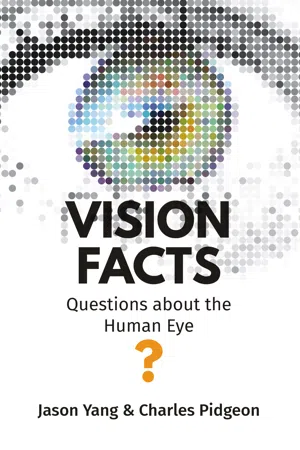
Vision Facts is a question and answer guide to the wonders of the human eye, its complex structures and the process of visual perception. It traces the journey of vision from a ray of light entering the eye to the processing done by the brain, to the development and aging of the human visual system and common disorders associated with both processes. Organized in an intuitive question-and-answer format and accompanied by clear diagrams, Vision Facts provides answers regarding your vision in a manner accessible to all who are interested. Each topic includes references to external resources such as lecture notes and research papers for those who wish to delve deeper. It is a perfect handbook for anyone who is interested in visual science, sensory processing, neuroscience, or physiology; and is an excellent reference for anyone considering a career in ophthalmology or optometry.°Some examples of the questions include the following. What is the resolution of the eye? Why do astronomers often cover flashlights with a red filter while stargazing? What is color-blindness and how does it occur? What role does vision play in the circadian rhythm? What chemical signals cause the eye to develop into its mature form? How does alcohol during pregnancy affect eye development? How well can a newborn baby see? How does being born prematurely affect vision? What is 20/20 vision? How does aging affect vision? These are all questions that are addressed in Vision Facts, along with countless more.
- 162 pages
- English
- ePUB (mobile friendly)
- Available on iOS & Android
eBook - ePub
About this book
Trusted by 375,005 students
Access to over 1.5 million titles for a fair monthly price.
Study more efficiently using our study tools.
Information
Part I
The Visual Pathway
| 1 | The Eye |
| Q1 | What are the important parts of the eye involved in detecting light? |
| Q2 | What is the cornea? |
| Q3 | What is the iris? |
| Q4 | What causes eye color? |
| Q5 | What is the pupil? |
| Q6 | What is the lens? |
| Q7 | What is the ciliary body? |
| Q8 | What is the ciliary muscle and what is its role in vision? |
| Q9 | What is the aqueous humor and what is its function? |
| Q10 | What is the vitreous humor and what is its function? |
| Q11 | What is the optic nerve? |
| Q12 | What is the retina? |
| Q13 | What is the fovea? |
| Q14 | What is the resolution of the human eye? |
| Q15 | What is the macula? |
| Q16 | Why is the macula yellow? |
| Q17 | What is the tapetum lucidum? |
| Q18 | What is the retinal pigment epithelium? |
| Q19 | What is the choroid? |
| Q20 | What is the sclera? |
| 2 | Detection |
| Q21 | What is sensory transduction? |
| Q22 | What types of neurons are found in the retina? |
| Q23 | What are the layers of the retina? |
| Q24 | How do the layers of the retina work together? |
| Q25 | What are photoreceptor cells? |
| Q26 | What are the two types of photoreceptors? |
| Q27 | What is the difference between the rods and cones? |
| Q28 | How many rods are there in an average human retina? |
| Q29 | How many cones are there in an average human retina? |
| Q30 | What is the distribution of rods and cones throughout the retina? |
| Q31 | What is the structure of a photoreceptor cell? |
| Q32 | What is rhodopsin? |
| Q33 | How do rods detect light? |
| Q34 | What happens when a rhodopsin molecule becomes activated? |
| Q35 | What is the absorption spectrum of rhodopsin? |
| Q36 | What is the Purkinje effect and why does it occur? |
| Q37 | What is photobleaching? |
| Q38 | Why do astronomers often cover flashlights with a red filter while stargazing? |
| Q39 | How do cones detect light? |
| Q40 | What are the absorption spectra of the three types of photopsin? |
| Q41 | Why is vitamin A important for the proper functioning of the eye? |
| Q42 | What is disc shedding? |
| Q43 | Why ... |
Table of contents
- Cover Page
- Half Title
- Full Title
- Copyright
- Dedication
- Contents
- Preface
- Introduction
- Acknowledgement
- Questions
- Part I: The Visual Pathway
- Part II: Development
- Part III: Aging
- Answers
- Part I: The Visual Pathway
- Part II: Development
- Part III: Aging
- Afterword
- Glossary
- Index
Frequently asked questions
Yes, you can cancel anytime from the Subscription tab in your account settings on the Perlego website. Your subscription will stay active until the end of your current billing period. Learn how to cancel your subscription
No, books cannot be downloaded as external files, such as PDFs, for use outside of Perlego. However, you can download books within the Perlego app for offline reading on mobile or tablet. Learn how to download books offline
Perlego offers two plans: Essential and Complete
- Essential is ideal for learners and professionals who enjoy exploring a wide range of subjects. Access the Essential Library with 800,000+ trusted titles and best-sellers across business, personal growth, and the humanities. Includes unlimited reading time and Standard Read Aloud voice.
- Complete: Perfect for advanced learners and researchers needing full, unrestricted access. Unlock 1.5M+ books across hundreds of subjects, including academic and specialized titles. The Complete Plan also includes advanced features like Premium Read Aloud and Research Assistant.
We are an online textbook subscription service, where you can get access to an entire online library for less than the price of a single book per month. With over 1.5 million books across 990+ topics, we’ve got you covered! Learn about our mission
Look out for the read-aloud symbol on your next book to see if you can listen to it. The read-aloud tool reads text aloud for you, highlighting the text as it is being read. You can pause it, speed it up and slow it down. Learn more about Read Aloud
Yes! You can use the Perlego app on both iOS and Android devices to read anytime, anywhere — even offline. Perfect for commutes or when you’re on the go.
Please note we cannot support devices running on iOS 13 and Android 7 or earlier. Learn more about using the app
Please note we cannot support devices running on iOS 13 and Android 7 or earlier. Learn more about using the app
Yes, you can access Vision Facts by Jason Yang,Charles Pidgeon in PDF and/or ePUB format, as well as other popular books in Medicine & Anatomy. We have over 1.5 million books available in our catalogue for you to explore.