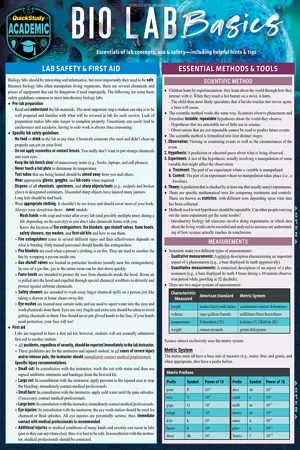
- 44 pages
- English
- ePUB (mobile friendly)
- Available on iOS & Android
About this book
The study of life, in all it's glory; animals and plants we see around us, the tiny organisms we can't see that affect us every day, and even the molecules which make up life. Learning biology, we ask questions about nature. Lab experiments are HOW we ask the questions. This guide shows how we ask questions in biology- what are the tools, terms, and major approaches scientists use to learn about the living world. It includes some of the major ideas biologists study, as well as descriptions of techniques and instruments used. This guide is intended for a high school or early college student, or anyone interested in understanding how biologists make the discoveries reported in the news daily.
- Lab Safety & First Aid
- Essential Methods & Tools
- Scientific Method
- Measurements
- Statistics
- Common Biology Lab Equipment
- Microscopy
- Essential Concepts
- Cell Structure
- Cell Transport
- Respiration
- Photosynthesis
- Enzyme Activity
- Organismal Diversity
- Mitosis
- Meiosis
- Molecular Genetics
- Mendelian Genetics
- Field Biology
Tools to learn more effectively

Saving Books

Keyword Search

Annotating Text

Listen to it instead
Information

- Prokaryotic cells are the simplest form of life. They:
- Have smallish circular DNA genomes.
- Lack intracellular membrane structures.
- Typically only a few micrometers in diameter.
- Eukaryotic cells may be either single- or multi-celled organisms.
- Genomes are organized into chromosomes.
- They contain multiple different membrane-bound organelles.
- They are often larger and more diverse in appearance.
- Archea are the third major type of organism that has characteristics intermediate between those of the eukaryotes and prokaryotes. They:
- Have a unique cell membrane that uses different lipids than prokaryotes or eukaryotes.
- Are single-celled organisms without membrane-bound organelles similar to prokaryotes.
- Have transcription and translation processes more similar to eukaryotes.
- Often live in extreme environments, including salt-loving halophiles, hot springloving thermophiles, and methane-generating methanogens.
- Cytology: The study of cell structure and function.
- Prokaryotes are often described based on their shape under the microscope and their pattern of growth. They are usually visualized with particular chemical stains such as a gram stain.
- Cocci: Spherical
- Bacilli: Rod shaped
- Spirilli: Spiral shaped
- Strepto: Prefix meaning cells grow in chains of cells
- Staphylo: Prefix meaning cells grow in clusters
- Organelles are membrane-bound structures found in eukaryotic cells.
- Organelles visible under a light microscope with appropriate stains include:
- Nucleus: Contains DNA and synthesizes RNA. It is the largest organelle and is often stained with haematoxylin.
- Chloroplast: Organelle in plant cells and used in photosynthesis. It appears green without staining due to the light-absorbing chlorophyll molecules.
- Mitochondria: Organelle that generates most ATP in eukaryotes. It is often stained with acid fuschine or newer fluorescent dyes.
- Cytoplasm: The liquid inside eukaryotic cells surrounding organelles. It is often stained by eosin.
- Other organelles are visible in the electron microscope, including:
- Endoplasmic reticulum: Membrane folds used to make lipids and membrane proteins.
- Golgi complex: A series of layered folds of membranes used to sort vesicles to different cellular locations.
- Lysosome: A digestive organelle that breaks down cellular waste.
- Peroxisome: An organelle that compartmentalizes reactions involving hydrogen peroxide.
- Vacuoles: Storage organelles most prominent in plants but also found in animals.
- Organelles visible under a light microscope with appropriate stains include:
- Biological membranes serve to separate two different compartments in living cells, such as separating the inside of the cells from the outside.
- Cell membranes are semipermeable, meaning that certain materials can pass through membranes and other materials cannot.
- The interiors of cell membranes are hydrophobic, as they repel water (it literally means “fear of water”), just like grease and oil.
- Nonpolar molecules (e.g., oxygen gas, carbon dioxide gas, steroid hormones) pass through cell membranes easily, as they are hydrophobic.
- Molecules that are hydrophillic (it literally means “water loving”) such as ions or water cannot pass through easily.
- There are two different mechanisms cells use to move things across their membranes:
- Passive transport relies on the thermal energy of matter. The cell does not have to put energy into these.
- Diffusion: Movement from an area of high to low concentration. For an example of passive transport, add a tea bag to a clear glass of hot water and watch diffusion occur as brownish tea particles spread into areas of clear water.
- Facilitated diffusion: A permease, or enzyme that exists in the membrane, carries substances from high to low concentrations.
- Osmosis: A form of diffusion across a barrier (such as a cell membrane) where a solvent (such as water) moves to reduce the concentration of a salt (i.e., water moves from a lower to a higher salt concentration).
- Tonicity: Relative solute concentration of two (or more) solutions. There are three possible situations:
- Isotonic: Both solutions have the same amount of solutes (no diffusion).
- Hypertonic: One solution has more solutes than the other.
- Hypotonic: One solution has fewer solutes than the other.
- Passive transport relies on the thermal energy of matter. The cell does not have to put energy into these.

-
- Active transport relies on the cell providing energy to physically move a substance across the membrane. There are three forms of active transport:
- Membrane pumps: Permease used to ...
- Active transport relies on the cell providing energy to physically move a substance across the membrane. There are three forms of active transport:
Table of contents
- Lab Safety & First Aid
- Essential Methods & Tools
- Essential Concepts
Frequently asked questions
- Essential is ideal for learners and professionals who enjoy exploring a wide range of subjects. Access the Essential Library with 800,000+ trusted titles and best-sellers across business, personal growth, and the humanities. Includes unlimited reading time and Standard Read Aloud voice.
- Complete: Perfect for advanced learners and researchers needing full, unrestricted access. Unlock 1.4M+ books across hundreds of subjects, including academic and specialized titles. The Complete Plan also includes advanced features like Premium Read Aloud and Research Assistant.
Please note we cannot support devices running on iOS 13 and Android 7 or earlier. Learn more about using the app