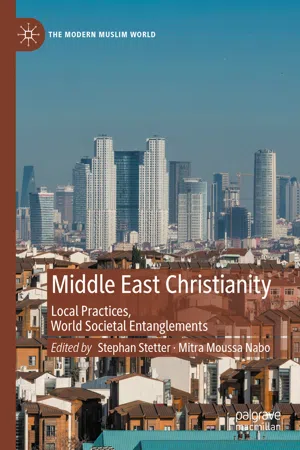
eBook - ePub
Middle East Christianity
Local Practices, World Societal Entanglements
- English
- ePUB (mobile friendly)
- Available on iOS & Android
eBook - ePub
Middle East Christianity
Local Practices, World Societal Entanglements
About this book
Drawing from theories of world society and from historical-sociological theories the book studies the past, present, and future of Middle East Christianity. It focuses on the interplay between local practices and post-colonial entanglements in global modernity. The chapters of this book engage, inspired by these theories, key empirical dynamics that affect Middle East Christianity. This includes a historical overview on the history of Christians in the region, the relationship between Islam and Christianity, as well as case studies on the Maronites in Lebanon, Egypt's Copts, the role of Protestant missionaries in the 19th century, processes of individualization amongst Middle East Christians, as well as papal diplomacy in the region.
Trusted by 375,005 students
Access to over 1.5 million titles for a fair monthly price.
Study more efficiently using our study tools.
Information
© The Author(s) 2020
S. Stetter, M. Moussa Nabo (eds.)Middle East ChristianityThe Modern Muslim Worldhttps://doi.org/10.1007/978-3-030-37011-4_11. Middle East Christianity in World Society: A Historical-Sociological Perspective on the Past and Present of Global/Local Entanglements
Stephan Stetter1
(1)
International Politics and Conflict Studies, Bundeswehr University Munich, Munich, Germany
Stephan Stetter
Abstract
The chapter proposes a theoretical framework for the study of Middle East Christianity that is rooted in historical-sociological theories of world society and global/local entanglements. This framework highlights in particular global/local encounters and how they are embedded in (colonial and post-colonial) power relations, differentiation, and social evolution, as well as contexts of change at macro-, micro-, and meso-levels. After outlining the main contours of this framework, the chapter provides a theoretically informed narrative of the 2000 years’ history of Christianity in the Middle East, re-constructed by drawing from such world societal perspectives. These empirical snapshots point to one over-arching feature that undergirds this conceptual perspective on Middle East Christianity. This is the entanglement of Middle Eastern Christianity with the global structures of a single modern yet internally highly fragmented and contested world society, both in the contemporary era and in the past.
Keywords
ChristianityMiddle EastWorld societyGlobal/local entanglementsDifferentiationGlobal modernity1 Time: And Time Again
A new millennium! The symbolism associated with the year 2000 was romanticized, globally, as a harbinger of a new era in human history. Given the diversity of global religious and non-religious beliefs, this is somewhat curious because the notion of a year “2000” is inherently linked to Christianity. Thus, this way of counting time re-inscribes in our daily lives, and our way of making sense of past, present, and future, the memory of the birth of the historical figure of Jesus of Nazareth—or God the Son as Christian faith holds. There are, to be sure, other ways of counting years, for example, in the Middle East. Thus, in Israel and in Arab/Muslim countries, alternative religious calendars are widely used. They refer to the creation of the world by God according to the Jewish tradition; and to Prophet Muhammad’s passage from Mecca to Medina where he established the first Muslim community (umma), remembered as al-hijra in Islam. In the Jewish and Muslim calendars , 1 January 2000 marked 23 Tevet 5760 and 24 Ramadan 1420.
Acknowledging sensitivities of post-religious publics, it has become popular to secularize the Christian way of counting, by keeping the Christian numbering of years, but substituting the religious marker Anno Domini (AD) with the neutral term “Common Era” (CE). But this is not as new as one might think. Thus, in global modernity the way we count years was secularized even before “AD” became contested. Thus, the global standardization of time in the late nineteenth century—a process inherently linked to European imperialism (Osterhammel 2009: 118–121)—was regulated on the basis of the Christian way of counting years. Fast forward, this explains why the symbolism of the year “2000” has become part of what can be termed “world culture ” (Boli and Thomas 1997), that is, cultural horizons in global modernity that are not exclusively linked to a specific world region. There is, thus, an inherent ambivalence to this date. It is of Christian origin but at the same time has become decoupled from Christianity. It is a global temporal horizon that is constantly actualized in different localities.
Hopes of a different and better future—based on more inclusion, more equality, and less sectarian strife—existed at the turn of the millennia also among Christians and non-Christians throughout the Middle East, that is, the region from where this religion originates. The Middle East is in a way the cradle of an early globalization movement that saw the global spread since antiquity—through spiritual, political, cultural, trade-related, and violent means—of Christianity. It was in what we term today the “Middle East” where Christianity emerged as a minority religion in the all-powerful Roman Empire, rose to the status of a majority religion, in particular after the Roman Emperor Constantine converted to Christianity in the year 312, but over the course of time, after the Arab conquest, has become a minority religion in a region in which Islam in its manifold forms became the dominant belief. A word of caution is needed here. Thus, when speaking of Muslim-majority countries, two things need to be kept in mind. Firstly, Islam not unlike Christianity is internally divers and fragmented. The notion of an alleged Muslim bloc—which often undergirds the parlance of “the Muslim world”—is in some societal circles part of a (quite old) trans-regional and global discourse of Islamophobia that is sociologically and historically inaccurate (Halliday 1996). Thus, Islam is itself a fragmented religion, not only due to the schism between Sunni and Shi’a, but also due to the manifold forms of internal differentiation within these and other branches. Secondly, while Islam plays a central role in historical and contemporary political struggles and is often re-inscribed and institutionalized in the body politics of countries such as Egypt, Turkey, Syria, Iraq, Iran, and others, states in the Middle East have, to varying degrees, strong secular underpinnings (Halliday 2011). It is true that in particular since the emergence of the Islamic reform movement in the nineteenth century, all these countries experience domestic struggles about the proper place of Islam in society. Yet, Middle Eastern states are first of all modern states in which political struggles mediate between different values such as nationalism, individualism, and religiosity. Differences with the West are a matter of graduation, not of general form.
The problem such nuanced perspectives on the Middle East and on Islam and Christianity in the region face is the often politicized and polarized way of talking about these topics. For example, the way in which the situation of Middle East Christianity is depicted in public discourse often lacks historical and sociological depth, now as during the nineteenth century when in the age of imperialism Western empires, states, and individuals ventured to “save” Middle East Christianity. Thus, the setbacks of the “Arab spring”—that is, authoritarian counter-revolution and the temporary rise of the “Islamic state of Syria and Iraq” (ISIS ), which persecuted Christians and others in the territories it conquered—have provided a floor for often alarmist media coverage on Middle Eastern Christianity. Some of these challenges such as the joint, non-sectarian protest by many Christians and Muslims against then-President Hosni Mubarak at Cairo’s Tahrir Square in February 2011 held the promise of more equality and inclusion of local Christianity in a predominantly Muslim Middle East. Yet, most analysts agreed that the major issue was the deterioration of collective and personal security of Middle Eastern Christians caused by authoritarianism, the cultural strength of political Islam, and by violence against Christians and others by ISIS and other jihadists but also everyday violence and forms of discrimination. These dynamics have triggered forced migration of Christians from the Middle East. However, and notwithstanding the serious hardships faced by these dynamics, the notion of an endgame of Middle East Christianity is exaggerated, and sociologically and historically uninformed.
A snapshot on the history of Middle East Christianity is an antidote to such presentist over-simplifications. Thus, a strained security situation and an ambivalent integration into local and national political systems are not new to local Christian communities. There is a long history of what could be termed “qualified” citizenship status dating back to the independence of Arab nations and policies of the Ottoman Empire at earlier periods. Today, these dynamics are part of a broader struggle about the very definition of citizenship in global modernity that is affecting Christians in the Middle East but, given the dominance of authoritarian forms of government in the contemporary Middle East, is also of relevance to Muslim citizens. It is true that in the light of global interconnectedness, such forms of identity-based exclusion or discrimination justified with recourse to “culture” and tradition can quite easily be contested and scandalized—but not necessarily altered. This has already been evident in the nineteenth century, when world societal horizons shaped global/local encounters in the Middle East, too. Thus, during this era, under the larger context of European imperialism and colonialism, the idea of political rights of individuals and nations, and a general sense of empowerment and political activism mushroomed, thereby also transforming the self-understanding of Middle Eastern Christians as a collective group ...
Table of contents
- Cover
- Front Matter
- 1. Middle East Christianity in World Society: A Historical-Sociological Perspective on the Past and Present of Global/Local Entanglements
- 2. Eastern Christian Subjectivities and Islam’s Hegemony in the Arab World
- 3. Between Communalism and State-Building: Lebanon’s Christians and the New Arab Disorder
- 4. “Modernization in the Name of God”: Christian Missionaries, Global Modernity, and the Formation of Modern Subjectivities in the Middle East
- 5. World Society Contexts of the Politics of Being Christian in the Middle East
- 6. Sectarianism and Terrorism: The Libya Beheadings and ISIS Violence Against Egypt’s Copts
- 7. Pilgrim Popes: How the Catholic Church Makes a Difference in World Society and the Middle East
- Back Matter
Frequently asked questions
Yes, you can cancel anytime from the Subscription tab in your account settings on the Perlego website. Your subscription will stay active until the end of your current billing period. Learn how to cancel your subscription
No, books cannot be downloaded as external files, such as PDFs, for use outside of Perlego. However, you can download books within the Perlego app for offline reading on mobile or tablet. Learn how to download books offline
Perlego offers two plans: Essential and Complete
- Essential is ideal for learners and professionals who enjoy exploring a wide range of subjects. Access the Essential Library with 800,000+ trusted titles and best-sellers across business, personal growth, and the humanities. Includes unlimited reading time and Standard Read Aloud voice.
- Complete: Perfect for advanced learners and researchers needing full, unrestricted access. Unlock 1.5M+ books across hundreds of subjects, including academic and specialized titles. The Complete Plan also includes advanced features like Premium Read Aloud and Research Assistant.
We are an online textbook subscription service, where you can get access to an entire online library for less than the price of a single book per month. With over 1.5 million books across 990+ topics, we’ve got you covered! Learn about our mission
Look out for the read-aloud symbol on your next book to see if you can listen to it. The read-aloud tool reads text aloud for you, highlighting the text as it is being read. You can pause it, speed it up and slow it down. Learn more about Read Aloud
Yes! You can use the Perlego app on both iOS and Android devices to read anytime, anywhere — even offline. Perfect for commutes or when you’re on the go.
Please note we cannot support devices running on iOS 13 and Android 7 or earlier. Learn more about using the app
Please note we cannot support devices running on iOS 13 and Android 7 or earlier. Learn more about using the app
Yes, you can access Middle East Christianity by Stephan Stetter, Mitra Moussa Nabo, Stephan Stetter,Mitra Moussa Nabo in PDF and/or ePUB format, as well as other popular books in Politics & International Relations & International Relations. We have over 1.5 million books available in our catalogue for you to explore.