This book analyses technology enhanced learning through the lens of Disruptive Innovation theory. The author argues that while technology has not disrupted higher education to date, it has the potential to do so. Drawing together various case studies, the book analyses established technologies through a Disruptive Innovation perspective, including virtual learning environments, and includes Wikipedia as an example of successful innovative disruption. The author also examines the disruptive potential of social media technologies and the phenomenon of user-owned technologies. Subsequently, the author explores strategic narratives for technology enhanced learning and imagines what the Disruptive University might look like in the future. This book will be valuable for scholars of technology enhanced learning in higher education as well as those looking to increase their understanding of and practice with technology enhanced learning.
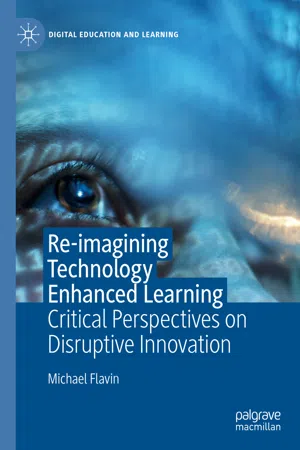
eBook - ePub
Re-imagining Technology Enhanced Learning
Critical Perspectives on Disruptive Innovation
- English
- ePUB (mobile friendly)
- Available on iOS & Android
eBook - ePub
Re-imagining Technology Enhanced Learning
Critical Perspectives on Disruptive Innovation
About this book
Trusted by 375,005 students
Access to over 1.5 million titles for a fair monthly price.
Study more efficiently using our study tools.
Information
Topic
EducationSubtopic
Education General© The Author(s) 2020
M. FlavinRe-imagining Technology Enhanced LearningDigital Education and Learninghttps://doi.org/10.1007/978-3-030-55785-0_11. Introduction
Keywords
History of innovationClayton ChristensenDisruptive innovationHigher educationViewed historically, Disruptive Innovation is a tautology. From the Renaissance onwards, uses of the word ‘innovation’ were accusatory rather than laudatory. Innovation was opposed to custom and order, and was disruptive by definition. As Godin (2013) argues, ‘Innovation was not the subject of inquiry, study or theory. It was a linguistic weapon used against an enemy: the revolutionary, the republican and, in the nineteenth century, the socialist’ (p. 19).
The meaning of innovation changed. It became aligned with progress and utility. Instead of signifying chaos and disruption in the present, innovation offered progress in the future (Godin, 2013). The understanding of innovation further developed through the twentieth century; the phrase ‘technological innovation’ emerged after World War Two and was understood as commercialised invention (Godin & Vinck, 2017a).
Understandings of innovation continued to shift in the second half of the twentieth century. Perren and Sapsed (2013) analyse the use of the word ‘innovation’ in UK parliamentary proceedings 1960–2005, finding a tenfold increase in its usage in parliamentary debates, as well as finding the term being used in an increasingly positive tone. Innovation has come to have invariably positive connotations, signifying something both inventive and aspirational. As Perren and Sapsed (2013) argue, ‘Thus, the successful introduction of novelty is seen as a worthy and important task in itself, and it has therefore become politically expedient to associate innovation with multiple agendas … providing solutions for the environment crisis, updating public services, educating children, governing health services, and for promoting economic growth and competitiveness’ (p. 1826). Innovation is now ubiquitous and an unalloyed good: ‘it seems as if all governmental functions must cater to the innovation discourse in order to appear economically defensible, politically legitimate, and modern’ (Pfotenhauer & Juhl, 2017, p. 82).
The situation we have arrived at in respect of understanding innovation is such that, ‘Today, the concept of innovation is wedded to an economic ideology, so much so that we forget that innovation has been a mainly political—and contested—concept for most of history’ (Godin & Vinck, 2017a, p. 4). In the twenty-first century innovation is seen as good axiomatically, a signifier for progress and transformation, bringing benefits wherever it goes. Godin (2010) argues, ‘Innovation has shifted from being evil to being panacea’ (p. 38), while Godin and Vinck (2017b) add, ‘That innovation is good, always good, is the mantra in the study of innovation’ (p. 319).
Other writers have noted the widespread applicability of innovation. Pfotenhauer and Juhl (2017) claim, ‘innovation is more than a mere vehicle for techno-economic development worthy of government attention: It is also a means of governing society through national projects, through the rationalization and legitimation of state action, and through national identity-formation’ (p. 83). We innovate, or we claim to innovate, in our economies, our societies, and our culture. Pfotenhauer and Juhl (2017) further argue, ‘The relationship between innovation and the state is without doubt one of the most important and challenging construction sites policy-makers face in highly technologized societies. Innovation has become a central arena for politics and societal self-imagination, perhaps the closest current-day equivalent we have to the promise of enlightenment of old’ (pp. 88–89). Moreover, innovation is one of the United Nation’s Sustainable Development Goals: ‘Build resilient infrastructure, promote inclusive and sustainable industrialization and foster innovation’ (UN, 2019). You are nobody if you are not innovating.
Resistance to innovation can be functional but it can also be psychological: innovations disrupt routines and humans can be attached to their routines (Laukkanen, Sinkkonen, & Laukkanen, 2009). Once a technology becomes embedded it can be hard to dislodge. Rivals to Microsoft can manufacture functional equivalents to the services offered by Microsoft Office, but users will tend to stay with convenient and easy to use technologies, and will often be tempted to stick with what they already know, leading to a form of lock-in.
This book examines the specific theory of Disruptive Innovation and applies it to technology enhanced learning in higher education. The book identifies the kind of technologies that succeed, the technologies that fail, and uses Disruptive Innovation theory to evaluate the state of technology enhanced learning in higher education and where it might go hereafter. This is a necessary enquiry because of the extent to which technology usage pervades higher education practice. Selwyn (2014) argues, ‘you cannot hope to understand higher education without paying serious attention to the varied uses of digital technology across the sector’ (p. 110), and Weeks (2015) acknowledges, Disruptive Innovation theory is, ‘a powerful lens for examining certain technological advances’ (p. 426).
The theory of Disruptive Innovation is closely associated with the work of Clayton Christensen (1952–2020). His original (1997) dualism was between sustaining and disruptive technologies. The former comprise incremental improvements of existing technologies; the latter prompt new practices. Subsequently, in a co-authored book (Christensen & Raynor, 2003), Christensen changed ‘technology’ to ‘Innovation,’ reflecting the argument that disruption is a matter of practice and not intrinsic to a technology.
Disruptive Innovation is fundamentally a theory about goods and services. Godin and Vinck (2017c) argue, ‘Innovation theories are mainly developed in economics and management, which are partly geared towards industry’ (p. 111). However, Disruptive Innovation can be applied more widely and it is highly relevant to a sector in which technology usage is exceptionally rife, and in which the increasing privatisation of higher education blurs the boundaries between education, business, politics and economics. A range of examples of Disruptive Innovation are cited in this book, from bookselling to air travel to watchmaking. Illustrative comparisons are made between these practices and higher education, without forgetting higher education’s distinctiveness. Each individual chapter is briefly summarised in the paragraphs below.
Chapter 2 summarises the theory of Disruptive Innovation. The chapter offers case studies to illustrate how Disruptive Innovation works in practice. The chapter argues Disruptive Innovation is a useful lens through which to consider technology enhanced learning in higher education, because it enables an understanding of which technologies succeed, and why they succeed.
Chapter 3 looks at the virtual learning environment (VLE). The VLE is examined because it is an embedded, indeed ubiquitous technology in higher education. However, despite its transformative potential, the chapter argues the VLE is a sustaining innovation, offering marginal enhancements but not challenging established higher education practices.
Chapter 4 examines Wikipedia as an example of a successful disruptive technology in higher education. Wikipedia conforms to Christensen’s (1997) core definition of a disruptive technology, being free, convenient and easy to use. It is also an example of Disruptive Innovation because of how it has changed practice. Wikipedia is often the first port of call for both students and lecturers when information is sought, despite the availability of institutional, and often costly, alternatives. However, Wikipedia is also commonly seen as academically inferior. The chapter therefore also evaluates Wikipedia as a resource to support learning and teaching in higher education.
Chapter 5 examines social media technologies in higher education. They have the core characteristics of disruptive technologies, being free, convenient and easy to use. It is simple to join and use a social networking technology. However, social media technologies are not, in practice, a disruptive innovation. This is partly the result of demarcation; users opt to maintain distance between their social and learning personae. The chapter also examines social media technologies as an aspect of marketing in higher education; and as examples of communities of practice. The chapter analyses examples of the commercial and political usage of data drawn from social media technologies, and how this fits within or conflicts with practice in higher education.
Chapter 6 looks at the practice of Bring Your Own Device (BYOD); at user-owned technologies in higher education more generally; and at the monetisation of higher education. The practice of BYOD is of interest because it enables contrasting yet equally valid interpretations. On the one hand, BYOD can be seen in the context of the increasing privatisation and monetising of higher education. Having transferred the costs of tuition to students and their families, some higher education systems transfer the hardware costs, too. On the other hand, the use of technologies owned or rented by students is an expression of personal preference, in part because the affordances of user-owned technologies can exceed those offered by institutions. The practice of BYOD is simpler and more convenient for many than logging-on to an institution as a prior step to accessing and using resources, though the practice is also complicated as it expresses different economic and social influences on technology usage.
Chapter 7 explores the narrative of technology enhanced learning in higher education. Disruption arises from practice more than design, but practice does not occur in a vacuum. Creating a narrative for what can be done with a technology is a significant spur to practice. The chapter therefore examines successful narratives for technology usage to see how narrative ...
Table of contents
- Cover
- Front Matter
- 1. Introduction
- 2. Whatever Happened to Technology Enhanced Learning?
- 3. Virtual Library Environment? VLEs in Practice
- 4. This Chapter Is a Stub: Wikipedia as a Disruptive Innovation
- 5. Putting a Brave Face on it: Social Media Technologies and Disruptive Innovation
- 6. Cash in the Academic: Technology Enhanced Learning and the Monetisation of Higher Education
- 7. Reboot the Messenger: A Narrative for Technology Enhanced Learning
- 8. Conclusion: Switch It Off, Switch It on Again—Reimagining Technology-Enhanced Learning in Higher Education
Frequently asked questions
Yes, you can cancel anytime from the Subscription tab in your account settings on the Perlego website. Your subscription will stay active until the end of your current billing period. Learn how to cancel your subscription
No, books cannot be downloaded as external files, such as PDFs, for use outside of Perlego. However, you can download books within the Perlego app for offline reading on mobile or tablet. Learn how to download books offline
Perlego offers two plans: Essential and Complete
- Essential is ideal for learners and professionals who enjoy exploring a wide range of subjects. Access the Essential Library with 800,000+ trusted titles and best-sellers across business, personal growth, and the humanities. Includes unlimited reading time and Standard Read Aloud voice.
- Complete: Perfect for advanced learners and researchers needing full, unrestricted access. Unlock 1.5M+ books across hundreds of subjects, including academic and specialized titles. The Complete Plan also includes advanced features like Premium Read Aloud and Research Assistant.
We are an online textbook subscription service, where you can get access to an entire online library for less than the price of a single book per month. With over 1.5 million books across 990+ topics, we’ve got you covered! Learn about our mission
Look out for the read-aloud symbol on your next book to see if you can listen to it. The read-aloud tool reads text aloud for you, highlighting the text as it is being read. You can pause it, speed it up and slow it down. Learn more about Read Aloud
Yes! You can use the Perlego app on both iOS and Android devices to read anytime, anywhere — even offline. Perfect for commutes or when you’re on the go.
Please note we cannot support devices running on iOS 13 and Android 7 or earlier. Learn more about using the app
Please note we cannot support devices running on iOS 13 and Android 7 or earlier. Learn more about using the app
Yes, you can access Re-imagining Technology Enhanced Learning by Michael Flavin in PDF and/or ePUB format, as well as other popular books in Education & Education General. We have over 1.5 million books available in our catalogue for you to explore.