Chapter 9 is available open access under a Creative Commons Attribution 4.0International License via link.springer.com.
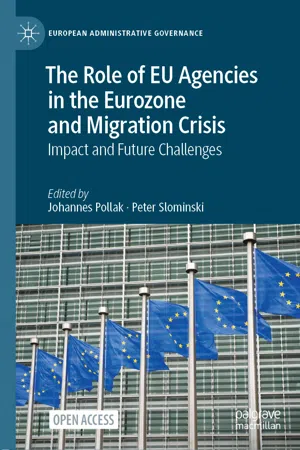
eBook - ePub
The Role of EU Agencies in the Eurozone and Migration Crisis
Impact and Future Challenges
- English
- ePUB (mobile friendly)
- Available on iOS & Android
eBook - ePub
The Role of EU Agencies in the Eurozone and Migration Crisis
Impact and Future Challenges
About this book
This book provides a wealth of empirical material to understand key aspects of EU governance including its plurality of actors and policy making modes and its functioning during crisis management. Authored by legal scholars and political scientists, it presents new research and insights on the role of EU agencies in the context of the Euro and migration crises. Specifically, the contributions assess why the crises have led to the creation of new EU agencies and what roles these agencies have performed since their inception; how the crisis, notably the migration crisis, has impacted on existing EU agencies; how EU agencies have shaped the policies during and after the crises; and, how the crisis has affected the accountability of EU agencies. This book is essential in understanding the intricacies of EU crisis management and the specific role of EU agencies therein, as well as EU governance more broadly.
Trusted by 375,005 students
Access to over 1.5 million titles for a fair monthly price.
Study more efficiently using our study tools.
Information
Part IIntroduction
© The Author(s) 2021
J. Pollak, P. Slominski (eds.)The Role of EU Agencies in the Eurozone and Migration CrisisEuropean Administrative Governancehttps://doi.org/10.1007/978-3-030-51383-2_11. EU Agencies in Times of Crisis: An Introduction
Johannes Pollak1 and Peter Slominski2
(1)
Webster Vienna Private University, Vienna, Austria
(2)
Institute for Political Science, University of Vienna, Vienna, Austria
1 Introduction
In the last two decades, the emergence and institutionalisation of EU agencies has been widely studied by EU scholars from many perspectives. While some studies focus on formal, functional or normative aspects of agencification (e.g. Curtin 2014; Borrás et al. 2007; Busuioc et al. 2012), others examine to what extent EU agencies have impacted on the EU’s institutional balance (e.g. Everson and Vos 2016; Kelemen 2005; Van Ooik 2005). Works within this strand of research are particularly interested in whether EU agencies are an important element of an increasingly intergovernmental governance structure (Bickerton et al. 2015) or whether they have gradually escaped control from the member states exercising de facto decision-making authority (Gehring and Krapohl 2007; Busuioc 2009). Yet others take a more global view arguing that EU agencies play a crucial role in an emergent European executive order (Trondal 2010) or in an EU administrative governance system (Hofmann and Türk 2006). What has received less academic attention, however, is how a crisis situation affects EU agencies and what role EU agencies play in crisis management (notable exceptions are e.g. Jordana and Triviño-Salazar 2020; Vos 2000; Moloney 2011; Horii 2018). Given their executive power in key areas including the Eurozone as well as border and migration management, this is an astonishing gap.
2 The EU’s Two Make or Break Moments: The Eurozone and the Migration Crisis
A crisis can be conceived as an exogenous event that can influence the trajectory of a policy (e.g. Kingdon 1984). We can define a political crisis as a situation in which policy makers are confronted with significant need for action, on the one hand, and limited time for extensive policy deliberations, on the other (Falkner 2016). The pressure to act in order to tackle a profound systemic challenge opens a window of opportunity that may be used by political entrepreneurs to advance their policy interests. Crises-related measures can either lead to deep policy change that creates a new policy path (Capoccia and Kelemen 2011; Sabatier 1988) or to gradual change (Mahoney and Thelen 2010).
Throughout its history, the EU has been compelled to deal with numerous crises. The EU historian Desmond Dinan even states that the history of the EU is replete with so-called crises (Dinan 2017). At the same time, many scholars agree that the EU has not only survived these past crises, but has even been strengthened by them (Kühnhardt 2011). However, both the Eurozone crisis and the migration crisis constitute a multi-dimensional crisis that is unprecedented in seriousness and severity (Dinan 2017). What is more, within the short time span of just a few years, the EU has been confronted with two major and overlapping ‘transboundary crises’ which have been perceived as a make or break moment (Kupchan 2011; Reuters 2018).
EU scholarship has devoted considerable attention to both crises. Focusing on the driving factors and varying outcome, scholars have asked why both crises, despite their similarities, led to different responses and paths of integration. From an intergovernmentalist perspective, Biermann et al. (2019) discussed the interest divergency among member states and inter-state bargaining dynamics with the view to explain the variation of crisis management and its impact in the context of the Euro and migration crisis. While both crises were triggered by external events, their trajectories proved to be different. While the Eurozone crisis led to substantial EU reforms enshrined in legally binding supranational rules, the migration crisis resulted in modest EU measures mainly revolving around administrative and financial support (Trauner 2016). By contrast, with regard to the migration crisis, member states’ preferences prohibited an agreement for ‘joint action’ to avoid a ‘common bad’. Asymmetric interdependence produced power asymmetry leaving states that have lower costs of non-agreement in a better position than states which carry the brunt of the crisis and thus have a greater interest in reform. As a result, states that are less affected by migratory pressures had no incentive to advocate or support major policy reforms (Biermann et al. 2019, p. 248).
From a neofunctional perspective, scholars emphasized the differences and deficiencies of the existing governance design (Schimmelfennig 2018). Like liberal intergovernmentalist scholars, neofunctionalists observed that the crisis responses and outcomes have been different. However, unlike intergovernmentalists, they identify transnational interdependence and supranational capacity as the main factors that explain the variation of these outcomes. While the governance system of the Eurozone has strong supranational institutions (e.g. European Central Bank [ECB]), EU migration and refugee policy lacks a similar institutional set-up. As a result, national authorities still have considerable powers in implementing and administering EU policies. Moreover, migrants are regarded as weak transnational actors who are not capable to impose strong costs on EU governments. In contrast to the Eurozone crisis, exiting the Schengen or Dublin regime or resorting to unilateral behaviour has been perceived as less costly than leaving the Eurozone (Schimmelfennig 2018, p. 970).
Transcending the intergovernmentalist-neofunctional divide, the newly developed ‘failing forward argument’ (Jones et al. 2016; Scipioni 2018a) focuses on the incomplete governance architecture of the eurozone and EU migration and refugee policy. Lowest common denominator bargaining results in incomplete agreements which create the conditions for subsequent crises which—in a next step—stimulates further functional spill overs dragging reluctant member states into the next incomplete agreement and so forth (Jones et al. 2016). Incomplete governance structures are characterized by a modest level of supranational harmonization, a low level of rule precision that is often complemented by legally non-binding instruments (i.e. soft law) which leaves considerable national autonomy and weak supranational monitoring (Slominski and Trauner 2020; for a pre-crisis assessment see Schelkle 2007). Structural similarities between the Eurozone crisis and the migration crisis have also been identified by proponents of ‘core state powers’. Since monetary and migration policy belong to core state powers (high political salience and heavily politicized), both crises can be characterized by three sources of failure: low compliance rate of the existing acquis; regulatory gaps which leaves large room of manoeuvre to the discretion of member states without creating a level-playing field or producing policy consistency; insufficient burden and risk-sharing ensuring solidarity between EU member states. Given the structural similarity of the crises, the EU basically relied on three instruments to manage both crises: regulatory tightening, strengthening of risk and burden-sharing arrangements and externalization of crisis management (Genschel and Jachtenfuchs 2014, 2018). What has been widely overlooked by this literature is that while the Eurozone and migration crises have produced different outcomes in terms of supranationalization, both events have further strengthened the agency governance in the EU.
3 Creation and Strengthening of EU Agencies in the Wake of Crises
Since the mid-1970s, the EU has established over 30 EU agencies which operate in numerous fields ranging from pharmaceutical regulation, energy regulation, food safety, environment or railways (Geradin et al. 2005). Scholarly literature widely agrees that agencies have the power to enhance the credibility of long-term policy commitments (Kelemen and Majone 2012). In order to meet these functional demands these agencies have to operate at arm’s length from their political principals (i.e. EU governments) who have an interest to strengthen the EU’s regulatory capacity without directly enhancing the p...
Table of contents
- Cover
- Front Matter
- Part I. Introduction
- Part II. Agencies and the Eurozone Crisis
- Part III. EU Agencies and the Migration Crisis
- Correction to: Interagency Relations and the EU Migration Crisis: Strengthening of Law Enforcement Through Agencification?
- Back Matter
Frequently asked questions
Yes, you can cancel anytime from the Subscription tab in your account settings on the Perlego website. Your subscription will stay active until the end of your current billing period. Learn how to cancel your subscription
No, books cannot be downloaded as external files, such as PDFs, for use outside of Perlego. However, you can download books within the Perlego app for offline reading on mobile or tablet. Learn how to download books offline
Perlego offers two plans: Essential and Complete
- Essential is ideal for learners and professionals who enjoy exploring a wide range of subjects. Access the Essential Library with 800,000+ trusted titles and best-sellers across business, personal growth, and the humanities. Includes unlimited reading time and Standard Read Aloud voice.
- Complete: Perfect for advanced learners and researchers needing full, unrestricted access. Unlock 1.5M+ books across hundreds of subjects, including academic and specialized titles. The Complete Plan also includes advanced features like Premium Read Aloud and Research Assistant.
We are an online textbook subscription service, where you can get access to an entire online library for less than the price of a single book per month. With over 1.5 million books across 990+ topics, we’ve got you covered! Learn about our mission
Look out for the read-aloud symbol on your next book to see if you can listen to it. The read-aloud tool reads text aloud for you, highlighting the text as it is being read. You can pause it, speed it up and slow it down. Learn more about Read Aloud
Yes! You can use the Perlego app on both iOS and Android devices to read anytime, anywhere — even offline. Perfect for commutes or when you’re on the go.
Please note we cannot support devices running on iOS 13 and Android 7 or earlier. Learn more about using the app
Please note we cannot support devices running on iOS 13 and Android 7 or earlier. Learn more about using the app
Yes, you can access The Role of EU Agencies in the Eurozone and Migration Crisis by Johannes Pollak, Peter Slominski, Johannes Pollak,Peter Slominski in PDF and/or ePUB format, as well as other popular books in Politics & International Relations & European Politics. We have over 1.5 million books available in our catalogue for you to explore.