eBook - ePub
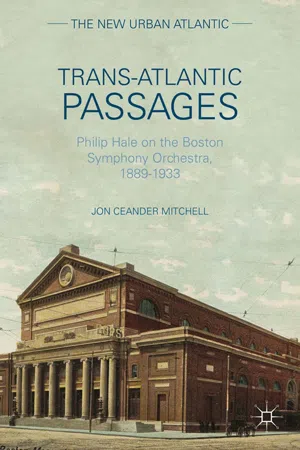
Trans-Atlantic Passages
Philip Hale on the Boston Symphony Orchestra, 1889-1933
- English
- ePUB (mobile friendly)
- Available on iOS & Android
eBook - ePub
About this book
Philip Hale (1854-1934) helped put Boston on the Transatlantic map through his music writing. Mitchell reconstructs Hale's oeuvre to produce an authoritative account of the role the Boston Symphony played in the international world of nineteenth- and early twentieth-century music.
Trusted by 375,005 students
Access to over 1.5 million titles for a fair monthly price.
Study more efficiently using our study tools.
Information
1
1854–1889
Though others preceded him, Philip Hale is considered to have been one of the first great American arts critics. He came into the world on March 5, 1854 in Norwich, Vermont, the first-born son of William Bainbridge Hale (1826–1892) and Harriet Amelia Porter Hale (ca. 1826–18721). The family’s roots in this country ran very deep; Philip himself was an eighth-generation descendent of one Thomas Hale, who had landed at Salem, Massachusetts in 1634 and settled in nearby Newbury the following year.
William Bainbridge Hale never went to college, but was a self-educated person, possessing a fine business acumen as well as an exceptional command over the English language. The Springfield Republican said of him, “Mr. Hale was a man of more than ordinary ability, of wide reading, and possessed an extraordinary gift of language, which at times amounted to eloquence.”2
Sometime around February 1858, when Philip’s younger brother Edward3 was born, William became president of the First National Bank of Northampton, Massachusetts and the family relocated there. Northampton, a utopian community of about 6,000, had much to offer. Within a short period of time, William had a home of significant proportions constructed for the family:
In 1860 he hired [Northampton architect William Fenno] Pratt to design a large, ten-gabled, brick home (described by local architect Karl Putnam as a “Gothic Revival in the Tudor Manner” and known locally as “The Gables”). Hale built for his gardener a small Carpenter Gothic cottage, a structure based on one of [Andrew Jackson] Downing’s simplest designs, across the street at 38.4
“The Gables,” located on Round Hill Road, was built only a few hundred yards from the then-future site of Smith College. It is still standing.
In a speech given to the Massachusetts Historical Society in 1923 titled “Musical and Theatrical Life in a New England Village in the Sixties,” Philip Hale reflected on the religious, social, and artistic life of Northampton:
. . . It was an industrious, matter-of-fact, temperate, God-fearing community, with parents endeavoring to bring up their children in the nurture and the admonition of the Lord; a reasonably intelligent if somewhat poker-backed and narrow community, with a sprinkling of the more liberal and more cultured; an old-fashioned community—would that there were more of them in New England of today!5
It was in Northampton that Philip began studying the organ and the piano. This first phase of his music education came to fruition early, for at the age of 14 he began duties as organist of the local Unitarian church.
In the meantime William continued to improve his position in the community. He was instrumental in the founding of Northampton’s public library and in 1871 became president and manager of the Florence Sewing Machine Company. His wealth and status in the world he knew meant that he was able to ensure that Philip’s schooling would be of the highest caliber. Indeed, starting in 1870 Philip attended the exclusive Phillips Exeter Academy in Exeter, New Hampshire for two years. While there he developed an interest in poetry and literature, particularly in the writings of Walt Whitman.
He wrote to the poet:
Exeter N-H.
Sep 14 1871
Dear Sir
I have just got your complete works—Ed 1871 and would like to ask you why you did not reprint the preface to the first edition? I have only read extracts from that preface and should like to have seen the whole reprint. I suppose I can not get the old one now at the stores.
I saw the other day that Mr. Swinburne6 said he enjoyed your “Song from the Sea” more than any of your other works. Did he mean Sea Shore Memories No. 1 – ? The poem of yours that I read over with the most satisfaction is your Burial Hymn of Lincoln—But as my opinion is not worth anything, being a boy I should not have entrusted it upon you—
If you are pressed with time even then I should like to hear from you—just a word.
Yours most respectfully,
Philip Hale
P.S. Do you know where I could get a 1st Ed with preface?7
Thus, even as a teenager, the future program essayist was concerned with having a sense of completeness with the sources that he read and consulted, and Whitman’s extensive 30-page preface to Leaves of Grass would serve as a source of inspiration to him for years to come.
Following Exeter, Hale studied law at Yale College (later University). During his years there he was involved in a variety of musical activities, including a stint as pianist for the Yale Glee Club; he also received awards in composition. Away from music, Hale was one of the editors of the nascent Yale Record, and he contributed four articles—probably his earliest publications—to The Yale Literary Magazine. One of these, “Walt Whitman,” appeared in the November 1874 issue. After writing some introductory comments, Hale penned the following passage, some of it nearly self-prophetic:
Fifty-five years ago Walt Whitman was born. Brought up in out-door life, strong, healthy, now a carpenter, now an editor, always one of the people, he became disgusted with our nature literature, and thought that no poet had come forth to sing the praises of true democracy. With sublime egotism he said to himself, I will be the poet of this land. To fit himself for the task he travelled much, noting the customs of our States. He studied carefully on politics and government. He read the literature of all lands, giving especial attention to the Greek drama, Homer, and the Bible. In 1855 the fruit of his work appeared, a thin book set in type and published by himself. “Leaves of Grass” was for a time thought to be the ravings of a madman. It was called, at once, gross, yet mystical, superficial and deep, as though a New York fireman had absorbed the transcendentalism of the Dial and had expressed it in his own brawny language. . . .
In the author’s preface to the 1955 edition, he says:
“To speak in literature with the perfect rectitude and insouciance of the movements of animals. And the unimpeachableness of the sentiment of trees in the woods and grass by the roadside, is the flawless triumph of art. What I tell, I tell for precisely what it is. Let who may exalt or startle, or fascinate, or soothe; I will have purposes, as health, or heat, or snow has, and be as regardless of observation.” And Nature found her long-lost poet.8
The following year, Hale once again wrote to him:
9 South College
New Haven CT
Oct 7th 1875
Dear Sir: –
I send you a copy of Yale Lit for Nov 74 containing an article “WW.” You will see at a glance that it is simply a condensed rehash of Mr. Burrough’s “notes”—a Westminster Review article9 and your Democratic Vistas.10
I have not sent it to you before because somehow or other I have not had the courage. I feared lest you have said in “Calamus”11—your cautions to would be pupils of yours—might be true.
I hope that you will not be offended at the imperfect way in which I have tried to express my faith in you. I first became acquainted with your books some four or five years ago and from them I have not only learned faith and courage but have become desirous of seeing you yourself. This last pleasure has been denied me; but one of the pleasantest memories of my life is the recollection of an hour passed with your mother in the summer of ’72.
The passage marked } is disjointed—for the false delicacy of the Ed’s of Lit kept out some remarks upon the physical degeneracy of our women.
Very respectfully,
Philip Hale
To
Walt Whitman
Camden
N.J.12
Early the following summer Hale ordered copies of new editions of Whitman’s books.
The author wrote to him:
431 Stevens St.
Camden, N Jersey
July 11 [1876?]
My dear Philip Hale,
I have rec’d your PO order for $10 for my books—for which hearty thanks. I send by same mail with this, One Vol. Leaves of Grass—the other Vol. Two Rivulets13 I will send soon as some copies of a new batch are ready (the old ones being all exhausted).
Please inform me (by postal card will do) if this Vol. comes safe.
Walt Whitman14
Throughout his life Hale would maintain an appreciation of Whitman’s writings, often quoting him in concert reviews. Among the items that he kept until his death was another of Whitman’s self-published pamphlets, After All, Not to Create Only, a speech given by the poet on September 7, 1871. Whitman also respected Hale’s writings. The following inscription in Whitman’s hand appears in the cover of what was undoubtedly a gift copy of Quarante Mélodies Choises de F. Schubert:15
Phil: Hale
“All music is what awake[n]s from you when you are reminded by the instruments.”
Walt Whitman16
Following his graduation from Yale (A. B., 1876), Hale turned his attention toward New York City, contributing articles to New York World while receiving private lessons from then well-known composer Dudley Buck (1839–1909), organist at Holy Trinity Church in Brooklyn. Shortly thereafter Hale moved to Albany, New York, where he served as an apprentice in the law office of his uncle, Robert L. Hale. This was fortuitous; it culminated in his being admitted to the New York Bar in 1880. As a result, Hale practiced law in Albany for two years.
Located about eighty miles west of Northampton, Albany had about 90,000 residents during Hale’s first period of residency there. This population figure is somewhat misleading, for the city was (and remains) the state capitol and the center of the tri-city metropolitan area consisting of Albany, Schenectady, and Troy. There was already a significant tradition of music making in Albany. At mid-century, Ferdinand Ingersoll Ilsley, owner of F. I. Ilsley & Co., an Albany firm which made square concert pianos for over a decade, conducted performances of Haydn’s oratorios The Creation and The Seasons. The latter was presented by the Harmonia Society, a singing organization founded in 1849. Within two decades a number of other Albany singing societies were established. Among them were The Union Musical Association (1858), The Singing Society Caecilia (1866), The Albany Music Association (1867), and the Gesang-Verein Eintracht Singing Society (1868), which, as its name suggests, cultivated German music, both instrumental and vocal. Sometimes orchestras accompanied these singing societies in their concerts, although, in order to ensure a sufficient caliber of performance, professional musicians—both vocal and instrumental—had to be brought in from New York or Boston. The Germania Orchestra of Boston, for example, was imported for the 1881 performance of Mendelssohn’s Elijah. Chamber music was also starting to gain a foothold in the city at this time. Among such groups was The Mozart Society (1875).17
Performance venues were relatively few and therefore in high demand. Tweddle Hall, located at 81 State Street, was built in 1860. This four-story structure was the principal location for oratorio performances before it burned down in 1883.18 The building also housed the McCammon Music Store. Nearby was the Perry Building, which also had a performance hall. Also downtown was the Leland Opera House, at 43 S. Pearl St., which opened its doors on November 24, 1873. It was later converted into a venue for vaudeville and movies before its demise in the mid-twentieth century.
Hale, of course, was drawn to Albany’s musical offerings. He studied piano and organ there with John Kautz (1850–1918) and from 1879 to 1882 served as organist at St. Peter’s (Episcopal) Church on State Street. One year earlier, starting in 1878, Hale began serving as music critic for the Albany Times.19 This marked the beginning of his work in what would become his true profession, even though Hale’s position with that paper often entailed writing about nonmusical events, doing telegraph copy editing, or chasing down police r...
Table of contents
- Cover
- Title
- Introduction
- Part I
- Part II Selected Writings of Philip Hale
- Notes
- Bibliography
- Index
Frequently asked questions
Yes, you can cancel anytime from the Subscription tab in your account settings on the Perlego website. Your subscription will stay active until the end of your current billing period. Learn how to cancel your subscription
No, books cannot be downloaded as external files, such as PDFs, for use outside of Perlego. However, you can download books within the Perlego app for offline reading on mobile or tablet. Learn how to download books offline
Perlego offers two plans: Essential and Complete
- Essential is ideal for learners and professionals who enjoy exploring a wide range of subjects. Access the Essential Library with 800,000+ trusted titles and best-sellers across business, personal growth, and the humanities. Includes unlimited reading time and Standard Read Aloud voice.
- Complete: Perfect for advanced learners and researchers needing full, unrestricted access. Unlock 1.5M+ books across hundreds of subjects, including academic and specialized titles. The Complete Plan also includes advanced features like Premium Read Aloud and Research Assistant.
We are an online textbook subscription service, where you can get access to an entire online library for less than the price of a single book per month. With over 1.5 million books across 990+ topics, we’ve got you covered! Learn about our mission
Look out for the read-aloud symbol on your next book to see if you can listen to it. The read-aloud tool reads text aloud for you, highlighting the text as it is being read. You can pause it, speed it up and slow it down. Learn more about Read Aloud
Yes! You can use the Perlego app on both iOS and Android devices to read anytime, anywhere — even offline. Perfect for commutes or when you’re on the go.
Please note we cannot support devices running on iOS 13 and Android 7 or earlier. Learn more about using the app
Please note we cannot support devices running on iOS 13 and Android 7 or earlier. Learn more about using the app
Yes, you can access Trans-Atlantic Passages by J. Mitchell in PDF and/or ePUB format, as well as other popular books in Mezzi di comunicazione e arti performative & Storia moderna. We have over 1.5 million books available in our catalogue for you to explore.