eBook - ePub
Australia, Migration and Empire
Immigrants in a Globalised World
- English
- ePUB (mobile friendly)
- Available on iOS & Android
eBook - ePub
Australia, Migration and Empire
Immigrants in a Globalised World
About this book
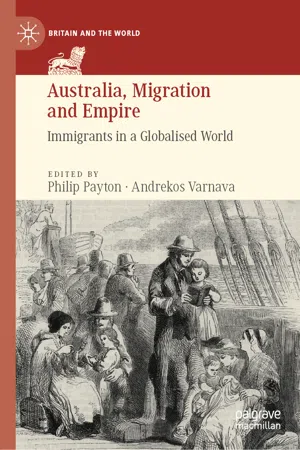
This edited collection explores how migrants played a major role in the creation and settlement of the British Empire, by focusing on a series of Australian case studies. Despite their shared experiences of migration and settlement, migrants nonetheless often exhibited distinctive cultural identities, which could be deployed for advantage. Migration established global mobility as a defining feature of the Empire. Ethnicity, class and gender were often powerful determinants of migrant attitudes and behaviour. This volume addresses these considerations, illuminating the complexity and diversity of the British Empire's global immigration story. Since 1788, the propensity of the populations of Britain and Ireland to immigrate to Australia varied widely, but what this volume highlights is their remarkable diversity in character and impact. The book also presents the opportunities that existed for other immigrant groups to demonstrate their loyalty as members of the (white) Australian community, along with notable exceptions which demonstrated the limits of this inclusivity.
Trusted by 375,005 students
Access to over 1.5 million titles for a fair monthly price.
Study more efficiently using our study tools.
Information
© The Author(s) 2019
Philip Payton and Andrekos Varnava (eds.)Australia, Migration and EmpireBritain and the Worldhttps://doi.org/10.1007/978-3-030-22389-2_11. Australia, Migration and Empire
Philip Payton1, 2 and Andrekos Varnava1, 3
(1)
College of Humanities, Arts and Social Science, Flinders University, Adelaide, SA, Australia
(2)
Emeritus Professor of Cornish and Australian Studies, University of Exeter, Exeter, UK
(3)
Honorary Professor of History, De Montfort University, Leicester, UK
In the great narratives of Britain and the World, migrants feature routinely, although the sheer diversity of their experience has not always been fully recognised. Migrants played a major role in the creation and settlement of the British Empire and the wider ‘Anglosphere’ and established global mobility as a defining feature of the Empire’s life. Most often this was outward movement, from Britain and Ireland to the far-flung destinations of emigrant settlement, not least to Australia, the focus of this volume. But there were also counter-flows, often distinctive and not always welcome, from the Empire back to Britain itself, establishing pockets of immigrants in the Imperial homeland long before the better known large-scale Commonwealth immigration of the post-colonial era. Likewise, despite the numerical and cultural dominance of British-Irish emigrants in Empire settlement, the complexity of global movement had attracted other European migrants to Britain’s Imperial project, creating new avenues of loyalty and identity. Contact between settlers and Indigenous peoples was similarly complex, in Australia as in other Imperial destinations, the nature of cross-cultural relations informed by the diversity of migrants’ backgrounds, ethnicities, religious affiliations and other factors. This, in turn, alerts us to the fact that British-Irish migrants were by no means the homogenous group often assumed by historians, especially in the Australian context. Despite their shared experiences of migration and settlement, not to mention the primacy of the English language, these migrants nonetheless often exhibited distinctive cultural identities, ones that could be deployed for community, political or economic advantage. In the same way, gender could be a powerful determinant of attitudes and behaviour, overlapping issues of ethnicity and class to influence ways that immigrant women in Australia and the wider Imperial world understood their role and purpose.
This volume is designed to address each of these considerations, using Australia as our example in illuminating the complexity and diversity of the British Empire’s global immigration story. Eric Richards, in his chapter, sets the scene and establishes many of the themes elaborated in the book. He alights upon the mass emigration from the British Isles to the Empire and wider ‘Anglosphere’, noting especially its sudden acceleration in numbers and intensity during the 1820s, an unprecedented surge that underpinned the fundamental relationship between migration and Empire. It was an outstanding outrush, a new dynamic force unleashed upon the world. But the first stirrings of this ‘great emigration’ had been noticeable in previous centuries, especially after 1770, and the outward movement from Britain and Ireland remained significant until at least the 1950s. Eventually about 19 million left the British Isles and they re-populated three continents—North America, South Africa and Australasia—creating the Anglosphere and acting as the spear carriers or foot soldiers of the greater Empire narrative. But there were discontinuities, as new destinations for potential emigrants appeared, and within the British Isles there was a fundamental disparity between the trajectories of Ireland on the one hand and Britain on the other. Within this dichotomy, there were also significant regional variations, such as the distinctive emigration regions of Ulster and Cornwall, and identifiable shifts in population from localities such as Scotland, Wales and various parts of England.
Within the grand narrative of a globalised Anglosphere, there were, as Richards notes, the sub-narratives of specific destinations. South Australia, he explains, forms a significant case study. The newly proclaimed colony began recruiting immigrants at the very moment emigration from the British Isles acquired its mass characteristics, entering the migrant market in 1835–1836 and offering special incentives to intending migrants who could meet the criteria. In this way, South Australia was successful in diverting some migrants away from more ‘mainstream’ destinations within the Anglosphere. Yet, as Heidi Ing shows in her chapter, among the early intending migrants to South Australia who had already applied for assisted passages and had been accepted, there were those who after all did not embark in the ships bound for the new colony in 1836. Some had become disillusioned by the seemingly interminable waiting and delays. Life-changing events—such as marriage, pregnancy, the birth of infants—also served to change people’s minds or lead to eleventh-hour alterations of plans. Some of these people may have merged back into the general population but many eventually chose competing destinations in the Anglosphere, such as New South Wales, Van Diemen’s Land, Canada and the USA, which lured potential emigrants away from the South Australian scheme. As Heidi Ing demonstrates, these individuals and families can be ‘hunted down’ by using techniques to interrogate online-digitised databases to identify their varied outcomes, and she employs such forensic methods to discover the fates of those early applicants for assisted passage to South Australia. Thirty-year-old Joseph Dennis, for example, was scheduled to emigrate to the colony in 1836, along with his wife, two sons and daughter, but instead the family headed for New South Wales in 1837. John Garread, meanwhile, abandoned plans to go to South Australia—a long and potentially hazardous journey of some four to five months—deciding upon the alternative destination of New York. His wife was pregnant, and they had a three-month-old son as well as an eighteen-month-old daughter, so the shorter trip across the Atlantic no doubt appeared a safer and more attractive option.
Emigration to early South Australia, then, was not quite as straightforward as its founders had hoped, and, despite the special attractions of the new colony, including incentives, not all intending migrants took the plunge, many ending up eventually in more ‘mainstream’ destinations within the British Empire and wider Anglosphere. Likewise, the seemingly attractive plan devised by the British government in the 1830s to encourage single female emigration to New South Wales was met with unanticipated opposition. Designed to address the acute gender imbalance in New South Wales, thought to be the source of all manner of social and moral evils in the colony, the single female emigration programme was seen by the British government as an ‘improving’ device. However, as Melanie Burkett explains in her chapter, the plan was viewed as anything but improving in the colony itself, especially among its elite. Still smarting from its reputation as a ‘convict colony’, New South Wales was alert to any development that might further damage its reputation. The prospect of a flood of single women, mostly from working-class backgrounds (with lives and socio-economic characteristics not unlike the convicts themselves), filled many with horror. The potential female immigrants were seen, not as models of acceptable (middle-class) femininity and ‘respectability’, but rather as a potential new threat to the moral fabric of New South Wales. This was a theme taken up in the colonial press, the plan’s vociferous detractors often motivated by their own political agendas, the emerging debate linking the proposed single female immigration explicitly to the convict ‘problem’ and highlighting the stark disconnect between British and colonial expectations of the programme. As a result, as Melanie Burkett concludes, ‘the single female immigrants were doomed to disappoint’.
Meanwhile, as potential migrants from Britain and Ireland mulled over the relative advantages and disadvantages of competing destinations, and as British emigration schemes sometimes met colonial resistance, so the new waves of emigrants intruded upon the traditional owners of ‘new’ land ostensibly only now being opened up for settlement. Again, South Australia is our case study. Skye Krichauff, in her chapter, focusses on the agricultural mid-north of South Australia. Initially, in the years after 1836, the mid-north was pastoral country, where the ‘squatters-cum-pastoralists’ ran large herds and flocks across extensive leases. During this period, the Aboriginal population outnumbered the new arrivals, and there were numerous opportunities for, and instances of, cross-cultural contact, sometimes violent. By the 1870s, however, the pastoral leases had given way to the freeholder farmers of the wheat frontier, a time of much closer settlement with fewer opportunities for cross-cultural contact, the European settler population now larger and the numbers of Aborigines already much diminished.
It is in this historical context, argues Skye Krichauff, that one can begin to explain the relative absence of Aboriginal people in the historical consciousness and oral narratives of those farming families today in South Australia’s mid-north descended from the nineteenth-century settlers. Conventional explanations for the absence of Aborigines in the historical consciousness of such descendants have ranged from ‘denial’ to ‘averted gaze’, a collective conspiracy (almost) to perpetuate what William Stanner famously labelled ‘the great Australian silence’. Skye Krichauff, however, calls for a more nuanced understanding of the phenomenon, pointing out that Aboriginal and non-Aboriginal people’s experiences of colonialism were diverse across Australia and often specific to particular eras and areas, with a range of factors, including geography, topography and resources, affecting cross-cultural contact. In the case of South Australia’s mid-north, she shows that settler families today, far from exhibiting the discomfit of the ‘averted gaze’, express genuine ignorance and sometimes surprise when asked to consider the erstwhile Aboriginal owners of their land. Moreover, the same lack of historical consciousness extends to an absence of knowledge regarding the earlier ‘squatters-cum-pastoralists’, the oral narratives of today generally going back no further than the arrival of a descendant’s first forebears on the land. If the traditional Aboriginal owners of the land are forgotten, then so too are the ‘squatters-cum-pastoralists’ who predated the freeholders.
Memory of a different sort helps explain the otherwise puzzling role played by South Australia in responses to the ‘Distress in Ireland’ in 1879–1880. Although, as Eric Richards once observed, South Australia was for the nineteenth-century Irish immigrant, ‘the most alien corner of the new continent’, the colony retaining its overwhelmingly Protestant flavour well into the twentieth century, there had been a significant arrival of Irish, particularly after 1850. Irish settlement was on a smaller scale than in the eastern colonies, and although their numbers were relatively low, the Irish formed a visible minority within the South Australian settler population, even to the extent of attracting the anti-Irish sentiment observable elsewhere in Australia. Moreover, many of those who had arrived in the colony in earlier years had experienced or remembered the great Irish Famine of 1845–1851, and when news broke of the renewed dearth and distress in Ireland in 1879–1880, they were moved to do something about it. As Stephanie James observes in her chapter, the actual extent of this response is at first sight surprising, given the modest size of the Irish community. Yet South Australia led the continent in initiating the relief movement. As she explains, the rapid and largely seamless mobilisation of South Australia’s population—Irish and non-Irish—in raising funds for the ‘Irish Distress’, when prejudicial opinion was broadly put to one side, was mainly due to the fund-raising energy and public relations flair of the Fund’s enigmatic Honorary Secretary, Irishman M.T. Montgomery. Although Adelaide’s Lord Mayor, E. T. Smith, was pivotal in launching the official response to the appeal, it was Montgomery who systematically engaged local government to support the establishment of colony-wide relief committees. Subscription lists demonstrated the breadth of community generosity, and extensive newspaper coverage revealed the range of fund-raising events and activities, which garnered more than £8000 in just three months. It was not all plain sailing, as Stephanie James shows, and there were very public disagreements, with Montgomery emerging as a somewhat divisive figure. Nonetheless, South Australians pulled together in a remarkably efficient and well-organised campaign to rise to the challenge of the ‘Irish Distress’.
Significantly, as Fidelma Breen argues in her chapter, the relatively small Irish population was likewise able to make its influence felt in the wider South Australian community during the debate over Irish Home Rule. Between 1883 and 1912, envoys from the Irish Parliamentary Party visited South Australia at the behest of its Irish population, engaging in fund-raising and enhancing the reputation of the Irish (in the absence of a coherent Orange opposition to Home Rule) through favourable press treatment of Irish issues. It is clear that the assumed assimilation of the Irish into the broad ‘Britis...
Table of contents
- Cover
- Front Matter
- 1. Australia, Migration and Empire
- 2. British Emigrants and the Making of the Anglosphere: Some Observations and a Case Study
- 3. Emigrant Choices: Following Emigrant Labourers on the Cusp of the Age of Mass Migration
- 4. Why Single Female Emigration to New South Wales (1832–1837) Was Doomed to Disappoint
- 5. Squatter-Cum-Pastoralist or Freeholder? How Differences in Nineteenth-Century Colonists’ Experiences Affect Their Descendants’ Historical Consciousness
- 6. Distress in Ireland 1879–1880: The Activation of the South Australian Community
- 7. ‘Yet We Are Told That Australians Do Not Sympathise with Ireland’: South Australian Support for Irish Home Rule
- 8. Cornish Miners in Western Australia 1850–1896
- 9. Bal-Maidens and Cousin Jenny: The Paradox of Women in Australia’s Historic Mining Communities
- 10. Mary Booth and British Boy Immigration: From Progressivism to Imperial Nationalism
- 11. The Memorialisation of Hector Vasyli: Civilisational Prestige, Imperial Association and Greek Migrant Performance
- 12. Dealing with Destitute Cypriots in the UK and Australia, 1914–1931
- Back Matter
Frequently asked questions
Yes, you can cancel anytime from the Subscription tab in your account settings on the Perlego website. Your subscription will stay active until the end of your current billing period. Learn how to cancel your subscription
No, books cannot be downloaded as external files, such as PDFs, for use outside of Perlego. However, you can download books within the Perlego app for offline reading on mobile or tablet. Learn how to download books offline
Perlego offers two plans: Essential and Complete
- Essential is ideal for learners and professionals who enjoy exploring a wide range of subjects. Access the Essential Library with 800,000+ trusted titles and best-sellers across business, personal growth, and the humanities. Includes unlimited reading time and Standard Read Aloud voice.
- Complete: Perfect for advanced learners and researchers needing full, unrestricted access. Unlock 1.5M+ books across hundreds of subjects, including academic and specialized titles. The Complete Plan also includes advanced features like Premium Read Aloud and Research Assistant.
We are an online textbook subscription service, where you can get access to an entire online library for less than the price of a single book per month. With over 1.5 million books across 990+ topics, we’ve got you covered! Learn about our mission
Look out for the read-aloud symbol on your next book to see if you can listen to it. The read-aloud tool reads text aloud for you, highlighting the text as it is being read. You can pause it, speed it up and slow it down. Learn more about Read Aloud
Yes! You can use the Perlego app on both iOS and Android devices to read anytime, anywhere — even offline. Perfect for commutes or when you’re on the go.
Please note we cannot support devices running on iOS 13 and Android 7 or earlier. Learn more about using the app
Please note we cannot support devices running on iOS 13 and Android 7 or earlier. Learn more about using the app
Yes, you can access Australia, Migration and Empire by Philip Payton, Andrekos Varnava, Philip Payton,Andrekos Varnava in PDF and/or ePUB format, as well as other popular books in History & Australian & Oceanian History. We have over 1.5 million books available in our catalogue for you to explore.