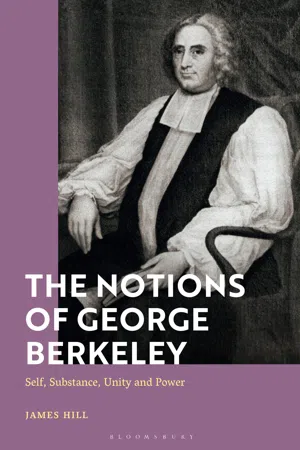
George Berkeley's doctrine of notions is often disparaged or dismissed. In a systematic interpretation and positive reconstruction of the doctrine, James Hill presents Berkeley's understanding of the inner sphere and self-awareness, and reassesses the widely held view of Berkeley as an empiricist.
Examining the development of Berkeley's philosophy from the early notebooks to the late Siris, Hill sets out how knowledge by notion involves a radical rejection of the perceptual model of self-cognition and of the attempt to frame our knowledge of the inner by analogy with the outer. He points to Berkeley's divergence from the assumption among rationalists and empiricists that we know our selves and our mental acts by idea, or by an immediate presentation before the mind.
Weaving together Berkeley's conception of the intellect, conceptual thought, mathematics, ethics and theology in the light of the doctrine of notions, Hill invites us to treat Berkeley's philosophy of mind as distinct from the empiricist tradition. This cutting edge reflection on the doctrine of notions is essential reading for students and scholars specialising in Berkeley as well as early modern accounts of the self, perception and God.
- 184 pages
- English
- ePUB (mobile friendly)
- Available on iOS & Android
eBook - ePub
About this book
Trusted by 375,005 students
Access to over 1.5 million titles for a fair monthly price.
Study more efficiently using our study tools.
Information
1 Introduction
One might divide George Berkeley’s philosophical work into two fundamental projects. The first is that of persuading his readers of the soundness of his ‘immaterial hypothesis’1 – the negative claim that material substance does not exist. Immaterialism exercises Berkeley’s considerable argumentative skills as he provides many different reasons for treating matter as not only an unnecessary or empty category, but – more strongly – as suffering from internal contradiction. This project includes his denial of abstract ideas, his views on linguistic meaning and his delimitation of the representative power of ideas, all of which are primarily motivated by the denial of matter. It also includes his defence of immaterialism on the principles of ‘common sense’. It is this strand in Berkeley’s thinking that takes pride of place in his Principles and the Three Dialogues, and it is the part of his work that made him famous – or infamous – among his contemporaries, and which receives most attention in the literature today.
Alongside the polemical attack on matter and materialism, however, is a second, positive project. Berkeley seeks to establish a defensible metaphysical picture of the world in the absence of matter. Central to this positive endeavour is a conception of the nature of the mind, along with conceptions of the fundamental ontological categories of substance, unity and causation. This positive project also includes answers to the questions of how the mind becomes aware of itself and its acts, and of how it gains knowledge of other minds including the divine active principle that, in Berkeley’s view, directs and sustains the phenomenal world. It is in addressing these epistemological questions that Berkeley develops his doctrine of ‘notions’ which is the subject of this monograph.
The doctrine of notions explains how mind with its different operations – its substance-hood, unity and its causality – are known to us. Berkeley’s use of the term ‘notion’ indicates his dissatisfaction with the widespread tendency in the ‘New Philosophy’ of his day to characterize knowledge of the inner sphere as mediated by ‘ideas’. Berkeley introduced the term ‘notion’ in the narrow sense that distinguishes it from ‘idea’, in his 1734 editions of the Principles and the Three Dialogues. However, this relatively late terminological innovation did not mark a doctrinal change. Berkeley had, in his earlier writings, already rejected the view that it is by the representative power of ideas that we have knowledge of the inner sphere. Indeed, such a rejection is visible as early as his Notebooks, and the first edition of the Principles of 1710 was crystal clear on this point. While nominally introduced in 1734, then, the doctrine of notions is in fact a part of his system from the first period of his philosophy.2
We shall examine, in Chapter 2, how some of the most influential thinkers on Berkeley’s early philosophy – Hobbes, Malebranche and Locke – had denied that immediate knowledge of mind, or spiritual substance, was attainable at all, and, in Chapter 3, we shall see how Berkeley, with his doctrine of notions, sought to vindicate immediate knowledge of the active, spiritual, self. We shall examine how exactly self-knowledge is achievable, in Berkeley’s view, and why he insists on our rejecting the easy, and seemingly natural, locution that we have an ‘idea of the mind’. Knowledge of the mind, Berkeley argues, is not to be treated as in any parallel way to the perceptual knowledge of objects, and thus cannot be captured by the contemplation of an idea or representation, particularly not one perceived by an ‘inner sense’ when construed on analogy with the outer senses.
Berkeley’s account of our knowledge of the mind will be examined in Chapters 3 and 4, and we will see that it also becomes the pathway to a proper grasp of the primary ontological categories of substance and causality. These categories, he holds, must be understood through the direct knowledge we have of our own active mind and its acts – the species of knowledge that he refers to as ‘notions.
Furthermore, our own essentially active nature allows us, on Berkeley’s view, to understand the divine mind which takes the place of inert material substance as the source of our perceptions, as discussed in Chapter 8. It is also reflected in his positive account of conceptual thought, discussed in Chapter 6, according to which concepts are treated as things we do rather than things we perceive, and therefore necessarily draw on notions as well as ideas.
Of course, the negative and positive projects that we have outlined are not fully independent of one another but are rather mutually supportive in Berkeley’s philosophy. A proper recognition of the nature of mind or spirit allows Berkeley’s opposition to the existence of matter to become a serious and natural proposition. One reason why Berkeley rejects any role for an inert material substance is because he finds that causal power can be fully understood in terms of mental acts. The mind is the causal foundation of the world of things that we perceive. Such a view, one should note, had already been anticipated in the Scholastic and Cartesian doctrine that the world lacks the power to continue in existence without the active support of God. As Berkeley himself stresses, the world in his idealism is no more inert and lacking in self-sustaining power than the material world described by Descartes in which matter is dependent on continuous divine conservation.3
Our task of making sense of Berkeley’s doctrine of notions, and his philosophy of mind in general, will only be successful if we recognize an important obstacle that stands in its way. There is an entrenched reading which treats Berkeley as belonging to one side of the empiricist–rationalist divide. I believe it is the widespread perception that Berkeley is an empiricist that has often thwarted attempts to make proper sense of his conception of mind and of self-knowledge, and indeed of the whole of the second project outlined above. The empiricist reading will be examined in detail below, particularly in Chapters 4, 5 and 8, but let me now make an initial sketch of its fundamental features.
The empiricist paradigm
The interpretation of Berkeley’s philosophical work that has been dominant since the middle of the nineteenth century treats Berkeley as the second great British empiricist and as the philosopher who stands between, and connects, the work of Locke and Hume. I shall call this interpretation the ‘empiricist paradigm’.
I find it useful to treat the empiricist reading as a paradigm because it has a holistic structure of theses and assumptions that makes it almost impervious to piecemeal criticism. To question this interpretation, it is never enough to point to anomalies – recalcitrant statements or passages – because the empiricist reading is able to neutralize their impact by telling us they are elliptical or ‘tactical’ or, in certain cases, by downplaying the importance of the text in which they appear.
I also call the empiricist reading a paradigm because I want to stress its historical character. It arose in a particular period, and since then it has been supported by the institutional practice of philosophy – particularly by how Berkeley is taught and how he is categorized by journals and libraries. But I shall not attempt to describe this historical and sociological dimension of the empiricist interpretation – I trust the reader will be already familiar with it, and that its presence need not be detailed or demonstrated.
Let me confine myself to a few brief comments about the history of this interpretational paradigm. It was first established by the Hegelian school, then maintained and refined by British empiricist thinkers of the twentieth century, and today it remains the default framework for understanding Berkeley. We find expression of the paradigm, in embryonic form, in the ‘Lectures on the History of Philosophy’ that were delivered by Hegel in Jena and published after his death.4 Hegel’s conviction that Berkeley ‘proceeds from the standpoint of Locke’ is then taken up by Kuno Fischer, Wilhelm Windelband and other German historians of philosophy of the latter part of the nineteenth century.5 In England, it was made popular by the T. H. Green, a follower of Hegel, in his ‘Introduction’ to Hume’s Philosophical Works.6 It was espoused with particular verve and wit by Bertrand Russell,7 and it is also a fundamental part of the popular interpretations of A. J. Ayer and J. O. Urmson.8 But its influence and expression goes far beyond the handful of thinkers I have just named. The empiricist reading remains the established view today, often providing the implicit framework for interpretations of Berkeley in scholarly work. It makes four large claims.
Firstly, and most importantly, Berkeley is treated as a concept empiricist. He is thus seen as part of a tradition of empiricism in which John Locke is the most significant forerunner. Berkeley ‘proceeds directly from’ the standpoint of Locke, Hegel declares.9 While Berkeley may have disagreed with Locke on important issues, relating particularly to ontology, it is still thought that he was working within the same epistemological framework, and that his thought was thus in principle opposed to the Cartesian rationalist tradition.
Concept empiricism can be encapsulated in the scholastic maxim: nihil est in intellectu quod non prius fuerit in sensu. In accordance with this, it rejects the possibility of innate content in the mind and excludes any appeal to a faculty, such as the ‘pure intellect’, with access to content underived from sense experience. This interpretation thus treats Berkeley as siding, in so far as epistemology is concerned, with Gassendi, Hobbes and Locke, and against Descartes, Spinoza, Malebranche and Leibniz.
The second claim of the empiricist interpretation of Berkeley is that his famous critique and rejection of material substance leads, almost inevitably, to David Hume’s rejection of spiritual substance. This claim has been advanced in a stronger form, such that Berkeley had already, covertly, endorsed the Humean move.10 But usually the claim is more circumspect. Berkeley’s rejection of material substance, along with his maintenance of spiritual substance, is held to be a philosophically precarious position – a leaning tower that soon falls when Hume brings pressure to bear on it. Interpreters thus treat Hume’s famous view of the mind in his Treatise, according to which it is nothing more than a ‘bundle of perceptions’, as the natural extension of Berkeley’s critique of material substance. T. H. Green wrote that
in his zeal against matter [Berkeley] took away the ground from under the spiritualism which he sought to maintain. He simply invited a successor in speculation, of colder blood than himself, to try the solution of spirit in the same crucible with matter.11
Or, as A. J. Ayer puts it:
Berkeley had eliminated matter, at least as the physicists conceived it, but left minds intact. Hume, an avowed sceptic, showed that this favouritism was unjustified.12
Of course, this second claim about the relation between the philosophy of Berkeley and Hume is not exclusive to proponents of the empiricist paradigm. Thomas Reid, in the late eighteenth century, had seen Berkeley and Hume as philosophical brothers-in-arms, with Hume extending a sceptical attack that had been started by Be...
Table of contents
- Cover
- Half-title Page
- Dedication Page
- Series Page
- Title Page
- Epigraph
- Contents
- Acknowledgements
- List of Abbreviations
- 1 Introduction
- 2 Berkeley’s predecessors on self-knowledge
- 3 A notion of an active self
- 4 Notions and innatism
- 5 Sense perception: A passive or an active power?
- 6 Berkeley’s conceptual dynamism
- 7 A notion of goodness
- 8 Number and the notion of God
- Appendix
- Notes
- Bibliography
- Index
- Copyright Page
Frequently asked questions
Yes, you can cancel anytime from the Subscription tab in your account settings on the Perlego website. Your subscription will stay active until the end of your current billing period. Learn how to cancel your subscription
No, books cannot be downloaded as external files, such as PDFs, for use outside of Perlego. However, you can download books within the Perlego app for offline reading on mobile or tablet. Learn how to download books offline
Perlego offers two plans: Essential and Complete
- Essential is ideal for learners and professionals who enjoy exploring a wide range of subjects. Access the Essential Library with 800,000+ trusted titles and best-sellers across business, personal growth, and the humanities. Includes unlimited reading time and Standard Read Aloud voice.
- Complete: Perfect for advanced learners and researchers needing full, unrestricted access. Unlock 1.5M+ books across hundreds of subjects, including academic and specialized titles. The Complete Plan also includes advanced features like Premium Read Aloud and Research Assistant.
We are an online textbook subscription service, where you can get access to an entire online library for less than the price of a single book per month. With over 1.5 million books across 990+ topics, we’ve got you covered! Learn about our mission
Look out for the read-aloud symbol on your next book to see if you can listen to it. The read-aloud tool reads text aloud for you, highlighting the text as it is being read. You can pause it, speed it up and slow it down. Learn more about Read Aloud
Yes! You can use the Perlego app on both iOS and Android devices to read anytime, anywhere — even offline. Perfect for commutes or when you’re on the go.
Please note we cannot support devices running on iOS 13 and Android 7 or earlier. Learn more about using the app
Please note we cannot support devices running on iOS 13 and Android 7 or earlier. Learn more about using the app
Yes, you can access The Notions of George Berkeley by James Hill in PDF and/or ePUB format, as well as other popular books in Philosophy & Ethics & Moral Philosophy. We have over 1.5 million books available in our catalogue for you to explore.