eBook - PDF
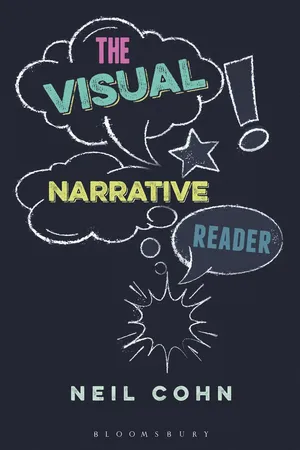
The Visual Narrative Reader
About this book
Sequential images are as natural at conveying narratives as verbal language, and have appeared throughout human history, from cave paintings and tapestries right through to modern comics. Contemporary research on this visual language of sequential images has been scattered across several fields: linguistics, psychology, anthropology, art education, comics studies, and others. Only recently has this disparate research begun to be incorporated into a coherent understanding.
In The Visual Narrative Reader, Neil Cohn collects chapters that cross these disciplinary divides from many of the foremost international researchers who explore fundamental questions about visual narratives.
How does the style of images impact their understanding?
How are metaphors and complex meanings conveyed by images?
How is meaning understood across sequential images?
How do children produce and comprehend sequential images?
Are visual narratives beneficial for education and literacy?
Do visual narrative systems differ across cultures and historical time periods?
This book provides a foundation of research for readers to engage in these fundamental questions and explore the most vital thinking about visual narrative. It collects important papers and introduces review chapters summarizing the literature on specific approaches to understanding visual narratives. The result is a comprehensive "reader" that can be used as a coursebook, a researcher resource and a broad overview of fascinating topics suitable for anyone interested in the growing field of the visual language of comics and visual narratives.
In The Visual Narrative Reader, Neil Cohn collects chapters that cross these disciplinary divides from many of the foremost international researchers who explore fundamental questions about visual narratives.
How does the style of images impact their understanding?
How are metaphors and complex meanings conveyed by images?
How is meaning understood across sequential images?
How do children produce and comprehend sequential images?
Are visual narratives beneficial for education and literacy?
Do visual narrative systems differ across cultures and historical time periods?
This book provides a foundation of research for readers to engage in these fundamental questions and explore the most vital thinking about visual narrative. It collects important papers and introduces review chapters summarizing the literature on specific approaches to understanding visual narratives. The result is a comprehensive "reader" that can be used as a coursebook, a researcher resource and a broad overview of fascinating topics suitable for anyone interested in the growing field of the visual language of comics and visual narratives.
Tools to learn more effectively

Saving Books

Keyword Search

Annotating Text

Listen to it instead
Information

Interdisciplinary
Approaches
to
Visual
Narrative
15
Saraceni,
M.
(2001).
Relatedness:
aspects
of
textual
connectivity
in
comics.
In:
J.
Baetens
(ed.),
e
Graphic
Novel
(pp.
167–179).
Leuven,
Belgium:
Leuven
University
Press.
Saraceni,
M.
(2003).
e
Language
of
Comics
.
New
York:
Routledge.
Saussure,
F.
de
(1916).
Course
in
general
linguistics.
Translated
by
Roy
Harris.
Chicago,
IL:
Open
Court
Classics,
1972.
Stainbrook,
E.
J.
(2003).
Reading
Comics
:
A
eoretical
Analysis
of
Textuality
and
Discourse
in
the
Comics
Medium.
Doctoral
dissertation,
Indiana
University
of
Pennsylvania,
Indiana,
PA.
Töpffer,
R.
(1845).
Enter:
e
Comics.
Rodolphe
Töpffer’s
Essay
on
Physiognomy
and
the
True
Story
of
Monsieur
Crépin
.
Translated
by
E.
Wiese.
Lincoln,
NE:
University
of
Nebraska
Press,
1965.
Wilson,
B.
(1974).
e
superheroes
of
J.
C.
Holz:
plus
an
outline
of
a
theory
of
child
art.
Art
Education
,
27(8):
2–9.
Wilson,
B.
(1988).
e
artistic
tower
of
Babel:
inextricable
links
between
culture
and
graphic
development.
In:
G.
W.
Hardiman
and
T.
Zernich
(eds),
Discerning
Art
:
Concepts
and
Issues
(pp.
488–506).
Champaign,
IL:
Stipes
Publishing.
Wilson,
B.,
and
Wilson,
M.
(1977).
An
iconoclastic
view
of
the
imagery
sources
in
the
drawings
of
young
people.
Art
Education
,
30(1):
4–12.

16
Table of contents
- Cover page
- Praise page
- Halftitle page
- Dedication page
- Title page
- Copyright page
- Contents
- List of Illustrations
- Notes on the Contributors
- Preface
- 1 Interdisciplinary Approaches to Visual Narrative
- Part I Theoretical Approaches to Sequential Images
- Part II Psychology and Development of Visual Narrative
- Part III Visual Narratives across Cultures
- Further Reading
- Index
Frequently asked questions
Yes, you can cancel anytime from the Subscription tab in your account settings on the Perlego website. Your subscription will stay active until the end of your current billing period. Learn how to cancel your subscription
No, books cannot be downloaded as external files, such as PDFs, for use outside of Perlego. However, you can download books within the Perlego app for offline reading on mobile or tablet. Learn how to download books offline
Perlego offers two plans: Essential and Complete
- Essential is ideal for learners and professionals who enjoy exploring a wide range of subjects. Access the Essential Library with 800,000+ trusted titles and best-sellers across business, personal growth, and the humanities. Includes unlimited reading time and Standard Read Aloud voice.
- Complete: Perfect for advanced learners and researchers needing full, unrestricted access. Unlock 1.4M+ books across hundreds of subjects, including academic and specialized titles. The Complete Plan also includes advanced features like Premium Read Aloud and Research Assistant.
We are an online textbook subscription service, where you can get access to an entire online library for less than the price of a single book per month. With over 1 million books across 990+ topics, we’ve got you covered! Learn about our mission
Look out for the read-aloud symbol on your next book to see if you can listen to it. The read-aloud tool reads text aloud for you, highlighting the text as it is being read. You can pause it, speed it up and slow it down. Learn more about Read Aloud
Yes! You can use the Perlego app on both iOS and Android devices to read anytime, anywhere — even offline. Perfect for commutes or when you’re on the go.
Please note we cannot support devices running on iOS 13 and Android 7 or earlier. Learn more about using the app
Please note we cannot support devices running on iOS 13 and Android 7 or earlier. Learn more about using the app
Yes, you can access The Visual Narrative Reader by Neil Cohn in PDF and/or ePUB format, as well as other popular books in Languages & Linguistics & Linguistics. We have over one million books available in our catalogue for you to explore.