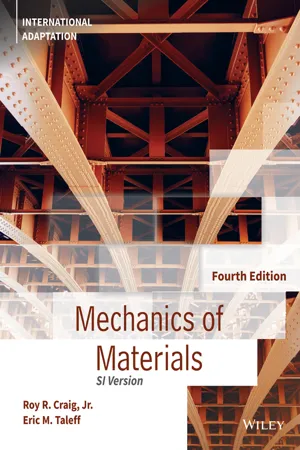
Mechanics of Materials providesan in-depth yet accessible introduction to the behavior of solid materials under various stresses and strains. Emphasizing the three key concepts of deformable-body mechanics—equilibrium, material behavior, and geometry of deformation—this popular textbook covers the fundamental concepts of the subject while helping students strengthen their problem-solving skills. Throughout the text, students are taught to apply an effective four-step methodology to solve numerous example problems and understand the underlying principles of each application. Focusing primarily on the behavior of solids under static-loading conditions, the text thoroughly prepares students for subsequent courses in solids and structures involving more complex engineering analyses and Computer-Aided Engineering (CAE). The text provides ample, fully solved practice problems, real-world engineering examples, the equations that correspond to each concept, chapter summaries, procedure lists, illustrations, flow charts, diagrams, and more. This International adaptation has been thoroughly updated to use SI units. In addition to the new and updated materials, this updated edition includes new Python computer code examples, problems, and homework assignments that require only basic programming knowledge.
- 864 pages
- English
- ePUB (mobile friendly)
- Available on iOS & Android
Mechanics of Materials
About this book
Trusted by 375,005 students
Access to over 1 million titles for a fair monthly price.
Study more efficiently using our study tools.
Key takeaways
Apply the fundamental principles of equilibrium, material behavior, and geometry of deformation to analyze the behavior of solid materials under various static-loading conditions. This includes utilizing a systematic problem-solving methodology to determine stresses and strains.
Analyze and calculate normal and shear stresses, strains, and deformations in members subjected to axial loads, torsion, and bending. This involves constructing shear-force and bending-moment diagrams and applying appropriate constitutive laws.
Perform stress and strain transformations, analyze combined loading scenarios, and evaluate the stability of columns against buckling. This also includes applying energy methods and considering design factors such as stress concentrations and failure theories, potentially using computational tools.
Information
Table of contents
- Cover Page
- Title Page
- Copyright Page
- Preface
- Acknowledgments
- About the Author
- 1 Introduction
- 2 Stress and Strain
- 3 Axial Deformation
- 4 Torsion
- 5 Transformation of Stress and Strain
- 6 Equilibrium of Beams
- 7 Stresses in Beams
- 8 Deflection of Beams
- 9 Pressure Vessels; Stresses Due to Combined Loading
- 10 Buckling of Columns
- 11 Energy Methods
- 12 Special Topics Related to Design
- A Numerical Accuracy; Approximations
- B Systems of units
- C Geometric Properties of Plane Areas
- D Section Properties of Selected Structural Shapes
- E Deflections and Slopes of Beams; Fixed-End Actions
- F Mechanical Properties of Selected Engineering Materials
- G Mechanical Properties of Composite Materials
- References
- Index
- EULA
Frequently asked questions
- Essential is ideal for learners and professionals who enjoy exploring a wide range of subjects. Access the Essential Library with 800,000+ trusted titles and best-sellers across business, personal growth, and the humanities. Includes unlimited reading time and Standard Read Aloud voice.
- Complete: Perfect for advanced learners and researchers needing full, unrestricted access. Unlock 1.4M+ books across hundreds of subjects, including academic and specialized titles. The Complete Plan also includes advanced features like Premium Read Aloud and Research Assistant.
Please note we cannot support devices running on iOS 13 and Android 7 or earlier. Learn more about using the app