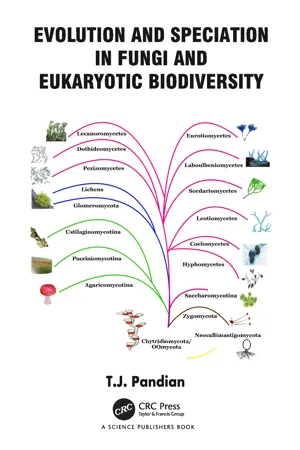
Being sessiles like autotrophic plants and heterotrophics as animals, fungi are fascinating eukaryotes. In them, the need for external digestion has demanded surface expansion and limited tissues to < eight types. To reproduce, 96% fungi engage spores. Being 800 times denser than air, water renders the spore dispersal costlier. Their externally excreted digestive enzymes may rapidly be dissolved in water. These have limited 96% fungi to land. As 90% fungi are clonals, and only 1,400 species are erected/y (year), their number may not exceed 260,000 species over the next 100 y. Mating types arising from homothallic basidium and their risky external fertilization in air have limited diversity to 23,975 species in Basidiomycota. Contrastingly, heterothallism and safer internal fertilization have accelerated it to 77,083 species in Ascomycotina. About 46, 40 and 14% fungi are decomposers, parasites and symbionts. Fungal ability to decompose in dry soil is 10 times greater than that of bacteria. Volume of dead plants decomposed by fungi is ~ 38 g carbon/m2/y. The mycorrhizas facilitate 85% angiosperms to acquire water and minerals, enhance productivity and fight against drought and pollutants. During the geological past, lichens have weathered rock and formed the present landscape. Only 121 fungal species excrete digestive enzymes to meet industrial demand. The beneficial fungi contribute 1,000 billion US$. Parasitic fungi cause 1.6 million human deaths and > 20% loss of commercial crops. Despite their ecological and economic importance, no university offers a degree course in Mycology. For 2,056,907 eukaryotic species, this book elaborates the role played by environmental factors (i) spatial distribution, (ii) light-temperature, (iii) precipitation-liquid water and biological attributes, (iv) cellularity, (v) symmetry, (vi) clonality, (vii) sexuality, (viii) modality and (ix) motility that either accelerate or decelerate biodiversity. About 20 and 80% eukaryotes are aquatics and terrestrials. Decreasing light intensity and temperature reduce diversity from the equator toward the polar zones. Water availability also reduces the diversity from 5.4 - 65.5 species/km2 in tropical evergreen forests to < 0.0045 species/km2 in deserts and polar zones. Unicellularity and radial symmetry decelerate the diversity to < 2 and < 26%, respectively. Increase in tissue types from < nine in lower eukaryotes to > 200 in mammals reduces clonality from 100 to 0%. Strategies developed by eukaryotes reduce selfing by < 24% in plants and < 1% in metazoans.
- 292 pages
- English
- ePUB (mobile friendly)
- Available on iOS & Android
eBook - ePub
Evolution and Speciation in Fungi and Eukaryotic Biodiversity
About this book
Trusted by 375,005 students
Access to over 1.5 million titles for a fair monthly price.
Study more efficiently using our study tools.
Information
Table of contents
- Cover Page
- Title Page
- Copyright Page
- Preface
- Acknowledgements
- Contents
- Preamble
- 1 General Introduction
- 2 Spatial Distribution
- 3 Fungi: Modes of Life
- 4 Acquisition of Micronutrients
- 5 Mycology: Teaching – Degrees
- 6 Clonal Multiplication
- 7 Sex – Mating Type – Sexuality
- 8 Gametangia – Gametogenesis
- 9 Sporogenesis – Quantity – Dispersal
- 10 Sex Determination – Pheromones
- 11 Lichens
- 12 Past: Fungal Evolution
- 13 Present: Desiccation and Dormancy
- 14 Future: Climate Change
- 15 Eukaryotes: Species Diversity
- 16 References
- Author Index
- Species Index
- Subject Index
- Epilogue
- Author’s Biography
Frequently asked questions
Yes, you can cancel anytime from the Subscription tab in your account settings on the Perlego website. Your subscription will stay active until the end of your current billing period. Learn how to cancel your subscription
No, books cannot be downloaded as external files, such as PDFs, for use outside of Perlego. However, you can download books within the Perlego app for offline reading on mobile or tablet. Learn how to download books offline
Perlego offers two plans: Essential and Complete
- Essential is ideal for learners and professionals who enjoy exploring a wide range of subjects. Access the Essential Library with 800,000+ trusted titles and best-sellers across business, personal growth, and the humanities. Includes unlimited reading time and Standard Read Aloud voice.
- Complete: Perfect for advanced learners and researchers needing full, unrestricted access. Unlock 1.5M+ books across hundreds of subjects, including academic and specialized titles. The Complete Plan also includes advanced features like Premium Read Aloud and Research Assistant.
We are an online textbook subscription service, where you can get access to an entire online library for less than the price of a single book per month. With over 1.5 million books across 990+ topics, we’ve got you covered! Learn about our mission
Look out for the read-aloud symbol on your next book to see if you can listen to it. The read-aloud tool reads text aloud for you, highlighting the text as it is being read. You can pause it, speed it up and slow it down. Learn more about Read Aloud
Yes! You can use the Perlego app on both iOS and Android devices to read anytime, anywhere — even offline. Perfect for commutes or when you’re on the go.
Please note we cannot support devices running on iOS 13 and Android 7 or earlier. Learn more about using the app
Please note we cannot support devices running on iOS 13 and Android 7 or earlier. Learn more about using the app
Yes, you can access Evolution and Speciation in Fungi and Eukaryotic Biodiversity by T. J. Pandian in PDF and/or ePUB format, as well as other popular books in Biological Sciences & Biology. We have over 1.5 million books available in our catalogue for you to explore.