- English
- PDF
- Available on iOS & Android
Early Events in Monocot Evolution
About this book
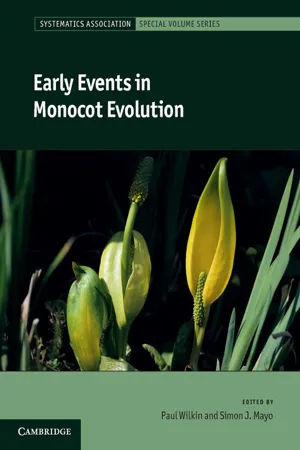
Tracing the evolution of one of the most ancient major branches of flowering plants, this is a wide-ranging survey of state-of-the-art research on the early clades of the monocot phylogenetic tree. It explores a series of broad but linked themes, providing for the first time a detailed and coherent view of the taxa of the early monocot lineages, how they diversified and their importance in monocots as a whole. Featuring contributions from leaders in the field, the chapters trace the evolution of the monocots from largely aquatic ancestors. Topics covered include the rapidly advancing field of monocot fossils, aquatic adaptations in pollen and anther structure and pollination strategies and floral developmental morphology. The book also presents a new plastid sequence analysis of early monocots and a review of monocot phylogeny as a whole, placing in an evolutionary context a plant group of major ecological, economic and horticultural importance.
Tools to learn more effectively

Saving Books

Keyword Search

Annotating Text

Listen to it instead
Information
Table of contents
- Contents
- Contributors
- Preface
- 1 A well-supported phylogenetic framework for the monocot order Alismatales reveals multiple losses of the plastid NADH dehydrogenase complex and a strong long-branch effect
- 2 The fossil record of noncommelinid monocots
- 3 Is syncarpy an ancestral condition in monocots and core eudicots?
- 4 Diversification of pollen and tapetum in early-divergent monocots
- 5 Macroecological correlates of global monocot species richness
- 6 In time and with water . . . the systematics of alismatid monocotyledons
- 7 Evolution of floral traits in relation to pollination mechanisms in Hydrocharitaceae
- 8 Patterns of bract reduction in racemose inflorescences of early-divergent monocots
- 9 Recent progress in the phylogenetics and classification of Araceae
- 10 The first evolutionary classification of Araceae: A. Engler's Natural System
- 11 Aroid floral morphogenesis in relation to phylogeny
- 12 Some observations on the homology of the daffodil corona
- 13 Anther, ovule and embryological characters in Velloziaceae in relation to the systematics of Pandanales
- 14 Contrasting patterns of support among plastid genes and genomes for major clades of the monocotyledons
- Taxonomic index
- Subject index
- Systematics Association Publications
- Systematics Association Special Volumes
- 1 A well-supported phylogenetic framework for the monocot order Alismatales reveals multiple losses of the plastid NADH dehydrogenase complex and a strong long-branch effect
- 2 The fossil record of noncommelinid monocots
- 3 Is syncarpy an ancestral condition in monocots and core eudicots?
- 4 Diversification of pollen and tapetum in early-divergent monocots
- 5 Macroecological correlates of global monocot species richness
- 6 In time and with water … the systematics of alismatid monocotyledons
- 7 Evolution of floral traits in relation to pollination mechanisms in Hydrocharitaceae
- 8 Patterns of bract reduction in racemose inflorescences of early-divergent monocots
- 9 Recent progress in the phylogenetics and classification of Araceae
- 10 The first evolutionary classification of Araceae: A. Engler's Natural System
- 11 Aroid floral morphogenesis in relation to phylogeny
- 12 Some observations on the homology of the daffodil corona
- 13 Anther, ovule and embryological characters in Velloziaceae in relation to the systematics of Pandanales
- 14 Contrasting patterns of support among plastid genes and genomes for major clades of the monocotyledons
Frequently asked questions
- Essential is ideal for learners and professionals who enjoy exploring a wide range of subjects. Access the Essential Library with 800,000+ trusted titles and best-sellers across business, personal growth, and the humanities. Includes unlimited reading time and Standard Read Aloud voice.
- Complete: Perfect for advanced learners and researchers needing full, unrestricted access. Unlock 1.4M+ books across hundreds of subjects, including academic and specialized titles. The Complete Plan also includes advanced features like Premium Read Aloud and Research Assistant.
Please note we cannot support devices running on iOS 13 and Android 7 or earlier. Learn more about using the app