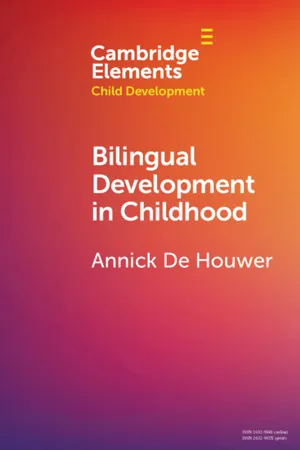
Bilingual Development in Childhood
About this book
In the first decade of life, children become bilingual in different language learning environments. Many children start learning two languages from birth (Bilingual First Language Acquisition). In early childhood hitherto monolingual children start hearing a second language through daycare or preschool (Early Second Language Acquisition). Yet other hitherto monolingual children in middle childhood may acquire a second language only after entering school (Second Language Acquisition). This Element explains how these different language learning settings dynamically affect bilingual children's language learning trajectories. All children eventually learn to speak the societal language, but they often do not learn to fluently speak their non-societal language and may even stop speaking it. Children's and families' harmonious bilingualism is threatened if bilingual children do not develop high proficiency in both languages. Educational institutions and parental conversational practices play a pivotal role in supporting harmonious bilingual development.
Tools to learn more effectively

Saving Books

Keyword Search

Annotating Text

Listen to it instead
Information
Table of contents
- Cover
- Title page
- Copyright page
- Bilingual Development in Childhood
- References
Frequently asked questions
- Essential is ideal for learners and professionals who enjoy exploring a wide range of subjects. Access the Essential Library with 800,000+ trusted titles and best-sellers across business, personal growth, and the humanities. Includes unlimited reading time and Standard Read Aloud voice.
- Complete: Perfect for advanced learners and researchers needing full, unrestricted access. Unlock 1.4M+ books across hundreds of subjects, including academic and specialized titles. The Complete Plan also includes advanced features like Premium Read Aloud and Research Assistant.
Please note we cannot support devices running on iOS 13 and Android 7 or earlier. Learn more about using the app