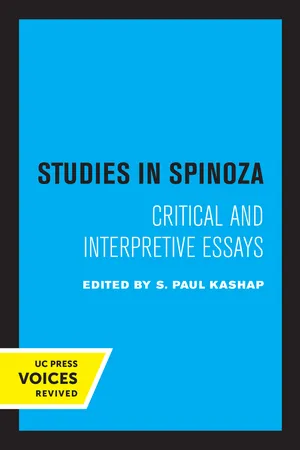
Studies in Spinoza: Critical and Interpretive Essays, edited by S. Paul Kashap, gathers leading Anglophone scholarship to illuminate why Spinoza's "impenetrable abstractions" continue to shape debates in metaphysics, mind, action, and ethics. Framed by the conviction—echoing Santayana—that Spinoza's stature only grows with time, the volume offers clear, contemporary vocabulary and argumentation to guide readers through the Ethics and its afterlives. The contributors balance rigorous exposition with pointed critique, making the collection equally valuable for specialists and advanced students seeking lucid entry points into persistent controversies. With most essays written after 1937 (and Kashap's own previously unpublished contribution), the book updates a classic canon while respecting its historical texture. Spanning substance, attributes, universals, time, knowledge, language, and freedom, the essays range from T. M. Forsyth's reconsideration of self-causation and immanent causality to A. Wolf's foundational analysis of attributes, F. S. Haserot's twin studies on attribute and universals, and Samuel Alexander's seminal "Spinoza and Time." Ruth L. Saw challenges assumptions about individuality and cognition; Henry Barker, H. F. Hallett, and G. H. R. Parkinson probe idea/ideatum, mind–body parallelism, and truth; David Savan and Guttorm Floistad reopen questions of language, imagination, and intuition; while Raphael Demos, A. E. Taylor, and Stuart Hampshire test the bounds of moral judgment and freedom. The result is a self-contained suite of interpretive and critical engagements that model how to read Spinoza philosophically: historically grounded, analytically precise, and alert to the live stakes of his system—from the coherence of universals to the possibility of purposive action and the "intellectual love of God." This title is part of UC Press's Voices Revived program, which commemorates University of California Press's mission to seek out and cultivate the brightest minds and give them voice, reach, and impact. Drawing on a backlist dating to 1893, Voices Revived makes high-quality, peer-reviewed scholarship accessible once again using print-on-demand technology. This title was originally published in 1972.
Many titles in the Voices Revived program are also newly available as ebooks, offered at a discounted price to support wider access to scholarly work.
- 376 pages
- English
- ePUB (mobile friendly)
- Available on iOS & Android
eBook - ePub
About this book
Trusted by 375,005 students
Access to over 1.5 million titles for a fair monthly price.
Study more efficiently using our study tools.
Information
Table of contents
- Cover
- Title
- Copyright
- Contents
- Introduction
- Notes on the Contributors
- Spinoza’s Doctrine of God in Relation to His Conception of Causality T.M. Forsyth
- Spinoza’s Conception of the Attributes of Substance115 A. Wolf
- Spinoza’s Definition of A ttribute Francis S. Haserot
- Spinoza and the Status of Universals132 Francis S. Haserot
- Spinoza and Time S. Alexander
- Personal Identity in Spinoza Ruth L. Saw
- Notes on the Second Part of Spinoza’s Ethics (I) H. Barker
- Notes on the Second Part of Spinoza’s Ethics (II) H. Barker
- Notes on the Second Part of Spinoza’s Ethics (III) H. Barker
- On a Reputed Equivoque in the Philosophy of Spinoza H. F. Hallett
- Some Incoherencies in Sp inoism (I) A. E. Taylor
- Truth and Falsity in Sp inoza********************************************************************* G. H. R. Parkinson
- Spinoza and Language355 David Savan
- Spinoza’s Theory of Knowledge Applied to the Ethics Guttorm Fløistad
- Spinoza’s Doctrine of Priv ation Raphael Demos
- Some Incoherencies in Spin ozism (II) A. E. Taylor
- Spinoza and the Idea of Freedom Stuart Hampshire
- Thought and Action in Sp inoza S. Paul Kashap
- Select Bibliography
Frequently asked questions
Yes, you can cancel anytime from the Subscription tab in your account settings on the Perlego website. Your subscription will stay active until the end of your current billing period. Learn how to cancel your subscription
No, books cannot be downloaded as external files, such as PDFs, for use outside of Perlego. However, you can download books within the Perlego app for offline reading on mobile or tablet. Learn how to download books offline
Perlego offers two plans: Essential and Complete
- Essential is ideal for learners and professionals who enjoy exploring a wide range of subjects. Access the Essential Library with 800,000+ trusted titles and best-sellers across business, personal growth, and the humanities. Includes unlimited reading time and Standard Read Aloud voice.
- Complete: Perfect for advanced learners and researchers needing full, unrestricted access. Unlock 1.5M+ books across hundreds of subjects, including academic and specialized titles. The Complete Plan also includes advanced features like Premium Read Aloud and Research Assistant.
We are an online textbook subscription service, where you can get access to an entire online library for less than the price of a single book per month. With over 1.5 million books across 990+ topics, we’ve got you covered! Learn about our mission
Look out for the read-aloud symbol on your next book to see if you can listen to it. The read-aloud tool reads text aloud for you, highlighting the text as it is being read. You can pause it, speed it up and slow it down. Learn more about Read Aloud
Yes! You can use the Perlego app on both iOS and Android devices to read anytime, anywhere — even offline. Perfect for commutes or when you’re on the go.
Please note we cannot support devices running on iOS 13 and Android 7 or earlier. Learn more about using the app
Please note we cannot support devices running on iOS 13 and Android 7 or earlier. Learn more about using the app
Yes, you can access Studies in Spinoza by S. Paul Kashap in PDF and/or ePUB format, as well as other popular books in Philosophy & Political Philosophy. We have over 1.5 million books available in our catalogue for you to explore.