Artists have worked from home for many reasons, including care duties, financial or political constraints, or availability and proximity to others.
From the 'home studios' of Charles and Ray Eames, to the different photographic representations of Robert Rauschenberg's studio, this book explores the home as a distinct site of artistic practice, and the traditions and developments of the home studio as concept and space throughout the 20th and into the 21st century.
Using examples from across Europe and the Anglophone world between the mid-20th century and the present, each chapter considers the different circumstances for working at home, the impact on the creative lives of the artists, their identities as artists and on the work itself, and how, sometimes, these were projected and promoted through photographs and the media. Key themes include the gendered and performative aspects of women practising 'at home', collaborative studio communities of the 1970s – 90s including the appropriation of abandoned spaces in East London, and the effects of Covid on artistic practices and family life within the spaces of 'home'. The book comprises full-length chapters by artists, architects, art and design historians, each of whom bring different perspectives to the issues, interwoven with short interviews with artists to enrich and broaden the debates.
At a time when individual relationships to home environments have been radically altered, The Artist at Home considers why some artists in previous decades either needed to or chose to work from home, producing work of vitality and integrity. Tracing this long tradition into the present, the book will provide a deeper understanding of how the home studio has affected the practices and identity of artists working in different countries, and in different circumstances, from the mid-20th century to the present.
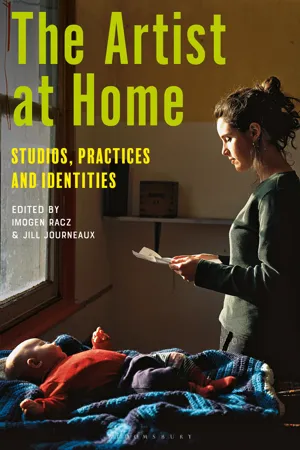
eBook - ePub
The Artist at Home
Studios, Practices and Identities
- 272 pages
- English
- ePUB (mobile friendly)
- Available on iOS & Android
eBook - ePub
The Artist at Home
Studios, Practices and Identities
About this book
Trusted by 375,005 students
Access to over 1.5 million titles for a fair monthly price.
Study more efficiently using our study tools.
Information
Table of contents
- Cover
- Half-Title Page
- Title Page
- Contents
- List of illustrations
- Notes on contributors
- Acknowledgements
- Introduction: the artist at home, Jill Journeaux and Imogen Racz
- Part One The studio at home: designing and projecting the creative life
- 1 Blurring boundaries between life and work: the home studios, homes and design/film/multi-media workshop of Charles and Ray Eames, 1941 to 1978
- 2 Liz Harrison interview with Imogen Racz
- 3 An atomization of the home: towards a compound dwelling interior
- 4 Paula Chambers interview with Imogen Racz
- 5 Zahrah Al Ghamdi interview with Imogen Racz
- 6 Robert Rauschenberg’s studio through the lenses of two photographers
- 7 Graham Chorlton interview with Jill Journeaux
- Part Two Women, home, studio
- 8 Working from home: Portuguese women artists during Estado Novo
- 9 Gerda Roper interview with Jill Journeaux
- 10 Making memory material: clutter and the home-studios of Margaret Olley and Mirka Mora
- 11 Carole Griffiths interview with Jill Journeaux
- Part Three Live–work communities from the 1970s to the 1990s
- 12 Abandoned and appropriated homes: the live–work spaces of artists in East London
- 13 Mikey Cuddihy reflections
- 14 Housewatch: cinematic architecture for the pedestrian
- 15 George Saxon interview with Jill Journeaux
- Part Four Rethinking relationships with home
- 16 Sailing to My Nearest Neighbours for Lockdown Cocktails: reflections on the politics of home and homemaking during a pandemic
- 17 Fran Cottell interview with Imogen Racz
- 18 Artists at home and away: mobile bodies, distance and proximity
- 19 Angie Pierre-Louis and Sarah Black-Frizell interview with Imogen Racz
- 20 Studio. Object. Home: place setting
- 21 Sreejata Roy interview with Jill Journeaux
- 22 Anastasia Starikova interview with Jill Journeaux
- Index
- Copyright
Frequently asked questions
Yes, you can cancel anytime from the Subscription tab in your account settings on the Perlego website. Your subscription will stay active until the end of your current billing period. Learn how to cancel your subscription
No, books cannot be downloaded as external files, such as PDFs, for use outside of Perlego. However, you can download books within the Perlego app for offline reading on mobile or tablet. Learn how to download books offline
We are an online textbook subscription service, where you can get access to an entire online library for less than the price of a single book per month. With over 1.5 million books across 990+ topics, we’ve got you covered! Learn about our mission
Look out for the read-aloud symbol on your next book to see if you can listen to it. The read-aloud tool reads text aloud for you, highlighting the text as it is being read. You can pause it, speed it up and slow it down. Learn more about Read Aloud
Yes! You can use the Perlego app on both iOS and Android devices to read anytime, anywhere — even offline. Perfect for commutes or when you’re on the go.
Please note we cannot support devices running on iOS 13 and Android 7 or earlier. Learn more about using the app
Please note we cannot support devices running on iOS 13 and Android 7 or earlier. Learn more about using the app
Yes, you can access The Artist at Home by Imogen Racz, Jill Journeaux, Imogen Racz,Jill Journeaux in PDF and/or ePUB format, as well as other popular books in Art & History of Architecture. We have over 1.5 million books available in our catalogue for you to explore.