This practical guide speaks to two audiences: those who read and those who conduct research. Clinicians are medical detectives by training. For each patient, they assemble clinical clues to establish causes of signs and symptoms. The task involves both clinical acumen and knowledge of medical research. This book helps guide clinicians through this detective work, by enabling them to make sense of research and to review medical literature critically. It will also be invaluable to researchers who conduct clinical research, particularly randomized controlled trials.Building on previously published, peer-reviewed articles from The Lancet, this handbook is essential for busy clinicians and active researchers interested in research methods.- Written by leaders in the field of clinical research who have published extensively with authorship of hundreds of articles in medical journals.- The authorship includes one of the three authors of the CONSORT guidelines for the reporting of randomized controlled trials.- The book presents the essential concepts to a wide array of topics including randomized control trials, descriptive studies, cohort studies, case-control studies, bias, and screening tests.- The book utilises a readable and humorous prose style, lightening what can be a difficult area for clinical readers.- Derived from decades of teaching clinical research in seminar settings the book will empower clinicians to make sense of, and critically appraise, current medical research and will enable researchers to enrich the quality of their work. For this Second Edition, the authors have revised and updated the original 16 chapters and added six new chapters. For busy clinicians and active researchers interested in research methods, this book provides helpful tools to derive satisfaction - indeed, fun - from clinical science.
eBook - ePub
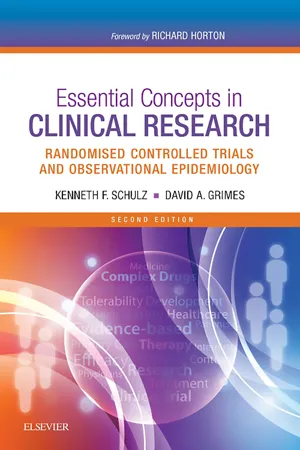
Essential Concepts in Clinical Research
Randomised Controlled Trials and Observational Epidemiology
- 272 pages
- English
- ePUB (mobile friendly)
- Available on iOS & Android
eBook - ePub
Essential Concepts in Clinical Research
Randomised Controlled Trials and Observational Epidemiology
About this book
Trusted by 375,005 students
Access to over 1.5 million titles for a fair monthly price.
Study more efficiently using our study tools.
Information
Topic
MedicineSubtopic
EpidemiologyTable of contents
- Cover image
- Title page
- Table of Contents
- Copyright
- Foreword
- Preface
- Chapter 1: An Overview of Clinical Research: The Lay of the Land
- Chapter 2: Descriptive Studies: What They Can and Cannot Do
- Chapter 3: Bias and Causal Associations in Observational Research
- Chapter 4: Cohort Studies: Marching Towards Outcomes
- Chapter 5: Case-Control Studies: Research in Reverse
- Chapter 6: Compared to What? Finding Controls for Case-Control Studies
- Chapter 7: The Limitations of Observational Epidemiology
- Chapter 8: Uses and Abuses of Screening Tests
- Chapter 9: Refining Clinical Diagnosis With Likelihood Ratios
- Chapter 10: Boosting Recruitment to Randomised Controlled Trials
- Chapter 11: Sample Size Calculations in Randomised Trials: Mandatory and Mystical
- Chapter 12: Generation of Allocation Sequences in Randomised Trials: Chance, Not Choice
- Chapter 13: Generation of Allocation Sequences in Non–Double-Blinded Randomised Trials: Guarding Against Guessing
- Chapter 14: Allocation Concealment in Randomised Trials: Defending Against Deciphering
- Chapter 15: Exclusions and Losses in Randomised Trials: Retention of Trial Participants
- Chapter 16: Blinding in Randomised Trials: Hiding Who Got What
- Chapter 17: Implementation of Treatment Blinding in Randomised Trials
- Chapter 18: Surrogate Endpoints and Composite Outcomes: Shortcuts to Unknown Destinations
- Chapter 19: Multiplicity in Randomised Trials I: Endpoints and Treatments
- Chapter 20: Multiplicity in Randomised Trials II: Subgroup and Interim Analyses
- Chapter 21: Conducting a Randomised Trial as Part of a Prospective Meta-Analysis
- Chapter 22: Reporting Studies in Medical Journals: CONSORT and Other Reporting Guidelines
- Index
Frequently asked questions
Yes, you can cancel anytime from the Subscription tab in your account settings on the Perlego website. Your subscription will stay active until the end of your current billing period. Learn how to cancel your subscription
No, books cannot be downloaded as external files, such as PDFs, for use outside of Perlego. However, you can download books within the Perlego app for offline reading on mobile or tablet. Learn how to download books offline
We are an online textbook subscription service, where you can get access to an entire online library for less than the price of a single book per month. With over 1.5 million books across 990+ topics, we’ve got you covered! Learn about our mission
Look out for the read-aloud symbol on your next book to see if you can listen to it. The read-aloud tool reads text aloud for you, highlighting the text as it is being read. You can pause it, speed it up and slow it down. Learn more about Read Aloud
Yes! You can use the Perlego app on both iOS and Android devices to read anytime, anywhere — even offline. Perfect for commutes or when you’re on the go.
Please note we cannot support devices running on iOS 13 and Android 7 or earlier. Learn more about using the app
Please note we cannot support devices running on iOS 13 and Android 7 or earlier. Learn more about using the app
Yes, you can access Essential Concepts in Clinical Research by Kenneth Schulz,David A. Grimes in PDF and/or ePUB format, as well as other popular books in Medicine & Epidemiology. We have over 1.5 million books available in our catalogue for you to explore.