- 352 pages
- English
- PDF
- Available on iOS & Android
About this book
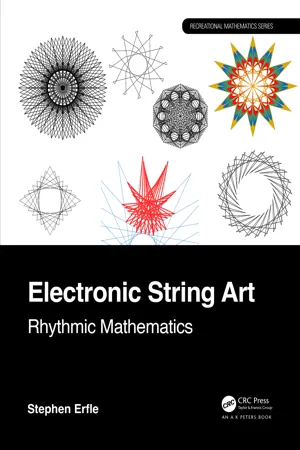
String art is a well-known and popular activity that uses string, a board, and nails to produce artistic images (although there are variations that use different modalities). This activity is beloved because simple counting rules are used to create beautiful images that can both adorn walls and excite young minds. The downside of this highly tactile activity is that it is quite time-consuming and rigid. By contrast, electronic string art offers much more flexibility to set up or change nail locations and counting rules, and the images created from those changes change instantaneously.
Electronic String Art: Rhythmic Mathematics invites readers to use the author's digital resources available on the ESA website to play with the parameters inherent in string art models while offering concise, accessible explanations of the underlying mathematical principles regarding how the images were created and how they change. Readers will have the opportunity to create visually beautiful works of art while learning concepts from geometry, number theory, and modular arithmetic from approximately 200 short-interdependent sections.
Features
- Readers are able to drill-down on images in order to understand why they work using short (1 to 2 page) stand-alone sections
-
- Sections are lessons that were created so that they could be digested in a single sitting
- These sections are stand-alone in the sense that they need not be read sequentially but can be referred to based on images that the reader finds interesting
- An open-ended, inherently flexible teaching resource for elementary, middle, and high school-level mathematics
-
- The most mathematically challenging sections (or portions of a section) are designated MA and may not be accessible to elementary and middle school readers
- Will be appreciated by anyone interested in recreational mathematics or mathematical artworks even if the users are not interested in the underlying mathematics
- Includes exercises, solutions, and many online digital resources
- These QR codes take you to these digital resources. One takes you directly to the web version of the string art model (used as a starting point for teaching the parameters of the model in Section 25.5). The other takes you to the ESA web page with additional links to a variety of resources.
Tools to learn more effectively

Saving Books

Keyword Search

Annotating Text

Listen to it instead
Information
Table of contents
- Cover
- Half Title
- Series Page
- Title Page
- Copyright Page
- Contents
- Preface
- Acknowledgments
- About the Author
- An Introduction to Part I: Preliminary Issues
- An Introduction to Part II: String Art
- An Introduction to Part III: Variations on the String Art Model
- An Introduction to Part IV: Issues, Mathematical and Otherwise
- Bibliography
Frequently asked questions
- Essential is ideal for learners and professionals who enjoy exploring a wide range of subjects. Access the Essential Library with 800,000+ trusted titles and best-sellers across business, personal growth, and the humanities. Includes unlimited reading time and Standard Read Aloud voice.
- Complete: Perfect for advanced learners and researchers needing full, unrestricted access. Unlock 1.4M+ books across hundreds of subjects, including academic and specialized titles. The Complete Plan also includes advanced features like Premium Read Aloud and Research Assistant.
Please note we cannot support devices running on iOS 13 and Android 7 or earlier. Learn more about using the app