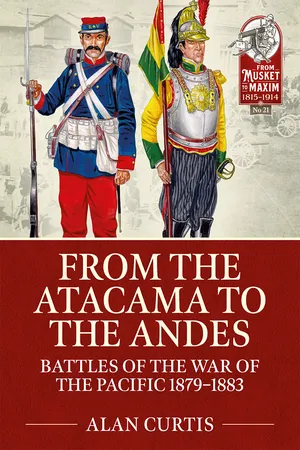
With the break up of the Spanish empire in South America, the continent split into nine independent states with often ill-defined boundaries. One of these was that between Bolivia and Chile, which were separated by the Atacama Desert, tone of the driest regions in the world. When it was realized that the area contained nitrates that the world needed for explosives and fertilizer the scene was set for the inevitable clash. When war broke out in February 1879, both sides found themselves unprepared for war. Rapid armament followed as the Peruvians were dragged into the conflict in support of their Bolivian allies. Initially there was a tiresome naval war of blockade and guerre de course. Two naval actions decided the naval campaign in favor of the Chileans who then proceeded to use their naval power to attack the Allies' isolated armies and capture Lima two years after war had broken out. Fighting then developed into a cruel and ruthless guerrilla war in the Andes, sometimes even pitting Peruvian against Peruvian, before the Peruvians finally concede defeat. The war was notable in the West for fights involving ironclads, particularly the Battle of Angamos, which saw the only time ironclads were pitted against each other between the Battle of Lissa and the Battle of the Yalu River. The war helped formulate Captain Mahan's thoughts in "The Influence of Sea Power upon History". The land war was more or less ignored abroad, although it included some of the biggest battles ever fought on the continent, using all the latest technology, including breech loading rifles and cannons and machine guns. The armies on both sides initially lacked experience and training as well as modern equipment. The Bolivian Army started the war with 806 officers and only 1369 other ranks! In the end the Chileans won because of their more stable government, better financial situation and their control of the sea, due to their two superior ironclads. From the Atacama to the Andes tells the brutal struggle between two sides to control the wealth of the Atacama and for retention of Bolivia's coast. The result was that Chile gained the mineral resources of the "New North" and Bolivia became the second landlocked country on the continent, paving the way for the even more catastrophic Chaco War 50 years later.
- 236 pages
- English
- ePUB (mobile friendly)
- Available on iOS & Android
eBook - ePub
About this book
Trusted by 375,005 students
Access to over 1.5 million titles for a fair monthly price.
Study more efficiently using our study tools.
Information
Subtopic
19th Century HistoryIndex
HistoryTable of contents
- Cover
- Title
- Copyright
- Contents
- List of Illustrations, Plates and Maps
- Introduction
- Prologue
- 1. The Road to War
- 2. The Contending Forces
- 3. The Battle of Calama
- 4. The Battle of Iquique
- 5. The Battle of Angamos
- 6. The Pisagua Landing
- 7. The Battle of San Francisco
- 8. The Battle of Tarapaca
- 9. The Battle of Los Angeles
- 10. The Battle of Tacna
- 11. The Assault on the Morro of Arica
- 12. The Blockade of Callao
- 13. The Battle of Chorrillos
- 14. The Battle of Miraflores
- 15. The First Battle of Pucara
- 16. The Actions at Acuchimay, Concepcion, Marcavalle and 2nd Pucara
- 17. The Battle of San Pablo
- 18. The Battle of Huamachuco
- 19. The Fall of Arequipa
- 20. The End
- 21. Organisation of the Armies
- 22. Artillery
- 23. Uniforms
- 24. Major Warships
- Appendix I: Chilean Forces at Pisagua
- Appendix II: Chilean Forces in Tarapaca
- Appendix III: Allied Forces in Tarapaca
- Appendix IV: Peruvian Forces at the Battle of Tarapaca
- Appendix V: Chilean Casualties at Tarapaca
- Appendix VI: Peruvian Casualties at Tarapaca
- Appendix VII: Chilean Divisions January 1880
- Appendix VIII: Forces at the Battle of Los Angeles
- Appendix IX: Second Army of the South (1880)
- Appendix X: Allied Forces at the Battle of Tacna
- Appendix XI: Chilean Forces at the Battle of Tacna
- Appendix XII: Chilean Losses at the Battle of Tacna
- Appendix XIII: Forces at the Storming of the Morro Arica
- Appendix XIV: Armies of the North and Centre
- Appendix XV: Chilean Forces Landed at Pisco
- Appendix XVI: Chilean Casualties at the Battle of Chorrillos
- Appendix XVII: Chilean Casualties at the Battle of Miraflores
- Appendix XVIII: Official Chilean Casualty Returns
- Appendix XIX: Forces for the First La Brena Campaign
- Appendix XX: Chilean Deployment in the Mantaro Valley May 1882
- Appendix XXI: Combined Armies of the North and Centre July 1883 (Peru)
- Appendix XXII: The Peruvian Army of Arequipa 1883
- Appendix XXIII: Armies of the Final Campaign 1883
- Appendix XXIV: Armies of the Final Campaign: The Bolivian Army 1883
- Colour Plate Commentaries
- Bibliography
- Plates
Frequently asked questions
Yes, you can cancel anytime from the Subscription tab in your account settings on the Perlego website. Your subscription will stay active until the end of your current billing period. Learn how to cancel your subscription
No, books cannot be downloaded as external files, such as PDFs, for use outside of Perlego. However, you can download books within the Perlego app for offline reading on mobile or tablet. Learn how to download books offline
Perlego offers two plans: Essential and Complete
- Essential is ideal for learners and professionals who enjoy exploring a wide range of subjects. Access the Essential Library with 800,000+ trusted titles and best-sellers across business, personal growth, and the humanities. Includes unlimited reading time and Standard Read Aloud voice.
- Complete: Perfect for advanced learners and researchers needing full, unrestricted access. Unlock 1.5M+ books across hundreds of subjects, including academic and specialized titles. The Complete Plan also includes advanced features like Premium Read Aloud and Research Assistant.
We are an online textbook subscription service, where you can get access to an entire online library for less than the price of a single book per month. With over 1.5 million books across 990+ topics, we’ve got you covered! Learn about our mission
Look out for the read-aloud symbol on your next book to see if you can listen to it. The read-aloud tool reads text aloud for you, highlighting the text as it is being read. You can pause it, speed it up and slow it down. Learn more about Read Aloud
Yes! You can use the Perlego app on both iOS and Android devices to read anytime, anywhere — even offline. Perfect for commutes or when you’re on the go.
Please note we cannot support devices running on iOS 13 and Android 7 or earlier. Learn more about using the app
Please note we cannot support devices running on iOS 13 and Android 7 or earlier. Learn more about using the app
Yes, you can access From the Atacama to the Andes by Alan Curtis in PDF and/or ePUB format, as well as other popular books in History & 19th Century History. We have over 1.5 million books available in our catalogue for you to explore.