Python Data Structures and Algorithms
eBook - ePub

Python Data Structures and Algorithms

  1. 310 pages
  2. English
  3. ePUB (mobile friendly)
  4. Available on iOS & Android
eBook - ePub

Python Data Structures and Algorithms

About this book

Implement classic and functional data structures and algorithms using PythonAbout This Book• A step by step guide, which will provide you with a thorough discussion on the analysis and design of fundamental Python data structures.• Get a better understanding of advanced Python concepts such as big-o notation, dynamic programming, and functional data structures.• Explore illustrations to present data structures and algorithms, as well as their analysis, in a clear, visual manner.Who This Book Is ForThe book will appeal to Python developers. A basic knowledge of Python is expected.What You Will Learn• Gain a solid understanding of Python data structures.• Build sophisticated data applications.• Understand the common programming patterns and algorithms used in Python data science.• Write efficient robust code.In DetailData structures allow you to organize data in a particular way efficiently. They are critical to any problem, provide a complete solution, and act like reusable code. In this book, you will learn the essential Python data structures and the most common algorithms. With this easy-to-read book, you will be able to understand the power of linked lists, double linked lists, and circular linked lists. You will be able to create complex data structures such as graphs, stacks and queues. We will explore the application of binary searches and binary search trees. You will learn the common techniques and structures used in tasks such as preprocessing, modeling, and transforming data. We will also discuss how to organize your code in a manageable, consistent, and extendable way. The book will explore in detail sorting algorithms such as bubble sort, selection sort, insertion sort, and merge sort. By the end of the book, you will learn how to build components that are easy to understand, debug, and use in different applications.Style and approachThe easy-to-read book with its fast-paced nature will improve the productivity of Python programmers and improve the performance of Python applications.

Tools to learn more effectively

Saving Books

Saving Books

Keyword Search

Keyword Search

Annotating Text

Annotating Text

Listen to it instead

Listen to it instead

Information

Python Data Types and Structures

In this chapter, we are going to examine the Python data types in detail. We have already been introduced to two data types, the string, str(), and list(). It is often the case where we want more specialized objects to represent our data. In addition to the built-in types, there are several internal modules that allow us to address common issues when working with data structures. First, we are going to review some operations and expressions that are common to all data types.

Operations and expressions

There are a number of operations that are common to all data types. For example, all data types, and generally all objects, can be tested for a truth value in some way. The following are values that Python considers False:
  • The None type
  • False
  • An integer, float, or complex zero
  • An empty sequence or mapping
  • An instance of a user-defined class that defines a __len__() or __bool__() method that returns zero or False
All other values are considered True.

Boolean operations

A Boolean operation returns a value of eighter True or False. Boolean operations are ordered in priority, so if more than one Boolean operation occurs in an expression, the operation with the highest priority will occur first. The following table outlines the three Boolean operators in descending order of priority:
Operator
Example
not x
Returns True if x is False; returns False otherwise.
x and y
Returns True if both x and y are True; returns False otherwise.
x or y
Returns True if either x or y is True; returns False otherwise.
Both the and operator and the or operator use "short-circuiting" when evaluating an expression. This means Python will only evaluate an operator if it needs to. For example, if x is True then in an expression x or y, the y does not get evaluated since the expression is obviously True. In a similar way, in an expression x and y where x is False, the interpreter will simply evaluate x and return False, without evaluating y.

Comparison and Arithmetic operators

The standard arithmetic operators (+, -, *, /) work with all Python numeric types. The // operator gives an integer quotient, (for example, 3 // 2 returns 1), the exponent operator is x ** y, and the modulus operator, given by a % b, returns the remainder of the division a/b. The comparison operators (<, <=, >, >=, ==, and !=) work with numbers, strings, lists, and other collection objects and return True if the condition holds. For collection objects, these operators compare the number of elements and the equivalence operator == b returns True if each collection object is structurally equivalent, and the value of each element is identical.

Membership, identity, and logical operations
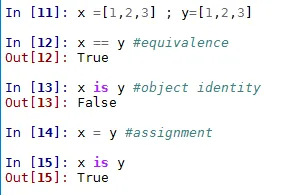
Membership operators (in, not in) test for variables in sequences, such as lists or strings do what you would expect, x in y returns True if a variable x is found in y. The is operator compares object identity. For example, the following snippet shows contrast equivalence with object identity:

Built-in data types

Python data types can be divided into three categories: numeric, sequence, and mapping. There is also the None object that represents a Null, or absence of a value. It should not be forgotten either that other objects such as classes, files, and exceptions can also properly be considered types; however, they will not be considered here.
Every value in Python has a data type. Unlike many programming languages, in Python you do not need to explicitly declare the type of a variable. Python keeps track of object types internally.
Python built-in data types are outlined in the following table:
Categ...

Table of contents

  1. Title Page
  2. Copyright
  3. Credits
  4. About the Author
  5. About the Reviewer
  6. www.PacktPub.com
  7. Customer Feedback
  8. Preface
  9. Python Objects, Types, and Expressions
  10. Python Data Types and Structures
  11. Principles of Algorithm Design
  12. Lists and Pointer Structures
  13. Stacks and Queues
  14. Trees
  15. Hashing and Symbol Tables
  16. Graphs and Other Algorithms
  17. Searching
  18. Sorting
  19. Selection Algorithms
  20. Design Techniques and Strategies
  21. Implementations, Applications, and Tools

Frequently asked questions

Yes, you can cancel anytime from the Subscription tab in your account settings on the Perlego website. Your subscription will stay active until the end of your current billing period. Learn how to cancel your subscription
No, books cannot be downloaded as external files, such as PDFs, for use outside of Perlego. However, you can download books within the Perlego app for offline reading on mobile or tablet. Learn how to download books offline
Perlego offers two plans: Essential and Complete
  • Essential is ideal for learners and professionals who enjoy exploring a wide range of subjects. Access the Essential Library with 800,000+ trusted titles and best-sellers across business, personal growth, and the humanities. Includes unlimited reading time and Standard Read Aloud voice.
  • Complete: Perfect for advanced learners and researchers needing full, unrestricted access. Unlock 1.4M+ books across hundreds of subjects, including academic and specialized titles. The Complete Plan also includes advanced features like Premium Read Aloud and Research Assistant.
Both plans are available with monthly, semester, or annual billing cycles.
We are an online textbook subscription service, where you can get access to an entire online library for less than the price of a single book per month. With over 1 million books across 990+ topics, we’ve got you covered! Learn about our mission
Look out for the read-aloud symbol on your next book to see if you can listen to it. The read-aloud tool reads text aloud for you, highlighting the text as it is being read. You can pause it, speed it up and slow it down. Learn more about Read Aloud
Yes! You can use the Perlego app on both iOS and Android devices to read anytime, anywhere — even offline. Perfect for commutes or when you’re on the go.
Please note we cannot support devices running on iOS 13 and Android 7 or earlier. Learn more about using the app
Yes, you can access Python Data Structures and Algorithms by Benjamin Baka in PDF and/or ePUB format, as well as other popular books in Computer Science & Programming Algorithms. We have over one million books available in our catalogue for you to explore.