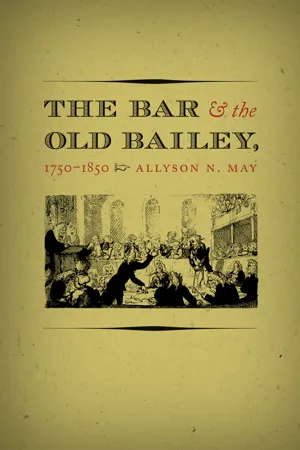
Allyson May chronicles the history of the English criminal trial and the development of a criminal bar in London between 1750 and 1850. She charts the transformation of the legal process and the evolution of professional standards of conduct for the criminal bar through an examination of the working lives of the Old Bailey barristers of the period. In describing the rise of adversarialism, May uncovers the motivations and interests of prosecutors, defendants, the bench, and the state, as well as the often-maligned “Old Bailey hacks” themselves.
Traditionally, the English criminal trial consisted of a relatively unstructured altercation between the victim-prosecutor and the accused, who generally appeared without a lawyer. A criminal bar had emerged in London by the 1780s, and in 1836 the Prisoners' Counsel Act recognized the defendant’s right to legal counsel in felony trials and lifted many restrictions on the activities of defense lawyers. May explores the role of barristers before and after the Prisoners' Counsel Act. She also details the careers of individual members of the bar — describing their civil practice in local, customary courts as well as their criminal practice — and the promotion of Old Bailey counsel to the bench of that court. A comprehensive biographical appendix augments this discussion.
- 376 pages
- English
- ePUB (mobile friendly)
- Available on iOS & Android
eBook - ePub
The Bar and the Old Bailey, 1750-1850
About this book
Trusted by 375,005 students
Access to over 1.5 million titles for a fair monthly price.
Study more efficiently using our study tools.
Information
CHAPTER ONE
London, Crime, and Criminal Justice
The Eighteenth-Century Metropolis
In 1750 England’s great metropolis comprised both the City of London, a medieval creation whose origins can be traced back to a Roman city established on the north bank of the Thames in the second century A.D.,1 and Westminster, which lies two miles west on the river. By the eighteenth century the City had become both a mercantile stronghold and the financial center of England, while Westminster, originally the site of an eighth-century Benedictine abbey, was the center of both the royal court and Parliament. London and Westminster retained separate identities for the purposes of municipal government, but the physical distance which divided them had long since been built up, the Strand running into Fleet Street, so that “geographically they had become one.”2 Buildings had likewise grown up on land whose administration, including the administration of criminal justice, lay with the county of Middlesex.
Eighteenth-century London would appear small to the modern observer: in 1750 the area to the north of Bloomsbury Square was still undeveloped; to the west Chelsea and Fulham were the sites of market gardens; to the east the former village of Whitechapel had become part of London, but Stepney had not yet been swallowed up. South of the Thames there was less development still: the bulk of metropolitan London lay on the river’s north shore. At the south end of London Bridge—until Westminster Bridge opened in November 1750 the city’s sole bridge—lay the borough of Southwark, east of which some commercial ribbon development was taking place. Very little building was to be found opposite Westminster in the mid-eighteenth century. Nevertheless, metropolitan London had become the largest city in Europe, and for contemporaries it was a place of rapid expansion and change.3 The construction of the “New Road” (now the Marylebone, Euston, and Pentonville Roads) in 1756–57 stimulated development in the north, while Westminster Bridge and a third bridge, Blackfriars, completed in 1769, allowed further development south of the river. The second half of the eighteenth century witnessed continued growth. By the 1760s the villages of Hammersmith, Chelsea, Paddington, Marylebone, and St. Pancras were being steadily drawn into the metropolis, and by the 1790s some early development had begun in Camden Town. Even the older parts of London looked new. Four-fifths of the City had been destroyed in the Great Fire of London (1666); in the process of rebuilding, the City within the walls retained its narrow, twisting lanes, but the gabled, half-timbered houses and lattice windows of the medieval and Elizabethan period were replaced by sash-windowed brick.4 Wren’s domed cathedral had arisen on the site of the medieval St. Paul’s, while to the west the palaces which had once lined the Strand were gone and in their place stood glass-fronted shops.
The growth of “opulent, enlarg’d, and still increasing” London5 in the first half of the eighteenth century owed as much, if not more, to increasing wealth as it did to population. The population of metropolitan London in 1700 has been estimated at 575,000; by 1750 it was 675,000, and by the end of the century it had reached 900,000. This growth in numbers owed primarily to immigration rather than natural increase: a contemporary estimated in 1757 that two-thirds of London’s adult population had been born elsewhere.6 London’s potent “brew of government, trade and industry”7 attracted immigrants from within and without England and from every social class. Thomas Gisborne wrote of its attraction for the “upper and middle ranks of society”: “Business, interest, curiosity, the love of pleasure, the desire for knowledge, the thirst for change, ambition to be deemed polite, occasion a continual influx into the metropolis from every corner of the Kingdom.”8 The center of conspicuous consumption, London attracted those whose social aspirations went beyond a mere ambition to be deemed polite, those who aspired to live in the “bon ton.”9 It also drew thousands of young Englishmen and women of the laboring classes in search of work. Irish immigrants likewise arrived in search of employment, while continental migrants included Huguenots fleeing persecution in France at the end of the seventeenth century and, from the 1750s, Polish and German Jews similarly in search of a safe haven.10
The majority of Londoners lived outside the City proper. In 1750 the intramural population was roughly 87,000, but London’s inhabitants had long since overflowed the walls built by the Romans, rebuilt in the medieval period, and now a memory—although the six gates which had once controlled access were not torn down until 1760, a few years after the last decayed houses and shops on London Bridge were demolished. Migrants in search of work gravitated toward adjoining districts, and many of those entitled to the City’s freedom were choosing to live farther afield. Affluent merchants had begun to move west in the reign of Charles II, and this process was accelerated by the rebuilding which took place after the fire. In the eighteenth century the West End became the more fashionable residential area, attracting not only London’s commercial wealth and the politicians (who naturally sought proximity to the seat of government) but aristocrats as well. England’s landed elite spent their winters in town, and the aristocracy had begun to migrate west from their former haunts—Covent Garden, Leicester Fields, Soho Square—in the early part of the century, to concentrate in the parishes of St. James’s and St. George’s and north of Piccadilly.11 The polarization between the East End and the West was well established by midcentury: polite society quitted the courts, lanes, and alleys typical of sixteenth, seventeenth, and early eighteenth-century London for the elegant new squares being built in the West End.
The bar, the upper branch of England’s legal profession, and the judiciary lagged behind in the westward migration of the well-to-do. Throughout the eighteenth century both bench and bar tended to remain near their professional institutions, the Inns of Court—the Inner and Middle Temple, Lincoln’s Inn, and Gray’s Inn—which lay just within and immediately without the City’s borders.12 Traditionally a barrister’s chambers had provided both living accommodation and legal office, and into the nineteenth century young, unmarried barristers lived in as well as worked from their Inn. Once married they sought larger quarters—chambers typically consisted of no more than three or four small rooms—but remained in the same area. Addresses in Chancery Lane and Lincoln’s Inn Fields were common; Bedford Row, just west of Gray’s Inn, was thickly populated with legal counsel by the 1780s;13 and the new suburb of Bloomsbury, designed to meet the needs of the professional classes, likewise proved popular. Where the bar is concerned, westward migration dates from the second half of the nineteenth century.14
Although the Inns of Court provided a young man with a “genteel” address, they also offered close proximity to less respectable neighborhoods.15 This diversity was typical of central London. Samuel Johnson, who famously claimed that a man who was tired of London was tired of life, commented that the intellectual man could not help but be struck with the metropolis “as comprehending the whole of human life in all its variety.”16 The “full tide of human existence” was to be found at Charing Cross.17 This full tide encompassed not only those aspiring to the good life but also legions of the poor, divided by Daniel Defoe earlier in the century into two classes: the merely poor, those who “fare hard,” and “the miserable, that really pinch and suffer want,”18 those who in the nineteenth century would be classified as the “residuum.” Against Cowper’s portrait of “opulent” London must be placed that of William Blake: “I wander thro’ each charter’d street, / Near where the charter’d Thames does flow/And mark in every face I meet, / Marks of weakness, marks of woe.”19
As Dorothy George described, London’s poor lived primarily in insalubrious and dangerous areas, notably in the interstices at the borders of municipal authority, such as the maze of lanes and alleys surrounding Chick Lane and Field Lane, or Turnmill Street and Cow Cross, where authority was divided among parishes of the City of London and the county of Middlesex.20 The older parts of the metropolis—“the courts off Holborn and Gray’s Inn Lane, the rookeries of St. Giles and some dreadful places off Great Queen Street and Long Acre”—had generally become dangerous areas in which to live, as were many of the courts and lanes off Fleet Street and the Strand, those surrounding Haymarket, St. James’s Market, and Covent Garden, and the older parts of Westminster. To the east of the City, “East Smithfield, Houndsditch, parts of Shoreditch and Whitechapel, Rosemary Lane (Rag Fair), Petticoat Lane, Ratcliffe Highway were dangerous neighbourhoods,” as was Southwark, south of the river.21 In fact, much of central London was riddled with neighborhoods of bad character, in which the honest poor and the criminal were forced to rub shoulders.
While the poverty-stricken were often blamed for their own distress, the nature of employment in the capital was frequently the root cause. Writing about London’s poor in 1753, the Methodist preacher John Wesley commented indignantly that he had found in the city’s cellars and garrets “not one of them unemployed who was able to crawl about the room. So wickedly, devilishly false is that common objection, they are poor only because they are idle.”22 Irregular and uncertain employment was the lot of many of London’s migrants: “The dominating impression of life in eighteenth-century London, from the standpoint of the individual,” wrote George, “is one of uncertainty and insecurity.”23 The metropolis might offer a reasonably secure living to those engaged in neither trade nor manufacture—a group which included lawyers—but those whose living depended on tradeable services inhabited a completely different world.24 Much of their work depended heavily on the social season, which affected not only providers of domestic and local services but those employed in the textile and clothing industries and, higher up the social scale, those involved in the luxury trades serving the West End: jewelers, furniture makers (Chippendale opened workshops in Long Acre around 1745), and coachmakers, among many others.25 Work on the river likewise depended on seasonal flows of trade. Many of London’s inhabitants thus routinely experienced long periods of unemployment. In 1750 1,000 of 2,400 houses in Spitalfields, a suburb to the east of the City inhabited largely by silk weavers, were not required to pay the poor rates levied on well-to-do householders, as they were occupied by “journeymen weavers and other artificers and labourers” unable to support themselves or their families without resort to credit.26 The situation worsened in the succeeding decades as downswings in trade led to further unemployment and riots in the streets.
Credit was not available to everyone in times of dearth. Magistrate Saunders Welch estimated that some twenty persons a week died indirectly of starvation in London, and the London Magazine reported with horror in 1763 that a prospective purchaser being shown over an “empty” house found in one of its rooms the semi-naked corpses of three emaciated women: whatever meager clothing they had possessed had apparently been stolen. Three other women were sheltering in the same house, two of them on the verge of the same fate.27 Poor relief in the metropolis was organized at the parish level, responsibility shared among the parishes of the City of London, the City of Westminster, and a further fifty or so metropolitan parishes, and the system was stretched to its limits. Technically, to be eligible for relief the petitioner had to prove that he or she belonged to a particular parish. Some of the metropolitan parishes bent the rules and...
Table of contents
- Cover Page
- Halftitle Page
- Title Page
- Copyright Page
- Dedication
- Contents
- Acknowledgments
- Introduction
- 1. London, Crime, and Criminal Justice
- 2. The Emergence of a Criminal Bar in London
- 3. Constructing a Career
- 4. The Criminal Trial before the Prisoners’ Counsel Act
- 5. Public Reaction and Professional Concerns
- 6. The Bar, the Bench, and the Central Criminal Court
- 7. Changing the Rules: The Prisoners’ Counsel Act
- 8. Justifying Advocacy
- Conclusion
- Appendix: Counsel at the Old Bailey, 1783–1850
- Notes
- Bibliography
- Index
Frequently asked questions
Yes, you can cancel anytime from the Subscription tab in your account settings on the Perlego website. Your subscription will stay active until the end of your current billing period. Learn how to cancel your subscription
No, books cannot be downloaded as external files, such as PDFs, for use outside of Perlego. However, you can download books within the Perlego app for offline reading on mobile or tablet. Learn how to download books offline
Perlego offers two plans: Essential and Complete
- Essential is ideal for learners and professionals who enjoy exploring a wide range of subjects. Access the Essential Library with 800,000+ trusted titles and best-sellers across business, personal growth, and the humanities. Includes unlimited reading time and Standard Read Aloud voice.
- Complete: Perfect for advanced learners and researchers needing full, unrestricted access. Unlock 1.5M+ books across hundreds of subjects, including academic and specialized titles. The Complete Plan also includes advanced features like Premium Read Aloud and Research Assistant.
We are an online textbook subscription service, where you can get access to an entire online library for less than the price of a single book per month. With over 1.5 million books across 990+ topics, we’ve got you covered! Learn about our mission
Look out for the read-aloud symbol on your next book to see if you can listen to it. The read-aloud tool reads text aloud for you, highlighting the text as it is being read. You can pause it, speed it up and slow it down. Learn more about Read Aloud
Yes! You can use the Perlego app on both iOS and Android devices to read anytime, anywhere — even offline. Perfect for commutes or when you’re on the go.
Please note we cannot support devices running on iOS 13 and Android 7 or earlier. Learn more about using the app
Please note we cannot support devices running on iOS 13 and Android 7 or earlier. Learn more about using the app
Yes, you can access The Bar and the Old Bailey, 1750-1850 by Allyson N. May in PDF and/or ePUB format, as well as other popular books in Law & British History. We have over 1.5 million books available in our catalogue for you to explore.