In a landmark study of history, power, and identity in the Caribbean, Pedro L. San Miguel examines the historiography of Hispaniola, the West Indian island shared by Haiti and the Dominican Republic. He argues that the national identities of (and often the tense relations between) citizens of these two nations are the result of imaginary contrasts between the two nations drawn by historians, intellectuals, and writers.
Covering five centuries and key intellectual figures from each country, San Miguel bridges literature, history, and ethnography to locate the origins of racial, ethnic, and national identity on the island. He finds that Haiti was often portrayed by Dominicans as “the other” — first as a utopian slave society, then as a barbaric state and enemy to the Dominican Republic. Although most of the Dominican population is mulatto and black, Dominican citizens tended to emphasize their Spanish (white) roots, essentially silencing the political voice of the Dominican majority, San Miguel argues. This pioneering work in Caribbean and Latin American historiography, originally published in Puerto Rico in 1997, is now available in English for the first time.
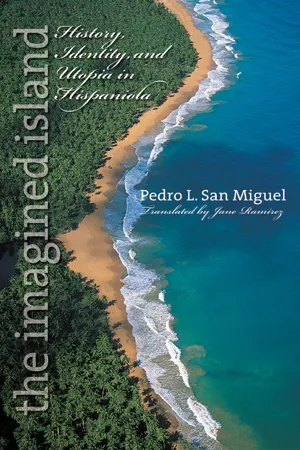
eBook - ePub
The Imagined Island
History, Identity, and Utopia in Hispaniola
- 208 pages
- English
- ePUB (mobile friendly)
- Available on iOS & Android
eBook - ePub
About this book
Trusted by 375,005 students
Access to over 1.5 million titles for a fair monthly price.
Study more efficiently using our study tools.
Information
NOTES
Introduction: A Kind of Sacred Writing
1 Silvia Álvarez-Curbelo, “Terrores de fin de siglo,” in Silvia Álvarez-Curbelo and Antonio Gaztambide-Géigel (eds.), Historias vivas: Historiografía puertorriqueña contemporánea (San Juan, P.R., 1996), 207-10.
2 Raúl Dorra, Profeta sin honra: Memoria y olvido en las narraciones evangélicas (Mexico City, 1994), 242.
3 Michel de Certeau, The Writing of History, trans. Tom Conley (New York, 1988), esp. 147-68; Joyce Appleby, Lynn Hunt, and Margaret Jacob, Telling the Truth about History (New York, 1994), esp. 15-43; Michel Foucault, Discipline and Punish: The Birth of the Prison, trans. Alan Sheridan (New York, 1979).
4 Thomas S. Kuhn, The Structure of Scientific Revolutions (2nd ed.; Chicago, 1994).
5 Appleby, Hunt, and Jacob, Telling the Truth, 52-90; Hayden White, Metahistory: The Historical Imagination in Nineteenth-Century Europe (Baltimore, 1973).
6 Edward Hallett Carr, What Is History? (New York, 1961), 5; Sir George Clark, The Listener, June 19, 1952, p. 992, quoted in ibid., 7.
7 De Certeau, Writing of History; Appleby, Hunt, and Jacob, Telling the Truth, esp. 91-125; Benedict Anderson, Imagined Communities: Reflections on the Origin and Spread of Nationalism (rev. ed.; New York, 1996); Partha Chatterjee, The Nation and Its Fragments: Colonial and Postcolonial Histories (Princeton, 1993).
8 Andrés L. Mateo, Al filo de la dominicanidad (Santo Domingo, 1996), 43, and Mito y cultura en la Era de Trujillo (Santo Domingo, 1993).
9 David K. Herzberger, Narrating the Past: Fiction and Historiography in Postwar Spain (Durham, N.C., 1995), 17.
10 Carr, What Is History?, esp. 3-35; White, Metahistory, xii. [The title of this section, “The Poetics of History,” is from White, Metahistory, 1. Trans.]
11 Hayden White, Tropics of Discourse: Essays in Cultural Criticism (2nd printing; Baltimore, 1986), 105, quoted in George E. Marcus and Dick Cushman, “Ethnographies as Texts,” Annual Review of Anthropology 11 (1982): 56.
12 Dorra, Profeta sin honra, 234.
13 Ibid., 11-14; Mateo, Mito y cultura.
14 White, Tropics of Discourse; Hayden White, The Content of the Form: Narrative Discourse and Historical Representation (2nd printing; Baltimore, 1992).
15 These terms are taken, respectively, from the essay by Marilyn Strathern, “Out of Context: The Persuasive Fictions of Anthropology,” Current Anthropology 28, no. 3 (1987): 251-81, and from a fictional work by Ana Lydia Vega, Falsas crónicas del sur (Río Piedras, P.R., 1991).
16 Herzberger, Narrating the Past, 84.
17 Dorra, Profeta sin honra, 14.
18 Marcus and Cushman, “Ethnographies as Texts,” 54, 56.
19 Patrick H. Hutton, History as an Art of Memory (Hanover, N.H., 1993); Roger Chartier, The World as Representation, published as El mundo como representación: Estudios sobre historia cultural (2nd ed.; Barcelona, 1995).
20 Dorra, Profeta sin honra, 156-57.
21 Chartier, El mundo como representación, esp. 107-62.
22 Hutton, History as an Art of Memory, xxi.
23 Clifford Geertz, Local Knowledge: Further Essays in Interpretive Anthropology (New York, 1983), 36-54. [The quotation is from the title of Geertz, Local Knowledge, chap. 2, p. 36. Trans.]
24 Herbert Marcuse, Eros and Civilization: A Philosophical Inquiry into Freud (Boston, 1955).
25 Michael Agar, Speaking of Ethnography (Beverly Hills, Calif., 1986), 19.
The Imagined Colony: Historical Visions of Colonial Santo Domingo
This essay is an expanded version of a paper presented before the Seventh Dominican History Congress, National Museum of History and Geography, Santo Domingo, October 16-19, 1995.
1 Hayden White, Metahistory: The Historical Imagination in Nineteenth-Century Europe (Baltimore, 1973), x, 7. See also Tropics of Discourse: Essays in Cultural Criticism (2nd printing; Baltimore, 1986), and The Content of the Form: Narrative Discourse and Historical Representation (2nd printing; Baltimore, 1992). In addition to White’s works, the following are also relevant: Ana Lydia Vega et al., Historia y literatura (San Juan, P.R., 1995), and David K. Herzberger, Narrating the Past: Fiction and Historiography in Postwar Spain (Durham, N.C., 1995).
2 Antonio Sánchez-Valverde, Idea del valor de la isla Española, annotated and ed. by Emilio Rodríguez-Demorizi and Fray Cipriano de Utrera (Santo Domingo, 1971) (cited hereinafter as Idea, followed by the corresponding page number[s]).
3 Ibid., 158.
4 Ibid., 169, 174-75.
5 The historical sections of Idea are found primarily in chaps. 11-15, apparently a summary of more extensive research conducted by Sánchez-Valverde, since he states at the beginning of his work, “I have produced a compleat History of the Island” (ibid., 5; in Emilio Rodríguez-Demorizi’s note 3, this work is said to be lost). For evaluations of Sánchez-Valverde’s work, see Roberto Cassá, “Historiografía de la República Dominicana,” Ecos: Órgano del Instituto de Historia de la Universidad Autónoma de Santo Domingo 1, no. 1 (1993): 10-12, and Máximo Rossi Jr., Praxis, historia y filosofía en el siglo XVIII: Textos de Antonio Sánchez Valverde (1729-90) (Santo Domingo, 1994).
6 This type of discursive strategy was common in the colonial period. See the shrewd analysis by Severo Martínez-Peláez, La patria del criollo: Ensayo de interpretación de la realidad colonial guatemalteca (3rd ed.; San José, Guat., 1975).
7 Idea, 98.
8 In his annotations to Idea, Rodríguez-Demorizi, who can hardly be suspected of trying to diminish the grandeur of Santo Domingo in colonial days, alludes to these exaggerations. See, for example, nn. 116 and 118.
9 See Roberto Cassá and Genaro Rodríguez, “Algunos procesos formativos de la identidad nacional dominicana,” Estudios Sociales 25, no. 88 (1992): 67-98.
10 Jacques Le Goff, El orden de la memoria: El tiempo como imaginario (Barcelona, 1991), 11.
11 [That is, the apportionment of native laborers among the Spanish colonizers. Trans.]
12 Idea, 107.
13 The term is borrowed from Samuel Stone, La dinastía de los conquistadores: La crisis del poder en la Costa Rica contemporánea (3rd ed.; San José, C.R., 1982).
14 See San Miguel, “Racial Discourse and National Identity: Haiti in the Dominican Imaginary,” in this volume.
15 Ibid. I take the term “criollo homeland” from Martínez-Peláez, La patria del criollo.
16 Rossi, Praxis, historia y filosofía. On the configuration of “criollo patriotism,” see Martínez-Peláez, La patria del criollo; Jacques Lafaye, Quetzalcóatl and Guadalupe: The Formation of Mexican National Consciousness, 1531-1813, trans. Benjamin Keen (Chicago, 1976); David A. Brading, Los orígenes del nacionalismo mexicano, trans. Soledad Loaeza-Grave (2nd ed.; Mexico City, 1991); and Enrique Florescano, Memoria mexicana (2nd ed.; Mexico City, 1994).
17 For general context, see Eric Williams, From Columbus to Castro: The History of the Caribbean, 1492-1969 (2nd printing; New York, 1973), esp. 255- 79, and Gordon K. Lewis, Main Currents in Caribbean Thought: The Historical Evolution of Caribbean Society in Its Ideological Aspects, 1492-1900 (Baltimore, 1987), 94-170. For studies of the islands mentioned, see Manuel Moreno-Fraginals, The Sugarmill: The Socioeconomic Complex of Sugar in Cuba, 1760- 1860, trans. Cedric Belfrage (New York, 1976), and Francisco A. Scarano, Sugar and Slavery in Puerto Rico: The Plantation Economy of Ponce, 1800-1850 (Madison, 1984).
18 This argument is based on Raymundo González, Bonó, un intelectual de los pobres (Santo Domingo, 1994), esp. 39-83.
19 I am indebted to Silvia Álvarez-Curbelo for suggesting this parallelism. On Michelet, see White, Metahistory, 135-62; Georges Lefebvre, El nacimiento de la historiografía moderna, trans. Alberto Méndez (Barcelona, 1974), 195-213; Josefina Vázquez-de Knauth, Historia de la historiografía (2nd ed.; Mexico City, 1973), 108-9; Josep Fontana, Historia: Análisis del pasado y proyecto social (Barcelona, 1982), 121-22; and Patrick H. Hutton, History as an Art of Memory (Hanover, N.H., 1993), 131-33.
20 Fonta...
Table of contents
- Title Page
- Copyright Page
- Table of Contents
- Dedication
- Epigraph
- PREFACE
- Introduction
- The Imagined Colony Historical Visions of Colonial Santo Domingo
- Racial Discourse and National Identity Haiti in the Dominican Imaginary
- The Island of Forking Paths Jean Price-Mars and the History of Hispaniola
- Storytelling the Nation Memory, History, and Narration in Juan Bosch
- NOTES
Frequently asked questions
Yes, you can cancel anytime from the Subscription tab in your account settings on the Perlego website. Your subscription will stay active until the end of your current billing period. Learn how to cancel your subscription
No, books cannot be downloaded as external files, such as PDFs, for use outside of Perlego. However, you can download books within the Perlego app for offline reading on mobile or tablet. Learn how to download books offline
Perlego offers two plans: Essential and Complete
- Essential is ideal for learners and professionals who enjoy exploring a wide range of subjects. Access the Essential Library with 800,000+ trusted titles and best-sellers across business, personal growth, and the humanities. Includes unlimited reading time and Standard Read Aloud voice.
- Complete: Perfect for advanced learners and researchers needing full, unrestricted access. Unlock 1.5M+ books across hundreds of subjects, including academic and specialized titles. The Complete Plan also includes advanced features like Premium Read Aloud and Research Assistant.
We are an online textbook subscription service, where you can get access to an entire online library for less than the price of a single book per month. With over 1.5 million books across 990+ topics, we’ve got you covered! Learn about our mission
Look out for the read-aloud symbol on your next book to see if you can listen to it. The read-aloud tool reads text aloud for you, highlighting the text as it is being read. You can pause it, speed it up and slow it down. Learn more about Read Aloud
Yes! You can use the Perlego app on both iOS and Android devices to read anytime, anywhere — even offline. Perfect for commutes or when you’re on the go.
Please note we cannot support devices running on iOS 13 and Android 7 or earlier. Learn more about using the app
Please note we cannot support devices running on iOS 13 and Android 7 or earlier. Learn more about using the app
Yes, you can access The Imagined Island by Pedro L. San Miguel, Jane Ramírez in PDF and/or ePUB format, as well as other popular books in History & Historiography. We have over 1.5 million books available in our catalogue for you to explore.