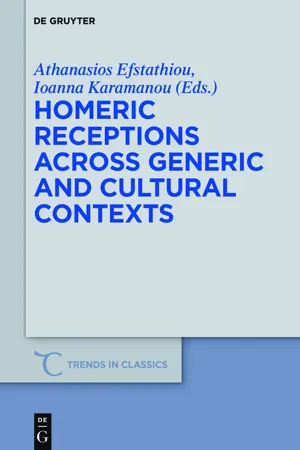
This collective volume provides a fresh perspective on Homeric reception through a methodologically focused, interdisciplinary investigation of the transformations of Homeric epic within varying generic and cultural contexts. It explores how various aspects of Homeric poetics appeal and can be mapped on to a diversity of contexts under different socio-historical, intellectual, literary and artistic conditions. The volume brings together internationally acclaimed scholars and acute young researchers in the fields of classics and reception studies, yielding insight into the varied strategies and ideological forces that define Homeric reception in literature, scholarship and the performing arts (theatre, film and music) and shape the 'horizon of expectations' of readers and audience. This collection also showcases that the wide-ranging 'migration' of Homeric material through time and across place holds significant cultural power, being instrumental in the construction of new cultural identities. The volume is of particular interest to scholars in the fields of classics, reception and cultural studies and the performing arts, as well as to readers fascinated by ancient literature and its cultural transformations.
eBook - ePub
Homeric Receptions Across Generic and Cultural Contexts
- 505 pages
- English
- ePUB (mobile friendly)
- Available on iOS & Android
eBook - ePub
Homeric Receptions Across Generic and Cultural Contexts
About this book
Trusted by 375,005 students
Access to over 1 million titles for a fair monthly price.
Study more efficiently using our study tools.
Information
Index
Literature
Part IFraming
Lorna Hardwick
Homer, Repetition and Reception
‘Slow-striding Achilles, who put the hex on Hector
A swallow twitters in Troy. That’s where we start.’
This is an extract from the opening sequence of Derek Walcott’s The Odyssey: A Stage Version.16 When I saw the play staged in its opening run at Stratford-upon-Avon, the audience laughed at these lines. Probably laughter was on several levels, but at least some of it was because spectators knew both that Achilles was ‘swift-footed’ and that the wound to his heel accounted for the actor’s limp across the stage. One characteristic of Walcott’s use of classical material is the way that he manipulates it to create an irreverent counter-text. The swallow twittering in Troy slyly reminded the spectators of chaos theory and also of the trauma that ensued from Troy. Here, however, my point is that Walcott continued to use the Homeric form, the formulaic epithet. It was part of the joke in which audience recognition was combined with a play on words. Achilles made Hector famous via the hexameters of the Iliad. In terms of epic poetics the epithet ‘slow-striding is a good example of substitution, where the singer takes a phrase and changes a single word.17 In Walcott’s riff, Homer and Caribbean vernacular intersect.
This essay aims to bring consideration of formal elements back to the centre of analysis of classical receptions. The artificial polarities between studies based on aesthetics and those based on cultural history and its contexts have sometimes precluded study in depth of the role of formal structures and conventions as a nexus between the ancient text and its audiences and between the ancient text and its subsequent receptions.18
If the relationship between the ante-text and its receptions is to be genuinely dialogical, that is, if the ancient text and its transmission and appropriations have something to say to one another and if each influences the way that the other is read, then ways have to be found of enabling close reading of the ancient text and the modern to stake out a field of exchange. Steiner calls this relationship one of ‘reciprocity’. However, reciprocity is just the fourth stage of his hermeneutic model, a model that is marred by the language of violence which he uses for the second stage – an image of violation of the ante-text by the new. I do, however, draw on the initial stage in Steiner’s model, that of trust – trust that the ante-text has something of value to offer.19
The hermeneutic process has been described in different ways: Julia Gaisser has written persuasively of ‘accretions’, qualities and associations that adhere to the ante-text in the course of its subsequent migrations, re-readings and rewritings. She describes how perceptions of the texts and of their meaning are altered through time. They become ‘pliable and sticky artefacts gripped, moulded and stamped with new meanings by every generation of readers and they come to us irreversibly altered by their experiences’.20 Equally important, in my view, are the dynamic processes through which poetry travels and survives and becomes an active agent through time, place, language and culture. This ‘iterability’ of poetry is one of the key aspects that reception scholars have to handle, as they struggle to find ways of describing and explaining how and why ancient texts continue to resurface and to act as artistic and cultural catalysts. Different approaches have characterised the process in different ways. Pucci, drawing on Derrida, has explored the capacity of ancient texts to produce semantic and emotional effects even when the original social and historical co-ordinates are occluded or misunderstood by the subsequent readers and spectators.21 Pucci’s discussion was grounded in theatre poetry. Poetic responses to Homer are not only a central strand in ancient tragedy but also carriers of the energy that enables the richness and moral and psychological complexities of the performance poetry of the Homeric poems to engage with the new situations into which they are transplanted.22 Elizabeth Cook, in her prose poem Achilles included a seductive sensory communication of ‘A game of Chinese whispers. A hot word thrown into the next lap before it burns. It has not been allowed to set. Each hand that momentarily holds it, weighs it, before depositing it with a neighbour also, inadvertently moulds it ; communicates its own heat’ (Cook 2001, 104).
Scholars have rightly turned away from ‘universalist’ models that kidnap poetic energy and write backwards, in order to permanently inscribe values that are largely invented restrospectively. But the problems of explaining and interpreting transhistorical and transcultural movements are real enough and have to be confronted afresh if classical reception research is to be more than an accumulation of case studies that do not go beyond the particularities and specificities in which they are embedded.
In this essay I suggest that the reception histories of the Homeric epics present case studies that are not only important in themselves but also, in combination, benefit from an approach that combines analysis of the formal elements of the ancient texts with close reading of what has been done with them. In that way, Homeric receptions can make a special contribution in offering paradigms for other areas of classical reception. There are two main reasons for this. Firstly, the formal elements of epic —such as, for example, formulaic epithets, similes, ring compositions, proems, codas and focalised narratives— provide productive opportunities for close reading of what happens when the formal aspects of the Homeric poems are transmitted and adapted in other literary traditions. Secondly, they also provide a way into the many receptions of Homer which are either not directly lexically-based or use the text in inventive ways. Sometimes formal aspects persist even when the interaction is not primarily lexical. The tensions between formal and non-formal aspects of Homeric reception may provide contrasts not just between different receptions but also sometimes within different aspects of the same work.
To make a start in exploring this challenging area I shall focus on one key area, the practice of repetition. Philosophers such as Deleuze have used the concept of repetition to counter any assumptions that exact replication can ever be possible; repetition is always repetition with a difference.23 Much has been written by scholars on the importance of cumulative technique in Homer24 and the directions and tones of the expansiveness that it creates both within the poems and in interactions with listeners and readers. This expansiveness occurs both within the Homeric poems and between the poems and their receptions. For example, in the Iliad the image of the reapers, which at 11.67–71 is part of a simile that holds in stark contrast the corn harvest and the mutual destruction of the two armies, is elaborated at 18.550 –60 in the scene of harvest plenty on the shield of Achilles. The image of the reapers has echoes in different directions within the poem. Writers responding to Homer can transplant that poetic movement, although they may contextualise it in a different way.25
Both within the Homeric poems and in subsequent literature embedded repetition grows into the poetics of difference. Poets such as Derek Mahon have self-reflexively exploited Heraclitus’ metaphor of the river, in which it is never possible to step into the same river twice. Not only the river but also the wader is never quite the same.
Nobody steps into the same river twice.
The same river is never the same
Because that is the nature of water.
Similarly your changing metabolism
Means that you are no longer you.
[…]
You will tell me that you have executed
A monument more lasting than bronze;
But even bronze is perishable.
Your best poem, you know the one I mean,
The very language in which the poem was written, and the idea of language,
All these things will pass away in time.
(Mahon, ‘Heraclitus on Rivers’ in Mahon 1979, 107)
Mahon’s allusion here is to Horace’s claim in Odes 3.30.1 that ‘Exegi monumentum are perennius’ (‘I have executed a monument more lasting than bronze’, trans. West 2002, 259), but an analogy might equally be made with the notion of kleos in Homer, the claim that the reputation of the heroic warriors and their ‘good deaths’, sung by the poets, will outlive them. One might reply ‘yes, but in different ways, in different traditions’ and, as Mahon suggests, in a constantly changing poetic.
I want to try to keep the axes of repetition and difference in a creative tension and to trace some examples of how ‘repetition with a difference’ uses and adapts Homeric formal qualities, with the result that the poetry that emerges helps readers and scholars to experience and to analyze the continual process of dialogue between ancient and modern. In his recent book David Hopkins has called this ‘Conversing with Antiquity’. He proposes a reading process which works both backwards and forwards, a process in which reception (and translation) is never a lone encounter between two parties: ‘though acts of reception are necessarily made in and by individual minds, those minds are themselves already full of the imaginings, intuitions and emotions of other human minds’.26 My approach is perhaps less gentle, less urbane; it recognizes the sharp edges and the difficulties and disturbances, even the conflicts that may arise from these encounters.
Homeric reception involves a variety of processes: translation, transplantation, re-imagining, rewriting, re-performance. Sometimes these overlap. Often the formal aspects of ‘repetition’ serve as a metaphor for agencies that transfer poetic energy across time, language and place. As a basis for discussion I have selected four aspects of the Homeric poems and shall briefly mention examples of each that bear on the topic of ‘repetition’. The four areas are: formal elements; iconic episodes; performance; themes.
a.Formal elements
Formal elements that we have become accustomed to identify with distinctive Homeric poetics include epithets, similes and focalised narrative. Separately and in combination, each of these has an impact in recent literary receptions, shaping readers’ perceptions of what is specifically Homeric about the new writing. The aesthetic and cultural power of the new writing both draws on Homer and also remodels Homer. The formal intertextuality becomes a distinctive part of the poetics of the new writer, who is both writing from his or her literary tradition and aiming to create a new dimension to it.
Homeric similes have been drawn into new work in ways that play with perceptions of both the ancient and the modern. For instance in Patrick Kavanagh’s ‘Epic’ (1951), the Irish poet Kavanagh (who was to be an important influence on Seamus Heaney and Michael Longley) transposes into a context of disputes about agricultural land in rural Ireland the simile from Iliad 12.421–25, in which there is a stalemate between the two opposing sides. In so doing he draws on the translation by E.V. Rieu that he had recently read: ‘they were like two men quarrelling across a fence in the common field with yardsticks in their hands, each of them fighting for his fair share in a narrow strip’.27
This is interesting because Kavanagh does not refer to the specific simile nor to the ancient context of the Achaian and Trojan armies. A reader who did not know the Iliad (or at least not very well) might miss the repetition.28 Kavanagh worked from the local to the global. In this case, the global was ‘the year of the Munich bother’, that is, the events preceding World War II, which were also exercising his mind as he wrote. Only later in the poem does he allude to ‘the ghost of Homer’ that helped him to see the links between local matters and the world stage. Some of Kavanagh’s readers would spot the reversal of the Homeric simile; others would merely have a generalised conception of Homer as a ‘poet of war’. In either case, it is the formal movement that is important.
There are many notable examples of the local/ global connection being made through the use of short (of...
Table of contents
- Cover
- Title Page
- Copyright
- Preface
- Contents
- Introduction: The Contexts of Homeric Reception
- Part I Framing
- Part II: Homer In Archaic Ideology
- Part III Homeric Echoes in Philosophical and Rhetorical Discourse
- Part IV Hellenistic and Later Receptions
- Part V Latin Transformations
- Part VI Homeric Scholarship at the Intersection of Traditions
- Part VII Homer on the Ancient and Modern Stage
- Part VIII Refiguring Homer in Film and Music
- Bibliography
- Notes on Contributors
- General Index
- Index of Homeric Passages
- Footnotes
Frequently asked questions
Yes, you can cancel anytime from the Subscription tab in your account settings on the Perlego website. Your subscription will stay active until the end of your current billing period. Learn how to cancel your subscription
No, books cannot be downloaded as external files, such as PDFs, for use outside of Perlego. However, you can download books within the Perlego app for offline reading on mobile or tablet. Learn how to download books offline
Perlego offers two plans: Essential and Complete
- Essential is ideal for learners and professionals who enjoy exploring a wide range of subjects. Access the Essential Library with 800,000+ trusted titles and best-sellers across business, personal growth, and the humanities. Includes unlimited reading time and Standard Read Aloud voice.
- Complete: Perfect for advanced learners and researchers needing full, unrestricted access. Unlock 1.4M+ books across hundreds of subjects, including academic and specialized titles. The Complete Plan also includes advanced features like Premium Read Aloud and Research Assistant.
We are an online textbook subscription service, where you can get access to an entire online library for less than the price of a single book per month. With over 1 million books across 990+ topics, we’ve got you covered! Learn about our mission
Look out for the read-aloud symbol on your next book to see if you can listen to it. The read-aloud tool reads text aloud for you, highlighting the text as it is being read. You can pause it, speed it up and slow it down. Learn more about Read Aloud
Yes! You can use the Perlego app on both iOS and Android devices to read anytime, anywhere — even offline. Perfect for commutes or when you’re on the go.
Please note we cannot support devices running on iOS 13 and Android 7 or earlier. Learn more about using the app
Please note we cannot support devices running on iOS 13 and Android 7 or earlier. Learn more about using the app
Yes, you can access Homeric Receptions Across Generic and Cultural Contexts by Athanasios Efstathiou, Ioanna Karamanou, Athanasios Efstathiou,Ioanna Karamanou in PDF and/or ePUB format, as well as other popular books in Literature & Ancient & Classical Literary Criticism. We have over one million books available in our catalogue for you to explore.