Winner of the 2007 Society for Cinema and Media Studies Katherine Singer Kovacs Book Award
2007 Choice Outstanding Academic Title
A classic study on the dynamic between an individual and different media channels
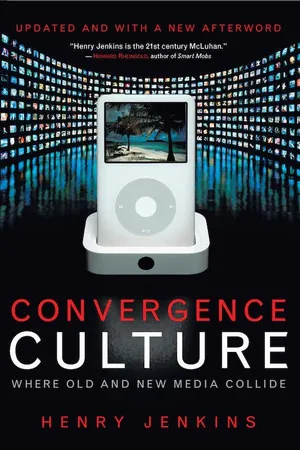
Convergence Culture maps a new territory: where old and new media intersect, where grassroots and corporate media collide, and where the powers of the media producer and the power of the consumer interact in unpredictable ways.
Henry Jenkins, one of America's most respected media analysts, delves beneath the new media hype to uncover the important cultural transformations that are taking place as media converge. He takes us into the secret world of Survivor Spoilers, where avid internet users pool their knowledge to unearth the show's secrets before they are revealed on the air. He introduces us to young Harry Potter fans who are writing their own Hogwarts tales while executives at Warner Brothers struggle for control of their franchise. He shows us how The Matrix has pushed transmedia storytelling to new levels, creating a fictional world where consumers track down bits of the story across multiple media channels. Jenkins argues that struggles over convergence will redefine the face of American popular culture. Industry leaders see opportunities to direct content across many channels to increase revenue and broaden markets. At the same time, consumers envision a liberated public sphere, free of network controls, in a decentralized media environment. Sometimes corporate and grassroots efforts reinforce each other, creating closer, more rewarding relations between media producers and consumers. Sometimes these two forces are at war.
Jenkins provides a riveting introduction to the world where every story gets told and every brand gets sold across multiple media platforms. He explains the cultural shift that is occurring as consumers fight for control across disparate channels, changing the way we do business, elect our leaders, and educate our children.
- 308 pages
- English
- ePUB (mobile friendly)
- Available on iOS & Android
eBook - ePub
About this book
Trusted by 375,005 students
Access to over 1.5 million titles for a fair monthly price.
Study more efficiently using our study tools.
Information
1
Spoiling Survivor
The Anatomy of a Knowledge Community
Survivor (2004)—the astonishingly popular CBS show that started the reality television trend—does not just pit sixteen strangers against one another. Around each carefully crafted episode emerges another contest—a giant cat and mouse game that is played between the producers and the audience. Every week, the eagerly anticipated results are fodder for water cooler discussions and get reported as news, even on rival networks. Survivor is television for the Internet age—designed to be discussed, dissected, debated, predicted, and critiqued.
The Survivor winner is one of television’s most tightly guarded secrets. Executive producer Mark Burnett engages in disinformation campaigns trying to throw smoke in viewers’ eyes. Enormous fines are written into the contracts for the cast and crew members if they get caught leaking the results. And so a fascination has grown up around the order of the “boots” (the sequence in which the contestants get rejected from the tribe), the “final four” (the last four contestants in the competition), and especially around the “sole survivor” (the final winner of the million-dollar cash prize).
The audience is one of the largest in broadcast television. In its first eight seasons, Survivor rarely dipped out of the top ten highest-rated shows. The most hard-core fans, a contingent known as the “spoilers,” go to extraordinary lengths to ferret out the answers. They use satellite photographs to locate the base camp. They watch the taped episodes, frame by frame, looking for hidden information. They know Survivor inside out, and they are determined to figure it out—together—before the producers reveal what happened. They call this process “spoiling.”
Mark Burnett acknowledges this contest between producer and fans is part of what creates Survivor’s mystique: “With so much of our show shrouded in secrecy until it’s broadcast, it makes complete sense that many individuals consider it a challenge to try to gain information before it’s officially revealed—sort of like a code they are determined to crack. While it’s my job to keep our fans on their toes and stay one step ahead, it is fascinating to hear some of the lengths these individuals are willing to go.”1
Into this intense competition entered ChillOne. Before his sudden fame within the fan realm, he claimed to be a lurker who has never previously posted to a discussion list. On vacation in Brazil for New Years 2003, he said, he stumbled into a detailed account of who was going to get bumped from Survivor: Amazon, the series’ sixth season. He posted this information on the Internet and lived through months of intense grilling by the spoiling community to defend his reputation. To some, ChillOne was a hero, the best spoiler of all time. For others, he was a villain, the guy who destroyed the game for everyone else.
As we have seen, the age of media convergence enables communal, rather than individualistic, modes of reception. Not every media consumer interacts within a virtual community yet; some simply discuss what they see with their friends, family members, and workmates. But few watch television in total silence and isolation. For most of us, television provides fodder for so-called water cooler conversations. And, for a growing number of people, the water cooler has gone digital. Online forums offer an opportunity for participants to share their knowledge and opinions. In this chapter 1 hope to bring readers inside the spoiling community to learn more about how it works and how it impacts the reception of a popular television series.
My focus here is on the process and ethics of shared problem-solving in an online community. I am less interested, ultimately, in who ChillOne is or whether his information was accurate than I am with how the community responded to, evaluated, debated, critiqued, and came to grips with the kinds of knowledge he brought to them. I am interested in how the community reacts to a shift in its normal ways of processing and evaluating knowledge. It is at moments of crisis, conflict, and controversy that communities are forced to articulate the principles that guide them.2
Spoiling as Collective Intelligence
On the Internet, Pierre Lévy argues, people harness their individual expertise toward shared goals and objectives: “No one knows everything, everyone knows something, all knowledge resides in humanity.”3 Collective intelligence refers to this ability of virtual communities to leverage the combined expertise of their members. What we cannot know or do on our own, we may now be able to do collectively. And this organization of audiences into what Lévy calls knowledge communities allows them to exert a greater aggregate power in their negotiations with media producers. The emergent knowledge culture will never fully escape the influence of commodity culture, any more than commodity culture can totally function outside the constraints of the nation-state. He suggests, however, that collective intelligence will gradually alter the ways commodity culture operates. Lévy sees industry panic over audience participation as shortsighted: “By preventing the knowledge culture from becoming autonomous, they deprive the circuits of commodity space … of an extraordinary source of energy.”4 The knowledge culture, he suggests, serves as the “invisible and intangible engine” for the circulation and exchange of commodities.
The new knowledge culture has arisen as our ties to older forms of social community are breaking down, our rooting in physical geography is diminished, our bonds to the extended and even the nuclear family are disintegrating, and our allegiances to nation-states are being redefined. New forms of community are emerging, however: these new communities are defined through voluntary, temporary, and tactical affiliations, reaffirmed through common intellectual enterprises and emotional investments. Members may shift from one group to another as their interests and needs change, and they may belong to more than one community at the same time. These communities, however, are held together through the mutual production and reciprocal exchange of knowledge. As he writes, such groups “make available to the collective intellect all of the pertinent knowledge available to it at a given moment.” More importantly, they serve as sites for “collective discussion, negotiation, and development,” and they prod the individual members to seek out new information for the common good: “Unanswered questions will create tension … indicating regions where invention and innovation are required.”5
Lévy draws a distinction between shared knowledge, information that is believed to be true and held in common by the entire group, and collective intelligence, the sum total of information held individually by the members of the group that can be accessed in response to a specific question. He explains: “The knowledge of a thinking community is no longer a shared knowledge for it is now impossible for a single human being, or even a group of people, to master all knowledge, all skills. It is fundamentally collective knowledge, impossible to gather together into a single creature.”6 Only certain things are known by all —the things the community needs to sustain its existence and fulfill its goals. Everything else is known by individuals who are on call to share what they know when the occasion arises. But communities must closely scrutinize any information that is going to become part of their shared knowledge, since misinformation can lead to more and more misconceptions as any new insight is read against what the group believes to be core knowledge.
Survivor spoiling is collective intelligence in practice.
Each fan I spoke with had their own history of how they became a spoiler. Shawn was a history major who loved the process of investigation and the challenge of weighing different accounts of a past event. Wezzie was a part-time travel agent who became fascinated with the faraway locations and the exotic people represented on the series. As for ChillOne, who knows, but it would seem from the outside to have to do with the ability to make the world pay attention to him.
Survivor asks us to speculate about what happened. It practically demands our predictions. Media scholar Mary Beth Haralovich and mathematician Michael W. Trosset describe the role chance plays in shaping outcomes: “Narrative pleasure stems from the desire to know what will happen next, to have that gap opened and closed, again and again, until the resolution of the story…. In Survivor, unpredictability whets the desire to know what happens next, but how that gap will be closed is grounded in uncertainty due to chance…. In its invitation to prediction, Survivor is more like a horse race than fiction.”7 At the same time, for those viewers who are most aware of the production circumstances, there is also an “uncertainty due to ignorance,” which is what galls these fans the most. Someone out there—Mark Burnett for one—knows something they don’t. They want to know what can be known. And that’s part of what makes spoiling Survivor such a compelling activity. The ability to expand your individual grasp by pooling knowledge with others intensifies the pleasures any viewer takes in trying to “expect the unexpected,” as the program’s ad campaign urges.
And, so, Survivor’s spoilers gather and process information. As they do so, they form a knowledge community. We are experimenting with new kinds of knowledge that emerge in cyberspace. Out of such play, Pierre Lévy believes, new kinds of political power will emerge which will operate alongside and sometimes directly challenge the hegemony of the nation-state or the economic might of corporate capitalism. Lévy sees such knowledge communities as central to the task of restoring democratic citizenship. At his most optimistic, he sees the sharing of knowledge around the world as the best way of breaking down the divisions and suspicions that currently shape international relations. Lévy’s claims are vast and mystifying, he speaks of his model of collective intelligence as an “achievable utopia,” yet he recognizes that small local experiments will be where we learn how to live within knowledge communities. We are, he argues, in a period of “apprenticeship” through which we innovate and explore the structures that will support political and economic life in the future.
Imagine the kinds of information these fans could collect, if they sought to spoil the government rather than the networks. Later, we will look at the roles collective intelligence played in the 2004 presidential campaign and we will see signs that players of alternative reality games are beginning to focus their energies toward solving civic and political problems. Having said that, I don’t want to seem to endorse a very old idea that fandom is a waste of time because it redirects energies that could be spent toward “serious things” like politics into more trivial pursuits. Quite the opposite, I would argue that one reason more Americans do not participate in public debates is that our normal ways of thinking and talking about politics requires us to buy into what we will discuss later in this chapter as the expert paradigm: to play the game, you have to become a policy wonk, or, more accurately, you have to let a policy wonk do your thinking for you. One reason why spoiling is a more compelling practice is because the way knowledge gets produced and evaluated is more democratic. Spoiling is empowering in the literal sense in that it helps participants to understand how they may deploy the new kinds of power that are emerging from participation within knowledge communities. For the moment, though, the spoilers are just having fun on a Friday night participating in an elaborate scavenger hunt involving thousands of participants who all interact in a global village. Play is one of the ways we learn, and during a period of reskilling and reorientation, such play may be much more important than it seems at first glance. On the other hand, play is also valuable on its own terms and for its own ends. At the end of the day, if spoiling wasn’t fun, they wouldn’t do it.
The word, spoiling, goes way back—or at least as far back as you can go—in the history of the Internet. Spoiling emerged from the mismatch between the temporalities and geographies of old and new media. For starters, people on the East Coast saw a series three hours earlier than people on the West Coast. Syndicated series played on different nights of the week in different markets. American series played in the United States six months or more before they broke in international markets. As long as people in different locations weren’t talking to each other, each got a first-time experience. But, once fans got online, these differences in time zones loomed large. Someone in the East Coast would go online and post everything about an episode and someone in California would get annoyed because the episode was “spoiled.” So, posters began putting the word “spoiler” in the subject line, so people could make up their own minds whether or not to read it.
Over time, though, the fan community turned spoiling into a game to find out what they could before the episodes even aired. Again, it is interesting to think about this in terms of temporality. Most viewers experience Survivor as something that unfolds week by week in real time. The show is edited to emphasize immediacy and spontaneity. The contestants don’t appear publicly until after they are booted and often they speak as if the events hadn’t already happened. They can only speak concretely about things that have already been aired and seem at times to speculate about what is yet to come. Spoilers, on the other hand, work from the knowledge that the series has already been shot. As one fan explains, “The results were determined months ago and here we wait for the official results. And a few people out there who participated know the results and they are supposed to keep it under lock. Hahahahahaha!”
They are searching for signs of the aftermath, trying to find out which contestants lost the most weight (thus, indicating that they spent more time surviving in the wilds) or which came back with full beards or bandaged hands; they seek leaks who are willing to give them some “small hints” about what took place, and then they pool their information, adding up all of the “small hints” into the “Big Picture.” Ghandia Johnson (Survivor: Thailand) thought she was smarter than the fan boards; she would post what she thought were tantalizing tidbits nobody could figure out. It turned out that the community—at least as an aggregate—was a whole lot smarter than she was and could use her “hints” to put together much of what was going to happen on the series. More recently, a news crew interviewed a Survivor producer in front of a white board that outlined the challenges for the forthcoming season; the fans were able to do a “frame grab” of the image, blow it up, and decipher the entire outline, giving them a road map for what was to come.
On one level, the story of Survivor: Amazon was done before ChillOne arrived on the scene; his sources at the Ariau Amazon Hotel were already starting to forget what had happened. On another level, the story hadn’t begun, since the cast hadn’t been publicly announced, the show was still being edited, and the episodes wouldn’t air for several more weeks when he made his first post at Survivor Sucks (http://p085.ezboard.com/bsurvivorsucks).
ChillOne knew he had some hot inside information and so he went where the hard-core fans hung out—Survivor Sucks, one of the oldest and most popular of the many discussion lists devoted to the series. The name bears some explanation, since clearly these people are dedicated fans who don’t really think the show sucks. Initially, Survivor Sucks was a forum for “recaps,” snarky summaries of the episodes. On the one hand, a recap is a useful tool for people who missed an episode. On the other hand, the recapping process was shaped by the desire to talk back to the television set, to make fun of formulas and signal your emotional distance from what’s taking place on the screen. Somewhere along the way, the Sucksters discovered “spoiling,” and the boards haven’t been the same since. So, it was here—to these people who pretended to hate Survivor but were pretty much obsessed with it —that ChillOne brought his information.
Anticipating some reaction, he started his own thread, “ChillOne’s Amazon Vacation Spoilers.” Surely, even ChillOne never imagined that the full thread would run for more than three thousand posts and continue across the full season. ChillOne made his first post at 7:13:25 p.m. on January 9, 2003. By 7:16:40 p.m. he was already facing questions. It wasn’t until 7:49:43 p.m., that someone implied that he might be connected to the show. A few minutes later, someone asked whether this might be a hoax.
It began innocently enough: “I have just returned from Brazil and a trip to the Amazon…. I will begin by saying that I do not have all the answers, or all the information about S6 [Survivor 6], but I have enough credible, spoiler type, information that I’d be open to sharing.”8
Images from space
We would learn later that ChillOne had gone on vacation with a bunch of friends to Rio to celebrate the New Year but had wanted to see more of the country. He made his way to the Amazon and then learned that the Ariau Amazon Towers had been the headquarters for the Survivor production staff, and as a fan of the series he wanted to see the locations firsthand. He wasn’t a spoiler; he mostly asked questions of the hotel staff trying to figure out what might be meaningful sites on a Survivor-themed tour of the Amazon. Where-as most of the people who came there were eco-tourists who wanted to see nature untouched by human presence, he was a tele-tourist trying to visit a location made meaningful because it was transmitted by television.
His first post focused primarily around the shooting location: “First off, the map posted by Wezzie is very accurate. Let me start by filling in some of the gaps.” This was a bold opening move, as “Wezzie” is one of the most respected members of the Survivor spoiling community. She and her partner, Dan Bollinger, have specialized in location spoiling. Offline, Wezzie is a substitute teacher, an arboretum docent, a travel agent, and a freelance writer. Dan is an industrial designer who runs a factory that makes refrigerator magnets. They live halfway across the country from each other but they work as a team to try to identify and document the next Survivor location—what Mark Burnett calls “the seventeenth character” —and to learn as much as they can about the area. As a team, Wezzie and Dan have been able to pinpoint the series location with astonishing accuracy. The process may start with a throwaway comment from Mark Burnett or a tip from “somebody who knows somebody, who knows somebody, who works for CBS or a tourist company.”9 Wezzie and Dan have built up contacts withtravel agencies, government officials, film bureaus, tourism directors, and resort op...
Table of contents
- Cover Page
- Title Page
- Copyright Page
- Contents
- Acknowledgments
- Introduction: “Worship at the Altar of Convergence”
- 1 Spoiling Survivor
- 2 Buying into American Idol
- 3 Searching for the Origami Unicorn
- 4 Quentin Tarantino’s Star Wars?
- 5 Why Heather Can Write
- 6 Photoshop for Democracy
- Conclusion
- Notes
- Glossary
- Index
- About the Author
Frequently asked questions
Yes, you can cancel anytime from the Subscription tab in your account settings on the Perlego website. Your subscription will stay active until the end of your current billing period. Learn how to cancel your subscription
No, books cannot be downloaded as external files, such as PDFs, for use outside of Perlego. However, you can download books within the Perlego app for offline reading on mobile or tablet. Learn how to download books offline
Perlego offers two plans: Essential and Complete
- Essential is ideal for learners and professionals who enjoy exploring a wide range of subjects. Access the Essential Library with 800,000+ trusted titles and best-sellers across business, personal growth, and the humanities. Includes unlimited reading time and Standard Read Aloud voice.
- Complete: Perfect for advanced learners and researchers needing full, unrestricted access. Unlock 1.5M+ books across hundreds of subjects, including academic and specialized titles. The Complete Plan also includes advanced features like Premium Read Aloud and Research Assistant.
We are an online textbook subscription service, where you can get access to an entire online library for less than the price of a single book per month. With over 1.5 million books across 990+ topics, we’ve got you covered! Learn about our mission
Look out for the read-aloud symbol on your next book to see if you can listen to it. The read-aloud tool reads text aloud for you, highlighting the text as it is being read. You can pause it, speed it up and slow it down. Learn more about Read Aloud
Yes! You can use the Perlego app on both iOS and Android devices to read anytime, anywhere — even offline. Perfect for commutes or when you’re on the go.
Please note we cannot support devices running on iOS 13 and Android 7 or earlier. Learn more about using the app
Please note we cannot support devices running on iOS 13 and Android 7 or earlier. Learn more about using the app
Yes, you can access Convergence Culture by Henry Jenkins in PDF and/or ePUB format, as well as other popular books in Social Sciences & Abnormal Psychology. We have over 1.5 million books available in our catalogue for you to explore.