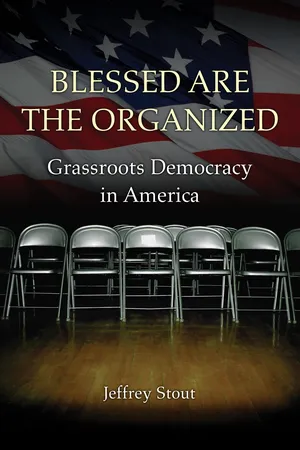
How ordinary citizens band together to bring about real change
In an America where the rich and fortunate have free rein to do as they please, can the ideal of liberty and justice for all be anything but an empty slogan? Many Americans are doubtful, and have withdrawn into apathy and cynicism. But thousands of others are not ready to give up on democracy just yet. Working outside the notice of the national media, ordinary citizens across the nation are meeting in living rooms, church basements, synagogues, and schools to identify shared concerns, select and cultivate leaders, and take action. Their goal is to hold big government and big business accountable. In this important new book, Jeffrey Stout bears witness to the successes and failures of progressive grassroots organizing, and the daunting forces now arrayed against it.
Stout tells vivid stories of people fighting entrenched economic and political interests around the country. From parents and teachers striving to overcome gang violence in South Central Los Angeles, to a Latino priest north of the Rio Grande who brings his parish into a citizens' organization, to the New Orleans residents who get out the vote by taking a jazz band through streets devastated by Hurricane Katrina, Stout describes how these ordinary people conceive of citizenship, how they acquire and exercise power, and how religious ideas and institutions contribute to their successes.
The most important book on organizing and grassroots democracy in a generation, Blessed Are the Organized is a passionate and hopeful account of how our endangered democratic principles can be put into action.
Trusted by 375,005 students
Access to over 1.5 million titles for a fair monthly price.
Well and wisely trained citizens you will hardly find anywhere.
—Thomas More (1516)
LATE IN THE SUMMER of 2005, somewhere in the Atlantic basin off the coast of Africa, an elongated trough of low pressure took shape and began moving west. Over the Bahamas, on August 23, it joined with the remains of Tropical Depression Ten to form the more powerful Tropical Depression Twelve. As it moved over the warm waters of the Atlantic, the system gathered energy from below. On August 24 meteorologists declared it a tropical storm and named it Katrina. By the time the storm reached Florida, it had become a hurricane. It weakened briefly while passing over land, but then rapidly gained strength from the Gulf of Mexico, before wreaking havoc on the Gulf coast on August 29. The damage done there had human as well as natural causes.
One evening, sixteen months after the storm, I was in Marrero, Louisiana, a city located on the West Bank in greater New Orleans. At St. Joseph the Worker Catholic Church, I met with several organizers and leaders of a citizens’ organization called Jeremiah, which consists of churches, synagogues, parent-teacher associations, unions, and other nongovernmental groups. Each of these institutions pays dues to Jeremiah, with the money going mainly to the salaries of the organizers. By joining the organization, the institutions also commit themselves to a great deal of internal organizational activity. What that activity amounts to will become clearer in the next three chapters.
For now, it will suffice to say that the internal organizing going on in various New Orleans institutions is directed toward two initial objectives. The first is to get people within a given institution talking with each other about their concerns. In the case of a church this would mean hundreds of individual conversations and small gatherings—called “one-on-ones” and “house meetings,” respectively—among church members. The second objective is to identify and cultivate leaders from within. These leaders represent their institutions in the citizens’ organization and in the broader forum of public discussion. Drawing together institutional leaders in this way creates the sort of power base that the citizens’ organization can then use to hold governmental and corporate officeholders accountable.
In the parlance of groups like Jeremiah, “organizers” are professionals tasked with helping ordinary citizens learn the practices of organizing and accountability. “Leaders” are citizen volunteers who have earned the right to represent an institution—such as a church or labor union—that has decided to join the organization. A “core team” is a set of leaders recognized as having the authority to formulate proposals and develop strategies on behalf of the organization.
Jeremiah is an affiliate of the Industrial Areas Foundation (IAF), a confederation of community organizations founded in 1940 by the legendary Saul Alinsky. Alinsky’s mission was to be the kind of mentor to ordinary American citizens that Machiavelli had been to the princes of Renaissance city-states: realistic, pragmatic, and fiercely dedicated to the ideal of liberty. Alinsky is best known for his work in the Back of the Yards neighborhood of Chicago in the 1930s and in Rochester, New York, in the 1960s.
Two of Alinsky’s books, Reveille for Radicals (1946) and Rules for Radicals (1971), vividly describe his experiences and tactics as an organizer.6 He fashioned himself as an irreverent radical, but both books express reverence for a tradition whose heroes include Patrick Henry, Sam Adams, Tom Paine, Thomas Jefferson, John Brown, Thaddeus Stevens, Walt Whitman, Henry David Thoreau, Edward Bellamy, and Upton Sinclair (Reveille, 13–14; Rules, 7). The true democrat, Alinsky insisted, is “suspicious of, and antagonistic to, any idea of plans that work from the top down. Democracy to him is working from the bottom up” (Reveille, 17). The purpose of Alinsky’s organizing, and of his writing, was to show ordinary people what bottom-up change involves.
Democracy, in his view, “is a way of life, not a formula to be ‘preserved’ like jelly” (Reveille, 47). Implicit in that way of life is a commitment to liberty and justice for all. These ideals become an ideological fog when they are abstracted from the activities of ordinary people. Liberty and justice are made actual in the lives of people who struggle for them. In the struggle to achieve liberty and justice for all, the “Have-Nots of the world” need to provide a counterweight to the “Haves” (Rules, 8, 18–23). Yet they can do this only by gathering in groups and exerting power.
If we strip away all the chromium trimmings of high-sounding metaphor and idealism which conceal the motor and gears of a democratic society, one basic element is revealed—the people are the motor, the organizations of the people are the gears. The power of the people is transmitted through the gears of their own organizations, and democracy moves forward. (Reveille, 46)
Alinsky’s books explain how such organizations are built and what they can do to seek democratic objectives by democratic means. By traveling to New Orleans and various other places where IAF groups have formed, I thought I might be able to see what Alinsky’s heritage amounts to today.
Presiding over our meeting in Marrero was Jackie Jones, an African-American woman who used to be a teacher in New Orleans and now serves as Jeremiah’s lead organizer. The leaders assembled at St. Joseph were all blacks, with the exception of one Latino, Reverend Jaime Oviedo of Christ Temple Church. When we went around the table introducing ourselves, the leaders gave not only their own names but also the names of the institutions they represented, all of which happened to be churches.
Jackie invited Reverend Jesse Pate, of the Harvest Ripe Church of Christ’s Holiness, to begin the meeting with a prayer. “Eternal Father,” Reverend Pate said, “we do thank you again for allowing us to be here. We ask your guidance, for we do seek your mercy and your instructions. Give us the wisdom to follow your lead to heaven. You will be our guiding principle and our guiding light, for truly we are members of the same body. Together we have to know that all things are possible if we continually believe in trusting you. So, right now, guide us, strengthen us, and we thank you for the time you have allowed us to be here. In Jesus’ name, Amen.”
Reverend Pate describes Jeremiah as “a broad-based organization. We deal with a lot of issues. We do take on the IAF motto of not doing for others what they can do for themselves. But we also believe in being a voice for the people, and representing the people. We do research, actions, and things of that nature, we go into house meetings, we bring the public in, and we talk to them. We do community walks and things of that nature. So it’s a lot of things that makes us what we are.”
David Warren, a tall, elegantly dressed African American who wore shades throughout the evening, was representing the Living Witness Church of God in Christ. Jeremiah, he said, has its roots in faith: “We’re a faith-based organization, and we believe in building relationships.” David made clear that he wasn’t disagreeing with Reverend Pate. Broad-based organizing encompasses, but is not limited to, faith-based organizing. Most member institutions in Jeremiah, as in many other IAF groups, are churches. The number of synagogues, mosques, schools, and labor unions involved in IAF is growing, and organizers hope to hasten this trend. Still, if one subtracted the churches from IAF and other similar organizing networks, then grassroots democracy in the United States would come to very little. In chapters 15–17, I will return to the significance of this fact for our understanding of pastoral responsibility, the training of pastors, and the proper relationship between church and state.
African Americans are heavily represented in the Jeremiah Group, and the leaders are quick to point out the role played by racial prejudice in the reconfiguration of New Orleans. But they have made a self-conscious decision to build a coalition that crosses racial lines, in the hope of accumulating sufficient power to address their concerns effectively. I found no reluctance among them to discuss the racial dimension of the situation. They present it, however, as one dimension among others; and they present it in this way, as far as I can tell, because they see it in this way, not merely because they are trying to draw whites, Asians, and Hispanics into the coalition. The major movers and shakers in the immediate wake of the storm were developers and bureaucrats, who took advantage of the racial prejudice in some sectors of the population to advance private interests at the expense of the common good. That is what happened, according to Jeremiah leaders, so that is the story that must be told.
Broad-based organizing aims to transcend racial boundaries.7 It would be fruitless to fight racism in post-Katrina New Orleans by assembling a coalition consisting only of African-American churches and associations. What it will take to combat injustices caused in part by racism is a coalition in which the interests of many groups converge. If those groups are to be assembled, the identity of the coalition itself will have to be found in a conception of the city’s common good. Racial identification cannot play the role in the process of coalition building that it plays in establishing solidarity within some of the groups participating in the coalition. Yet many of those groups will have less reason to join the coalition if racial prejudice is not named as one important source of domination in present-day New Orleans.
Jeremiah and the other broad-based citizens’ groups discussed in this book all belong to a single network known as Southwest IAF, which stretches from Mississippi to Idaho to California. The ethnic, racial, and religious makeup of these groups vary considerably from place to place, yet they all employ the same political concepts and go about their organizing in a way that bears the stamp of Alinsky’s influence. The network’s supervisor is Ernesto Cortés Jr.
Around the time Rules for Radicals appeared, Cortés was a young organizer in Texas. His frustrations with his work led him to enroll in Alinsky’s Training Institute in Chicago. By that time, however, Alinsky was spending most of his time on the road, giving speeches and raising funds. Within a few months of Cortés’s arrival, Alinsky died of a heart attack, and Ed Chambers, Alinsky’s successor, became the young organizer’s mentor. After working on several projects in the Midwest with Chambers and a brief stint of organizing in California, Cortés returned to his home state of Texas in 1974, and began laying the groundwork for citizens’ organizations in several major cities there. The first of these was COPS (Communities Organized for Public Service), an organization located in San Antonio that is known among organizers not only for building a power base for Latinos and for many concrete victories, but also for its longevity.
Ernie Cortés has since organized elsewhere in Texas and in California. In addition to coordinating Southwest IAF, he now serves as a director of IAF at the national and international levels.8 Like his predecessors in that role, Alinsky and Chambers, Cortés teaches that democracy depends for its very survival, as well as for its health, on what citizens do. This claim is hardly new. Montesquieu inferred it from a theory of politics in The Spirit of the Laws, Tocqueville placed great weight on it in Democracy in America, and Whitman spun it into poetry in Leaves of Grass. Of course, these thinkers all had in mind a worry that goes back to Plato. The worry is that a democratic polity assigns to ordinary citizens a set of responsibilities for which they do not appear qualified.
If democracy depends for its survival on what citizens do, it could still be that citizens are not up to the task envisioned for them. Walt Whitman was as troubled as anyone by what he called the “question of character” haunting American democracy in the decades after the Civil War. In “Democratic Vistas,” his long list of reasons for concern includes the “robbery and scoundrelism” practiced by economic elites. Justice, he wrote, “is always in jeopardy.” Why, then, suppose that the people are capable of effective collective action on behalf of justice? His answer was grounded in “the experiences of the fight,” including both successes and failures.9 He witnessed thousands of acts of benevolence and courage during the war. He understood that the slaves would not have been emancipated unless countless ordinary people had campaigned for abolition. Whitman hoped that similar movements would eventually win the franchise for women and constrain scoundrels in high places from robbing ordinary folk.
Alinsky, Chambers, and Cortés all share Whitman’s desire to prove democracy’s detractors mistaken. Like him, they are committed to grassroots democracy.10 That is, they hold that ordinary citizens can indeed act responsibly and effectively if they organize themselves properly and cultivate the virtues and skills of democratic citizenship. The belief that this condition can be met is grounded in the experience of particular examples of collective action—a social movement for Whitman, community organizing for Alinsky, and organizing on an increasingly broad scale for Chambers and Cortés. Abolitionism, the Back of the Yards organization in 1930s Chicago, and Southwest IAF represent three particular kinds of grassroots democracy.
In this book, I shall mainly be examining the third kind. Broad-based organizing differs from social movement organizing in that it does not restrict itself to a single issue and instead takes up different issues over time in response to concerns expressed by citizens. It differs from community organizing insofar as it sometimes succeeds in building lasting coalitions that involve multiple communities. Social movements are inherently limited in focus and duration.11 Community organizations are inherently limited in geographical scope and have also often fizzled—or become corrupted by antidemocratic impulses—after a few local campaigns. Broad-based citizens’ groups are meant to transcend these limitations. This is why the longevity of the COPS organization in San Antonio is significant for our understanding of grassroots democracy today. It is also why the network in which Jeremiah and COPS participate has importance for an appraisal of democracy’s prospects at a time of worsening stratification. If grassroots democracy is going to address the most pressing issues now emerging at the national and international levels, and sustain itself over time, broad-based organizing will have to be expanded and strengthened.
On the many occasions when I have discussed this matter with Cortés, however, he has always underlined the importance of patience. In broad-based organizing that aspires ultimately to have a significant impact at the national and international levels, the standing temptation is, as he puts it, “to skip steps, to take short cuts.” If the right sort of micro-organizational work is not being done, the macro-organizational work of connecting citizens’ groups with one another in progressively wider networks will create only an illusion of democratic power. This can happen in two ways. In the first, the networks are too loosely connected with people on the ground to generate power. In the second, the connections linking network spokespersons with people on the ground are somewhat stronger, but function in a way that is not democratic. The first way creates an illusion of power, the second an illusion of democratic power.
If Cortés is right, it seems that high degrees of participation, vigilance, self-constraint, and patience on the part of organizers, leaders, and citizens will be required to scale up the organizational effort without sacrificing either effectiveness or internal accountability. In an era of economic crisis, globalization, terrorism, and melting ice caps, the task is as consequential as it is daunting. The trouble is that many citizens appear too alienated, deluded, ignorant, or fearful to advance even their private interests wisely. Still less do they seem capable of striving for the common good. Cortés would be the first to point out that elections are, for the most part, exercises in mass manipulation. Candidates declare their allegiance to democratic ideals, but behind the scenes something antidemocratic is going on. Citizens who sense that the puppeteers are pulling their strings are tempted to withdraw from the process in disgust.
An old adage has it that the cur...
Table of contents
Cover
Halftitle
Title
Copyright
Dedication
Contents
Preface
List of maps
Preface
Chapter One The Responsibilities of a Citizenu
Chapter Two A Power Analysis
Chapter Three Organizing for the Common Good
Chapter Four Rites of Solidarity, Commitment, and Mourning
Chapter Five Domination, Anger, and Grief
Chapter Six Public Address
Chapter Seven Ain’t It Awful?
Chapter Eight The Authority to Lead
Chapter Nine On the Treatment of Opponents
Chapter Ten Organize, Reflect, and Reorganize
Chapter Eleven The Compelling Force of the Ideal
Chapter Twelve Face-to-Face Meetings
Chapter Thirteen The Passion of St. Rose
Chapter Fourteen Blood and Harmony
Chapter Fifteen Fathers and Sisters for Life
Chapter Sixteen Pastors and Flocks
Chapter Seventeen The Contested Sacred
Chapter Eighteen Across Great Scars of Wrong
Chapter Nineteen The Organizer President
Chapter Twenty Walking in Our Sleep
Acknowledgments
Notes
Index
Frequently asked questions
Yes, you can cancel anytime from the Subscription tab in your account settings on the Perlego website. Your subscription will stay active until the end of your current billing period. Learn how to cancel your subscription
No, books cannot be downloaded as external files, such as PDFs, for use outside of Perlego. However, you can download books within the Perlego app for offline reading on mobile or tablet. Learn how to download books offline
Perlego offers two plans: Essential and Complete
Essential is ideal for learners and professionals who enjoy exploring a wide range of subjects. Access the Essential Library with 800,000+ trusted titles and best-sellers across business, personal growth, and the humanities. Includes unlimited reading time and Standard Read Aloud voice.
Complete: Perfect for advanced learners and researchers needing full, unrestricted access. Unlock 1.5M+ books across hundreds of subjects, including academic and specialized titles. The Complete Plan also includes advanced features like Premium Read Aloud and Research Assistant.
Both plans are available with monthly, semester, or annual billing cycles.
We are an online textbook subscription service, where you can get access to an entire online library for less than the price of a single book per month. With over 1.5 million books across 990+ topics, we’ve got you covered! Learn about our mission
Look out for the read-aloud symbol on your next book to see if you can listen to it. The read-aloud tool reads text aloud for you, highlighting the text as it is being read. You can pause it, speed it up and slow it down. Learn more about Read Aloud
Yes! You can use the Perlego app on both iOS and Android devices to read anytime, anywhere — even offline. Perfect for commutes or when you’re on the go. Please note we cannot support devices running on iOS 13 and Android 7 or earlier. Learn more about using the app
Yes, you can access Blessed Are the Organized by Jeffrey Stout in PDF and/or ePUB format, as well as other popular books in Politics & International Relations & Political Advocacy. We have over 1.5 million books available in our catalogue for you to explore.