Hands-On Reinforcement Learning with Python
eBook - ePub

Hands-On Reinforcement Learning with Python

Master reinforcement and deep reinforcement learning using OpenAI Gym and TensorFlow

  1. 318 pages
  2. English
  3. ePUB (mobile friendly)
  4. Available on iOS & Android
eBook - ePub

Hands-On Reinforcement Learning with Python

Master reinforcement and deep reinforcement learning using OpenAI Gym and TensorFlow

About this book

A hands-on guide enriched with examples to master deep reinforcement learning algorithms with Python

Key Features

  • Your entry point into the world of artificial intelligence using the power of Python
  • An example-rich guide to master various RL and DRL algorithms
  • Explore various state-of-the-art architectures along with math

Book Description

Reinforcement Learning (RL) is the trending and most promising branch of artificial intelligence. Hands-On Reinforcement learning with Python will help you master not only the basic reinforcement learning algorithms but also the advanced deep reinforcement learning algorithms.

The book starts with an introduction to Reinforcement Learning followed by OpenAI Gym, and TensorFlow. You will then explore various RL algorithms and concepts, such as Markov Decision Process, Monte Carlo methods, and dynamic programming, including value and policy iteration. This example-rich guide will introduce you to deep reinforcement learning algorithms, such as Dueling DQN, DRQN, A3C, PPO, and TRPO. You will also learn about imagination-augmented agents, learning from human preference, DQfD, HER, and many more of the recent advancements in reinforcement learning.

By the end of the book, you will have all the knowledge and experience needed to implement reinforcement learning and deep reinforcement learning in your projects, and you will be all set to enter the world of artificial intelligence.

What you will learn

  • Understand the basics of reinforcement learning methods, algorithms, and elements
  • Train an agent to walk using OpenAI Gym and Tensorflow
  • Understand the Markov Decision Process, Bellman's optimality, and TD learning
  • Solve multi-armed-bandit problems using various algorithms
  • Master deep learning algorithms, such as RNN, LSTM, and CNN with applications
  • Build intelligent agents using the DRQN algorithm to play the Doom game
  • Teach agents to play the Lunar Lander game using DDPG
  • Train an agent to win a car racing game using dueling DQN

Who this book is for

If you're a machine learning developer or deep learning enthusiast interested in artificial intelligence and want to learn about reinforcement learning from scratch, this book is for you. Some knowledge of linear algebra, calculus, and the Python programming language will help you understand the concepts covered in this book.

Tools to learn more effectively

Saving Books

Saving Books

Keyword Search

Keyword Search

Annotating Text

Annotating Text

Listen to it instead

Listen to it instead

Deep Learning Fundamentals

So far, we have learned about how reinforcement learning (RL) works. In the upcoming chapters, we will learn about Deep reinforcement learning (DRL), which is a combination of deep learning and RL. DRL is creating a lot of buzz around the RL community and is making a serious impact on solving many RL tasks. To understand DRL, we need to have a strong foundation in deep learning. Deep learning is actually a subset of machine learning and it is all about neural networks. Deep learning has been around for a decade, but the reason it is so popular right now is because of the computational advancements and availability of a huge volume of data. With this huge volume of data, deep learning algorithms will outperform all classic machine learning algorithms. Therefore, in this chapter, we will learn about several deep learning algorithms like recurrent neural network (RNN), Long Short-Term Memory (LSTM), and convolutional neural network (CNN) algorithms with applications.
In this chapter, you will learn about the following:
  • Artificial neurons
  • Artificial neural networks (ANNs)
  • Building a neural network to classify handwritten digits
  • RNNs
  • LSTMs
  • Generating song lyrics using LSTMs
  • CNNs
  • Classifying fashion products using CNNs

Artificial neurons

Before understanding ANN, first, let's understand what neurons are and how neurons in our brain actually work. A neuron can be defined as the basic computational unit of the human brain. Our brain contains approximately 100 billion neurons. Each and every neuron is connected through synapses. Neurons receive input from the external environment, sensory organs, or from the other neurons through a branchlike structure called dendrites, as can be seen in the following diagram. These inputs are strengthened or weakened, that is, they are weighted according to their importance and then they are summed together in the soma (cell body). Then, from the cell body, these summed inputs are processed and move through the axons and are sent to the other neurons. The basic single biological neuron is shown in the following diagram:
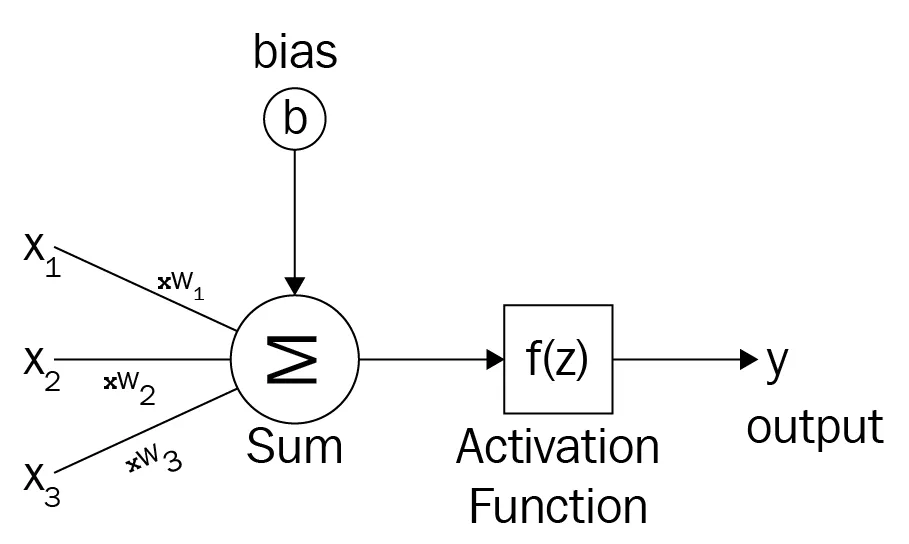
Now, how do artificial neurons work? Let's suppose we have three inputs, x1, x2, and x3, to predict output y. These inputs are multiplied by weights, w1, w2, and w3, and are summed together, that is, x1.w1 + x2.w2 + x3.w3. But why are we multiplying these inputs with weights? Because all of the inputs are not equally important in calculating the output y. Let's say that x2 is more important in calculating the output compared to the other two inputs. Then, we assign a high value to w2 rather than for the other two weights. So, upon multiplying weights with inputs, x2 will have a higher value than the other two inputs. After multiplying inputs with the weights, we sum them up and we add a value called bias b. So, z = (x1.w1 + x2.w2 + x3.w3) + b, that is:
Doesn't z look like the equation of linear regression? Isn't it just the equation of a straight line? z = mx + b.
Where m is the weights (coefficients), x is the input, and b is the bias (intercept). Well, yes. Then what is the difference between neurons and linear regression? In neurons, we introduce non-linearity to the result, z, by applying a function f() called the activation or transfer function. So, our output is y = f(z). A single artificial neuron is shown in the following diagram:
In neurons, we take the input x, multiply the input by weights w, and add bias b before applying the activation function f(z) to this result and predict the output y.

ANNs

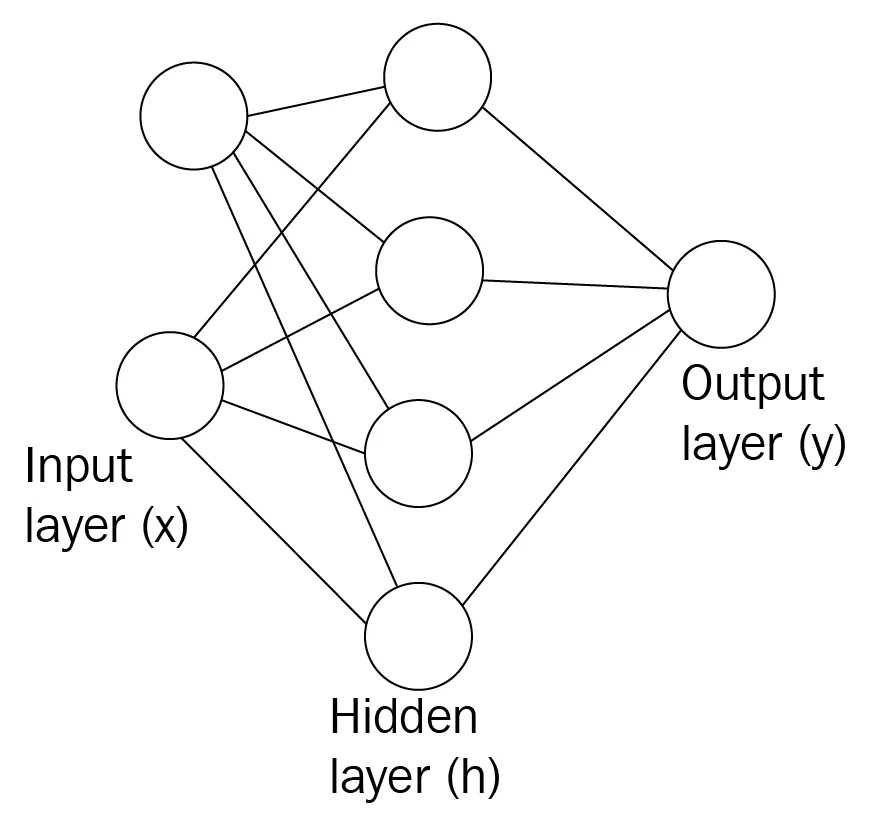
Neurons are cool, right? But single neurons cannot perform complex tasks, which is why our brain has billions of neurons, organized in layers, forming a network. Similarly, artificial neurons are arranged in layers. Each and every layer will be connected in such a way that information is passed from one layer to another. A typical ANN consists of the following layers:
  • Input layer
  • Hidden layer
  • Output layer
Each layer has a collection of neurons, and the neurons in one layer interact with all the neurons in the other layers. However, neurons in the same layer will not interact with each other. A typical ANN is shown in the following diagram:

Input layer

The input layer is where we feed input to the network. The number of neurons in the input layer is the number of inputs we feed to the network. Each input will have some influence on predicting the output and this will be multiplied by weights, while bias will be added and passed to the next layer.

Hidden layer

Any layer between the input layer and the output layer is called a hidden layer. It processes the input received from the input layer. The hidden layer is responsible for deriving complex relationships between input and output. That is, the hidden layer identifies the pattern in the dataset. There can be any number of hidden layers, however we have to choose a number of hidden layers according to our problem. For a very simple problem, we can just use one hidden layer, but while performing complex tasks like image recognition, we use many hidden layers where each layer is responsible for extracting important...

Table of contents

  1. Title Page
  2. Copyright and Credits
  3. Dedication
  4. Packt Upsell
  5. Contributors
  6. Preface
  7. Introduction to Reinforcement Learning
  8. Getting Started with OpenAI and TensorFlow
  9. The Markov Decision Process and Dynamic Programming
  10. Gaming with Monte Carlo Methods
  11. Temporal Difference Learning
  12. Multi-Armed Bandit Problem
  13. Deep Learning Fundamentals
  14. Atari Games with Deep Q Network
  15. Playing Doom with a Deep Recurrent Q Network
  16. The Asynchronous Advantage Actor Critic Network
  17. Policy Gradients and Optimization
  18. Capstone Project – Car Racing Using DQN
  19. Recent Advancements and Next Steps
  20. Assessments
  21. Other Books You May Enjoy

Frequently asked questions

Yes, you can cancel anytime from the Subscription tab in your account settings on the Perlego website. Your subscription will stay active until the end of your current billing period. Learn how to cancel your subscription
No, books cannot be downloaded as external files, such as PDFs, for use outside of Perlego. However, you can download books within the Perlego app for offline reading on mobile or tablet. Learn how to download books offline
Perlego offers two plans: Essential and Complete
  • Essential is ideal for learners and professionals who enjoy exploring a wide range of subjects. Access the Essential Library with 800,000+ trusted titles and best-sellers across business, personal growth, and the humanities. Includes unlimited reading time and Standard Read Aloud voice.
  • Complete: Perfect for advanced learners and researchers needing full, unrestricted access. Unlock 1.4M+ books across hundreds of subjects, including academic and specialized titles. The Complete Plan also includes advanced features like Premium Read Aloud and Research Assistant.
Both plans are available with monthly, semester, or annual billing cycles.
We are an online textbook subscription service, where you can get access to an entire online library for less than the price of a single book per month. With over 1 million books across 990+ topics, we’ve got you covered! Learn about our mission
Look out for the read-aloud symbol on your next book to see if you can listen to it. The read-aloud tool reads text aloud for you, highlighting the text as it is being read. You can pause it, speed it up and slow it down. Learn more about Read Aloud
Yes! You can use the Perlego app on both iOS and Android devices to read anytime, anywhere — even offline. Perfect for commutes or when you’re on the go.
Please note we cannot support devices running on iOS 13 and Android 7 or earlier. Learn more about using the app
Yes, you can access Hands-On Reinforcement Learning with Python by Sudharsan Ravichandiran in PDF and/or ePUB format, as well as other popular books in Informatique & Intelligence artificielle (IA) et sémantique. We have over one million books available in our catalogue for you to explore.