One can love and not forgive or out of love decide not to forgive. Or one can forgive but not love, or choose to forgive but not love the ones forgiven. Love and forgiveness follow parallel and largely independent paths, a truth we fail to acknowledge when we pressure others to both love and forgive. Individuals in conflict, sparring social and ethnic groups, warring religious communities, and insecure nations often do not need to pursue love and forgiveness to achieve peace of mind and heart. They need to remain attentive to the needs of others, an alertness that prompts either love or forgiveness to respond.
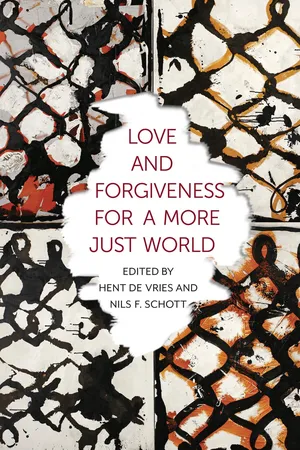
By reorienting our perception of these enduring phenomena, the contributors to this volume inspire new applications for love and forgiveness in an increasingly globalized and no longer quite secular world. With contributions by the renowned French philosophers Jacques Derrida and Jean-Luc Marion, the poet Haleh Liza Gafori, and scholars of religion (Leora Batnitzky, Nils F. Schott, Hent de Vries), psychoanalysis (Albert Mason, Orna Ophir), Islamic and political philosophy (Sari Nusseibeh), and the Bible and literature (Regina Schwartz), this anthology reconstructs the historical and conceptual lineage of love and forgiveness and their fraught relationship over time. By examining how we have used—and misused—these concepts, the authors advance a better understanding of their ability to unite different individuals and emerging groups around a shared engagement for freedom and equality, peace and solidarity.
eBook - ePub
Love and Forgiveness for a More Just World
- English
- ePUB (mobile friendly)
- Available on iOS & Android
eBook - ePub
Love and Forgiveness for a More Just World
About this book
Trusted by 375,005 students
Access to over 1.5 million titles for a fair monthly price.
Study more efficiently using our study tools.
Information
Topic
PhilosophySubtopic
Ethics & Moral Philosophy1
ORANGE ALERT
We’re on orange alert again I hear
as we cross the East River
and the winter sun beams its blinding white light
across the jagged surface of the water.
Orange alert?
So am I to be on the lookout now
for a suitcase that ticks, for a turbaned man,
a veiled woman, a shoulder belt of rockets?
Shall I suspect all Mohammeds today?
Or shall I envision my escape through the office hall, the bathroom window,
through the shaken streets as ash rains down
and my morning coffee gets cold?
I am so tired of terror!
Orange alert, really?
How about a russet alert?
A coral alert, a sienna alert,
a burnt ochre, vermilion alert,
a salmon, pumpkin, persimmon alert,
a rust carrot apricot alert, a saffron alert!
Give me a saffron alert!
Take me to the rugged mountains of Iran and let’s get down on our knees and pluck the saffron threads from purple crocuses that paint a belt out to the blue sea!
Let’s stand over a burlap sack stuffed with it and inhale its aroma of honey, hay, and steel
Saffron alert!
Give me one glimpse of the powdery grains the color of flames, of my great grandmother’s mortar and pestle they stained a luminous yellow,
of Cleopatra’s tinted bathwater,
or the saffron robes of Buddhist monks meditating as the first sliver of sun appears on the horizon
Saffron, the color of illumination!
Give me a saffron alert!
Or give me an orange alert, but make it a citrus alert!
Naval, Valencia, Satsuma, Blood—
glowing spheres of trapped sunlight I hold in my palm,
their yielding skin and the fragrant spray of summer wakes me through the winter.
Desert lime, clementines, tangerine, citron,
tangelo, pomelo, bergamot, mandarin—
the juice is dripping down my fingers!
This is a citrus alert!
And if tomorrow is a red alert,
then make it a ruby alert, a pomegranate alert, a full-bodied Bordeaux alert, a blood alert!
Our blood, this magical medium pumping through us,
brimming with iron atoms that were once inside the core stars—
iron atoms that were once shooting across the cosmos, now inside our blood, delivering oxygen to our muscles, minds, and hearts even while we’re sleeping!
Alert me to the magic of our blood!
This is a red alert!
But red alert is maximum terror alert they say again and again
So what am I to do now?
Shall I avoid all close quarters, elevators, buses, and subways?
Shall I walk over two bridges to get to work?
Or shall I stay at home, lock the door, sit on the sofa and consider the tears of a child six thousand miles away, just orphaned
Streaks of red dripping down an Afghani man’s arm,
Streaks of red dripping down an American soldier’s arm,
Children sleepwalking in bodies rigid with trauma
This is a red alert!
For who experiencing such agony wouldn’t consider revenge?
Red alert, orange alert, human alert
Under that veil, a woman
Under that turban, that cap, that beard
Under that skin the color of pyramids, the color of sand dunes, the color of lions is a soul
And under that ink-blue business suit walking up the bone-white stairs of the Capitol is a soul
And under that U.S. army camouflage the color of my skin is a soul!
Alert me, alert us to this possibility
as we cross the sacred, wretched, swirling river
2
WHAT LOVE KNOWS
I HAVE BEEN ASKED to say some few words about the concept of love and how it can lead to a concept of forgiveness. I shall try to do that by addressing the following points:
• love and the question of space
• love and the question of time
• love and the question of self and
• the question of reciprocity,
in order to then make some final points about forgiveness.
I
I think the great obstacle to any approach to the question of love lies in the common assumption that we understand very well what it means to love and to be loved. We assume this because we rely on the modern understanding of love, which is the experience of love as a passion. From the point of view of the history of Western philosophy, from the point of view of human subjectivity from, let’s say, Descartes to the twentieth century, we love the way we suffer from a disease. The literary presentation of love was exactly that of a disease. When you read Proust or Stendhal, among the French authors, for example, you see that to be in a situation of loving means that free will is suspended, that you go through the stages of “I love you” and a crisis, which lead you to a conclusion that—whether positive or negative, that makes no real difference—was not decided by you. The idea is that love is an excruciating joy or an exciting pain, but it is not, in any case, decided by us—like a disease. This idea prevents us from understanding that love is a question of knowledge. The situation of love means that by loving we shall understand things around us in a different way and understand new information or understand new connections in this information than we would do otherwise. Love is not a passion; it is a point of view.
I think that there is a kind of erotic reduction. Reduction, in phenomenology, is the operation by which you put into brackets some assumption usually made about the state of the world around us and focus on what is really given. Let’s say we think of the noise made by the water in a fountain. In the natural attitude, from the point of view of classical empiricism, when asked, what do you hear, they would say, I hear sound of a certain frequency, on a certain place on the decibel scale, etc. In fact, that is not true, that is an abstraction. What we hear is a fountain. In most cases, what we perceive is not a sound; it is the thing itself. When we are in the street, we do not perceive sounds, we not only perceive the sound of this or that machine, but we hear a car, say, and can even identify a particular model of car. So we very often have to make a reduction to really understand what is experienced. And that is also the case when we are in love, when we are talking about the erotic phenomenon. It is another way of experiencing the world. Let’s take three dimensions of the erotic reduction.
II
The first is about the experience of space. In the...
Table of contents
- Cover
- Title Page
- Copyright
- Contents
- Preface and Acknowledgments
- Human Alert: Concepts and Practices of Love and Forgiveness
- 1. Orange Alert
- 2. What Love Knows
- 3. Unpower: An Interview with Hugues Choplin
- 4. Revenge, Forgiveness, and Love
- 5. Love and Law: Some Thoughts on Judaism and Calvinism
- 6. “A Mother to all”: Love and the Institution of Community in Augustine
- 7. Looking Evil in the Eye/I: The Interminable Work of Forgiveness
- 8. Beyond Right and Wrong: An Exploration of Justice and Forgiveness
- 9. Remarks on Love
- 10. To Forgive: The Unforgivable and the Imprescriptible
- 11. Thoughts on Love
- 12. The Passionate Utterance of Love
- Suggested Reading
- Contributors
- Index
- Series Page
Frequently asked questions
Yes, you can cancel anytime from the Subscription tab in your account settings on the Perlego website. Your subscription will stay active until the end of your current billing period. Learn how to cancel your subscription
No, books cannot be downloaded as external files, such as PDFs, for use outside of Perlego. However, you can download books within the Perlego app for offline reading on mobile or tablet. Learn how to download books offline
Perlego offers two plans: Essential and Complete
- Essential is ideal for learners and professionals who enjoy exploring a wide range of subjects. Access the Essential Library with 800,000+ trusted titles and best-sellers across business, personal growth, and the humanities. Includes unlimited reading time and Standard Read Aloud voice.
- Complete: Perfect for advanced learners and researchers needing full, unrestricted access. Unlock 1.5M+ books across hundreds of subjects, including academic and specialized titles. The Complete Plan also includes advanced features like Premium Read Aloud and Research Assistant.
We are an online textbook subscription service, where you can get access to an entire online library for less than the price of a single book per month. With over 1.5 million books across 990+ topics, we’ve got you covered! Learn about our mission
Look out for the read-aloud symbol on your next book to see if you can listen to it. The read-aloud tool reads text aloud for you, highlighting the text as it is being read. You can pause it, speed it up and slow it down. Learn more about Read Aloud
Yes! You can use the Perlego app on both iOS and Android devices to read anytime, anywhere — even offline. Perfect for commutes or when you’re on the go.
Please note we cannot support devices running on iOS 13 and Android 7 or earlier. Learn more about using the app
Please note we cannot support devices running on iOS 13 and Android 7 or earlier. Learn more about using the app
Yes, you can access Love and Forgiveness for a More Just World by Hent de Vries,Nils F. Schott, Hent de Vries, Nils Schott in PDF and/or ePUB format, as well as other popular books in Philosophy & Ethics & Moral Philosophy. We have over 1.5 million books available in our catalogue for you to explore.