This textbook teaches the basics of French grammar, reinforcing its lessons with exercises and key practice translations. A systematic guide, the volume is a critical companion for university-level students learning to read and translate written French into English; for graduate scholars learning to do research in French or prepping for proficiency exams; and for any interested readers who want to improve their facility with the French language. In addition, A Short Course in Reading French exposes readers to a broad range of French texts from the humanities and social sciences, including writings by distinguished francophone authors from around the world.
The book begins with French pronunciation and cognates and moves through nouns, articles, and prepositions; verbs, adjectives, and adverbs; a graduated presentation of all the indicative and subjunctive tenses; object, relative, and other pronouns; the passive voice; common idiomatic constructions; and other fundamental building blocks of the French language. Chapters contain translation passages from such authors as Pascal, Montesquieu, Proust, Sartre, Bourdieu, Senghor, Césaire, de Certeau, de Beauvoir, Barthes, and Kristeva. Drawn from more than two decades of experience teaching French to students from academic and nonacademic backgrounds, Celia Brickman's clear, accessible, and time-tested format enables even beginners to develop a sophisticated grasp of the language and become adept readers of French.
There is an answer key for translation exercises and for non-copyrighted translation passages available to professors and teachers who have assigned this title in a class. Please provide your name, title, institution, and number of students in the course in an email to [email protected].

- English
- ePUB (mobile friendly)
- Available on iOS & Android
eBook - ePub
A Short Course in Reading French
About this book
Trusted by 375,005 students
Access to over 1.5 million titles for a fair monthly price.
Study more efficiently using our study tools.
Information
Subtopic
French Language1
NOUNS, ARTICLES, AND PREPOSITIONS, AND THE PRINCIPLE OF AGREEMENT
1.1. NOUNS, GENDER, AND THE PRINCIPLE OF AGREEMENT
All nouns in French are gendered. As in all Romance languages—that is, all languages derived from Latin—all nouns are either masculine or feminine. (In English our nouns have no grammatical gender.) The gender of nouns is a grammatical quality that in most instances has no relationship to the meaning of the word. Occasionally, some noun endings indicate the gender of the noun: Those that end in -ion or -ie are usually feminine, whereas those that end in -ment, -eur, and -ien tend to be masculine.
All words in French that modify nouns—all adjectives—agree in number and gender with the nouns that they modify. This is called the principle of agreement. (As we will see later on, in some tenses, certain verb forms agree with nouns as well.) This means that any adjective that modifies a masculine noun must be masculine in form, and any adjective that modifies a feminine noun must be feminine in form. If a noun is plural, the adjective must be plural in form, as well as masculine or feminine, according to the noun it modifies.
1.2. ARTICLES
1.2.1. DEFINITE ARTICLES
Articles, both definite and indefinite, are a subgroup of adjectives and therefore agree in number and gender with the nouns they modify. In English, we have only one definite article: the. In French, however, the definite article varies according to the grammatical gender of the noun (masculine or feminine) and according to its number (singular or plural):
masculine singular definite article: | le |
feminine singular definite article: | la |
alternative singular definite article: | l’ |
masculine and/or feminine plural definite article: | les |
Definite articles always precede the noun they modify:

1.2.2. THE GLOTTAL STOP AND THE ALTERNATIVE SINGULAR DEFINITE ARTICLE
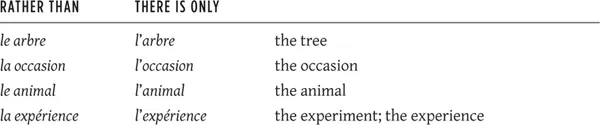
In speaking, we usually can hear where one word ends and the other begins by the enunciation of the consonant that ends the first word, or of the consonant that begins the second word. When one word ends with a vowel and the next word begins with a vowel, we are forced to indicate where one word ends and the other begins by closing the glottis, the space the between the vocal cords in the throat, ever so slightly (try to say “zoo owner” or “bee eater”). This action is called a glottal stop. The French language dislikes the glottal stop, and goes to great lengths to avoid it. Therefore, when a definite article—le or la—is followed by a noun that begins with a vowel, an alteration of the article has been devised in order to avoid the glottal stop that would otherwise occur. This altered, alternative definite article is the letter l followed by an apostrophe, which replaces the le or la when the following word begins with a vowel: Therefore,
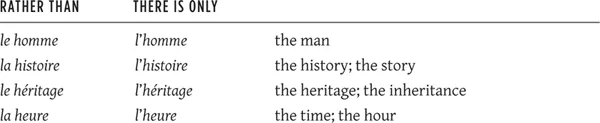
Since the h in French is silent (i.e., it is not aspirated) when it begins a word, a word beginning with h sounds as though, and is treated as though, it begins with its second letter, the vowel following the h. The abbreviated article l’ will be used as the definite article for these words as well. Therefore,
However, as with almost all grammatical rules in French, ther...
Table of contents
- Cover
- Half title
- Title
- Copyright
- Dedication
- Contents
- Acknowledgments
- Introduction
- 1. Nouns, Articles, and Prepositions, and the Principle of Agreement
- 2. Verbs, Subject Pronouns, and the Present Tense/Présent De l’Indicatif
- 3. Adjectives and Adverbs
- 4. Reflexive Verbs
- 5. The Imperfect/l’Imparfait
- 6. Past Participles/Les Participes Passés
- 7. Le Passé Composé/The Compound Past
- 8. Direct and Indirect Object Pronouns
- 9. Additional Forms of the Negative
- 10. More Irregular Yet Common Verbs
- 11. Impersonal Pronouns, Demonstrative Pronouns, Impersonal Verbs, and an Introduction to the Word QUE
- 12. The Future and Conditional Tenses/Le Futur Simple et le Conditionnel
- 13. Present Participles and Imperatives
- 14. The Passive Voice
- 15. Le Passé Simple/The simple Past, or the Past Historic
- 16. Relative and Interrogative Pronouns and Adjectives
- 17. More Compound Tenses
- 18. The Causative FAIRE
- 19. Le Subjonctif/The Subjunctive
- 20. Modal Verbs and Other Common Idiomatic Verbal Constructions
- 21. Changes of Tense with Idioms of Time
- 22. Common Idiomatic Expressions
- 23. Configurations of the Infinitive
- 24. Some Verb Families
- 25. Further Translation Passages
- Appendix
- Index
Frequently asked questions
Yes, you can cancel anytime from the Subscription tab in your account settings on the Perlego website. Your subscription will stay active until the end of your current billing period. Learn how to cancel your subscription
No, books cannot be downloaded as external files, such as PDFs, for use outside of Perlego. However, you can download books within the Perlego app for offline reading on mobile or tablet. Learn how to download books offline
Perlego offers two plans: Essential and Complete
- Essential is ideal for learners and professionals who enjoy exploring a wide range of subjects. Access the Essential Library with 800,000+ trusted titles and best-sellers across business, personal growth, and the humanities. Includes unlimited reading time and Standard Read Aloud voice.
- Complete: Perfect for advanced learners and researchers needing full, unrestricted access. Unlock 1.5M+ books across hundreds of subjects, including academic and specialized titles. The Complete Plan also includes advanced features like Premium Read Aloud and Research Assistant.
We are an online textbook subscription service, where you can get access to an entire online library for less than the price of a single book per month. With over 1.5 million books across 990+ topics, we’ve got you covered! Learn about our mission
Look out for the read-aloud symbol on your next book to see if you can listen to it. The read-aloud tool reads text aloud for you, highlighting the text as it is being read. You can pause it, speed it up and slow it down. Learn more about Read Aloud
Yes! You can use the Perlego app on both iOS and Android devices to read anytime, anywhere — even offline. Perfect for commutes or when you’re on the go.
Please note we cannot support devices running on iOS 13 and Android 7 or earlier. Learn more about using the app
Please note we cannot support devices running on iOS 13 and Android 7 or earlier. Learn more about using the app
Yes, you can access A Short Course in Reading French by Celia Brickman in PDF and/or ePUB format, as well as other popular books in Languages & Linguistics & French Language. We have over 1.5 million books available in our catalogue for you to explore.