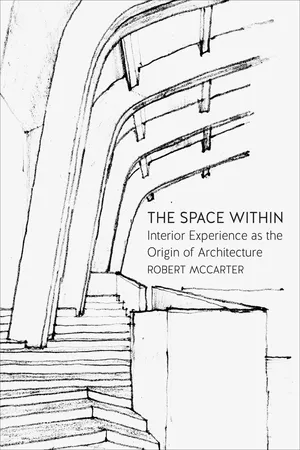
The architect Alvar Aalto once argued that what mattered in architecture was not what a building 'looks like' on the day it opens, but what it 'is like' to live in thirty years later. In this book Robert McCarter presents a persuasive defence of why and how interior spatial experience is the necessary starting point for design, and why the quality of that experience is the only appropriate means of evaluating a work of architecture after it is built.
The Space Within explores how interior space has been integral to the development of Modern architecture from the late 1800s to today, and how generations of architects have engaged with interior space and its experience in their design processes. In doing so, they fundamentally transformed the traditional methods and goals of architectural composition. As McCarter argues, for many of the most recognized and respected architects practising today, the conception of the interior spatial experience continues to be the starting point for design. Through historical and current examples of architectural works he takes us through how this is done, and eloquently places us within the spaces.
- English
- ePUB (mobile friendly)
- Available on iOS & Android
eBook - ePub
About this book
Trusted by 375,005 students
Access to over 1.5 million titles for a fair monthly price.
Study more efficiently using our study tools.
Information
Topic
ArchitectureSubtopic
Architecture GeneralReferences
1 The Space Within as the Origin of Architecture
1 The Japanese culture of blackness and shadows is documented in Jun’ichiro Tanizaki, In Praise of Shadows, trans. Thomas J. Harper and Edward G. Seidensticker (New Haven, CT, 1977).
2 Frank Lloyd Wright, An American Architecture (New York, 1955), pp. 217–19.
3 Ibid., p. 80.
4 Okakura Kakuzō, The Book of Tea (Tokyo, 1956), p. 45.
5 John Dewey, Art as Experience (New York, 1980), p. 209.
6 Wright, An American Architecture, pp. 208–10.
7 Le Corbusier, Oeuvre complète, 1946–1952, ed. W. Boesiger (Zurich, 1953), p. 186.
8 Le Corbusier and Jean Petit, Un couvent de Le Corbusier (Paris, 1961), p. 20.
9 Le Corbusier, letter to Edgar Varèse, 12 June 1956, Fondation Le Corbusier, g2.20.516–517, quoted in Roberto Gargiani and Anna Rosellini, Le Corbusier: Béton Brut and Ineffable Space, 1940–1965, Surface Materials and Psychophysiology of Vision (Lausanne, 2011), p. 465.
10 Louis Kahn, ‘The Room, the Street, and Human Agreement’ [1971], in Louis I. Kahn: Writings, Lectures, Interviews, ed. Alessandra Latour (New York, 1991), p. 263.
11 Louis Kahn, What Will Be Has Always Been: The Words of Louis I. Kahn, ed. Richard Saul Wurman (New York, 1991), p. 85.
12 Kahn, ‘The Room, the Street, and Human Agreement’, p. 265.
13 Kahn, What Will Be Has Always Been, p. 248.
14 Kahn, ‘The Room, the Street, and Human Agreement’, p. 264.
15 Kahn, ‘How’m I doing, Corbusier?’ [1972], in Louis I. Kahn: Writings, Lectures, Interviews, pp. 298–9.
16 Steven Holl, Steven Holl: Architecture Spoken (New York, 2007), p. 274.
17 Tod Williams and Billie Tsien, ‘What Lasts’, lecture given at Washington University in St Louis, Missouri, 30 January 2009; from the author’s notes taken at the lecture.
18 Tod Williams and Billie Tsien, quoted in Michael Welton, ed., Drawing from Practice (London, 2015), p. 208.
19 Adrian Stokes, ‘Smooth and Rough’ [1951], in The Critical Writings of Adrian Stokes (London, 1978), vol. II, p. 241.
20 Adrian Stokes, ‘The Stones of Rimini’ [1934], in The Critical Writings of Adrian Stokes, vol. I, p. 258.
21 Ibid., p. 235.
22 Adrian Stokes, ‘The Invitation in Art’ [1965], in The Critical Writings of Adrian Stokes, vol. III, p. 277.
23 Adrian Stokes, ‘The Stones of Rimini’, p. 229.
2 The Nearness of Interior Experience and the Distance of Exterior Form
1 During the 1990s, when I was Director of the School of Architecture at the University of Florida, at the beginning of the school year the 300 new freshman architecture and design students were asked to name their favourite architect, with some 98 per cent typically responding ‘Frank Lloyd Wright’, and then they were asked if they had ever visited a building designed by that architect, to which only 1 per cent responded in the affirmative – they ‘knew’ Wright’s work only through photographs of it.
2 Alvar Aalto, quoted in Colin St John Wilson, The Other Tradition of Modern Architecture (London, 1995), p. 123.
3 Frank Lloyd Wright, ‘Reply to Mr Sturgis’s Criticism’, in In the Cause of Architecture (Buffalo, NY, 1909), reprinted in Jack Quinan, Frank Lloyd Wright’s Larkin Building (Cambridge, MA, 1987), p. 166.
4 Josef Albers, ‘On General Education and Art Education’, quoted in Mary Emma Harris, The Arts at Black Mountain College (Cambridge, MA, 1987), p. 17.
5 Wilfried Wang, ‘Architecture as Art’, in Alterstudio Architecture, 6 Houses (Oxford, OH, 2014), pp. 8–9.
6 Aldo van Eyck, Aldo van Eyck: Writings, ed. Vincent Ligtelijn and Francis Strauven (Amsterdam, 2008), vol. I, p. 63.
7 David Van Zanten, ‘Kahn and Architectural Composition’, unpublished paper read on 24 January 2004, ‘Engaging Louis I. Kahn: A Legacy for the Future’, conference, 23–24 January 2004, Yale University; courtesy of David Van Zanten.
8 Louis Kahn, quoted in ‘Kahn on Beaux-Arts Training’, ed. William Jordy, Architectural Review, CLV (June 1974), p. 332.
9 Frank Lloyd Wright, Frank Lloyd Wright: Collected Writings, 1894–1930, ed. Bruce Brooks Pfeiffer (New York, 1992), vol. I, p. 24; vol. II, p. 205.
10 Ibid., vol. I, p. 36. Wright later restated this even more explicitly: ‘for buildings are the background or framework for the human life within their walls’; Frank Lloyd Wright, An American Architecture (New York, 1955), p. 53.
11 Walter Benjamin, ‘The Work of Art in the Age of Mechanical Reproduction’, in Illuminations: Walter Benjamin, ed. Hannah Arendt (New York, 1969), pp. 239–40.
12 Martin Heidegger, ‘The Thing’, in Poetry, Language, Thought, ed. Albert Hofstadter (New York, 1971), pp. 168–9.
13 Juhani Pallasmaa, The Eyes of the Skin (London, 1996), p. 10. Pallasmaa followed this first book, an instant classic, with two other equally succinct arguments for all the senses to be re-engaged in architectur...
Table of contents
- Front Cover
- Half Title
- Title Page
- Copyright
- Contents
- Introduction: The Primacy of Interior Experience in Architecture
- one The Space Within as the Origin of Architecture
- two The Nearness of Interior Experience and the Distance of Exterior Form
- three Three Early Modern Conceptions of Interior Space
- four The Separate Paths of the Eye and the Body in Experience
- five The Shape of Interior Space and the Boundary of Place
- six The Society of Spaces and the Emplacement of Encounters
- seven The Nesting of Places at Once Intimate and Immense
- eight Making Room for Experience and Memory
- nine Interior Experience of the Exterior Environment
- Conclusion: Interior Experience as Initiation and Evaluation of Architecture
- References
- Bibliography
- Acknowledgements
- Index
Frequently asked questions
Yes, you can cancel anytime from the Subscription tab in your account settings on the Perlego website. Your subscription will stay active until the end of your current billing period. Learn how to cancel your subscription
No, books cannot be downloaded as external files, such as PDFs, for use outside of Perlego. However, you can download books within the Perlego app for offline reading on mobile or tablet. Learn how to download books offline
Perlego offers two plans: Essential and Complete
- Essential is ideal for learners and professionals who enjoy exploring a wide range of subjects. Access the Essential Library with 800,000+ trusted titles and best-sellers across business, personal growth, and the humanities. Includes unlimited reading time and Standard Read Aloud voice.
- Complete: Perfect for advanced learners and researchers needing full, unrestricted access. Unlock 1.5M+ books across hundreds of subjects, including academic and specialized titles. The Complete Plan also includes advanced features like Premium Read Aloud and Research Assistant.
We are an online textbook subscription service, where you can get access to an entire online library for less than the price of a single book per month. With over 1.5 million books across 990+ topics, we’ve got you covered! Learn about our mission
Look out for the read-aloud symbol on your next book to see if you can listen to it. The read-aloud tool reads text aloud for you, highlighting the text as it is being read. You can pause it, speed it up and slow it down. Learn more about Read Aloud
Yes! You can use the Perlego app on both iOS and Android devices to read anytime, anywhere — even offline. Perfect for commutes or when you’re on the go.
Please note we cannot support devices running on iOS 13 and Android 7 or earlier. Learn more about using the app
Please note we cannot support devices running on iOS 13 and Android 7 or earlier. Learn more about using the app
Yes, you can access The Space Within by Robert McCarter in PDF and/or ePUB format, as well as other popular books in Architecture & Architecture General. We have over 1.5 million books available in our catalogue for you to explore.