- 521 pages
- English
- PDF
- Available on iOS & Android
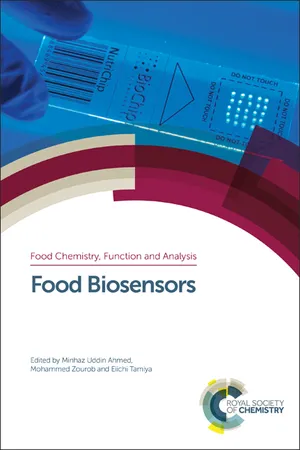
Food Biosensors
About this book
Biosensors are increasingly being used to replace traditional methods of analyte detection in the food industry. They offer a much quicker, more reliable and more versatile method for the detection of toxins, allergens, hormones, microorganisms, pesticides and other related compounds. This book, therefore, showcases the latest biosensor development in a single resource.
Edited by Minhaz Uddin Ahmed, Mohammed Zourob and Eiichi Tamilya and with contributors from a list of world renowned scientists, this book covers the fabrication of biosensors, the development of miniatursied devices as well as the latest applications in the food industry. Several case studies of recent European food scandals emphasise the need for the development of reliable and affordable food monitoring devices.
Up to date information on the current issues facing food biosensor development is presented in this key resource for food biotechnologists, food chemists and biosensor related students and researchers all over the world.
Tools to learn more effectively

Saving Books

Keyword Search

Annotating Text

Listen to it instead
Information
Table of contents
- Cover
- Food Biosensors
- Preface
- Contents
- Chapter 1 - Introduction to Food Biosensors
- Chapter 2 - Innovative Tools with Miniaturized Devices for Food Biosensing
- Chapter 3 - Glucose, Glutamate, and Lactate Sensors for Measuring Food Components
- Chapter 4 - Biosensor Platforms for Detecting Target Species in Milk Samples
- Chapter 5 - Bionanotechnology-Based Colorimetric Sensors for Food Analysis
- Chapter 6 - An Evanescent Wave Fluorescent Immunosensor for Milk Quality Monitoring
- Chapter 7 - Chemiluminescence and Fluorescence Optical Biosensor for the Detection of Aflatoxins in Food
- Chapter 8 - Colorimetric Biosensors for Bacterial Detection
- Chapter 9 - Nanomaterial-Based Electrochemical Sensors for Highly Sensitive Detection of Foodborne Pathogens
- Chapter 10 - Development of Rapid Electrobiochemical Assays for Food Toxins
- Chapter 11 - Food Biosensors Based on Molecularly Imprinted Polymers
- Chapter 12 - Electrochemical Monitoring of Antioxidant Capacity in Food
- Chapter 13 - Nanostructure-Modified Electrodes for Food Sensors
- Chapter 14 - Graphene-Based Biosensors for Food Analysis
- Chapter 15 - Rapid Detection of Food Pathogens by Portable and On-Site Electrochemical DNA Sensors
- Chapter 16 - Isothermal DNA Amplification Strategies for Food Biosensors
- Chapter 17 - Capillary Array-Based Microanalytical Devices for Simple and Multiplexed Detection in Bioanalysis
- Chapter 18 - Biosensor Systems for the Monitoring of Fish Health and Freshness in Aquaculture
- Chapter 19 - Phage-Based Biosensors for Food Analysis
- Chapter 20 - Food Biosensors: Perspective, Reliability, Selectivity, Response Time, Quality Control, and Cost-Effectiveness
- Subject Index
Frequently asked questions
- Essential is ideal for learners and professionals who enjoy exploring a wide range of subjects. Access the Essential Library with 800,000+ trusted titles and best-sellers across business, personal growth, and the humanities. Includes unlimited reading time and Standard Read Aloud voice.
- Complete: Perfect for advanced learners and researchers needing full, unrestricted access. Unlock 1.4M+ books across hundreds of subjects, including academic and specialized titles. The Complete Plan also includes advanced features like Premium Read Aloud and Research Assistant.
Please note we cannot support devices running on iOS 13 and Android 7 or earlier. Learn more about using the app