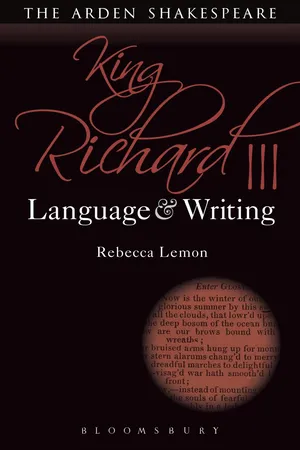
A new type of study aid which combines lively critical insight with practical guidance on the critical writings skills students need to develop in order to engage fully with Shakespeare's texts. The book's core focus is on language: both understanding and enjoying Shakespeare's complex dramatic language, and expanding the student's own critical vocabulary as they respond to the play.
The book explores several different approaches to Shakespeare's language. It looks at how the subtleties of Shakespeare's language reveal the thought processes and motivations of his characters, often in ways those characters themselves don't recognise; it analyses how Shakespeare's language works within or sometimes against various historical contexts, the contexts of stage performance, of genre and of discourses of his day (of religion, law, commerce, and friendship); and it explores how the peculiarities of Shakespeare's language often point to broad issues, themes, or ways of thinking that transcend any one character or line of action. Each chapter includes a "Writing Matters" section, giving students ideas and guidance for building their own critical response to the play and the skills to articulate it with confidence.
- 201 pages
- English
- PDF
- Available on iOS & Android
eBook - PDF
King Richard III: Language and Writing
About this book
Trusted by 375,005 students
Access to over 1.5 million titles for a fair monthly price.
Study more efficiently using our study tools.
Information

LANGUAGE
IN
PRINT:
WORDS,
LINES,
SPEECHES
75
extremes—that
of
a
man
who
is
not
eminently
good
and
just,
yet
whose
misfortune
is
brought
about
not
by
vice
or
depravity,
but
by
some
error
or
frailty.
He
must
be
one
who
is
highly
renowned
and
prosperous—a
personage
like
Oedipus,
Thyestes,
or
other
illustrious
men
of
such
families.
Of
the
“bad
man
passing
from
adversity
to
prosperity”
Aristotle
claims
“nothing
can
be
more
alien
to
the
spirit
of
Tragedy.”
But
this
is,
arguably,
what
Richard
III
offers.
The
play
also
offers
“the
downfall
of
the
utter
villain,”
a
problematic
and
untragic
plot
that,
even
if
it
satisfies
the
audience
morally,
“would
inspire
neither
pity
nor
fear.”
Consider
the
question
of
Richard
III
as
tragedy,
as
its
title
page
announces.
Does
the
play
unexpectedly
inspire
pity
or
fear
in
the
manner
of
Aristotelian
tragedy,
even
if
it
does
depict
the
downfall
of
a
villain?
Might
Richard
be
more
complex
than
a
mere
“utter
villain”?
In
other
words,
does
the
tragedy
of
Richard
III
push
back
against
the
Aristotelian
definition
of
the
genre,
which
insists
that
a
play
centered
on
a
bad
man
cannot
be
tragedy?
If
so,
how
might
you
shape
another
definition
of
the
genre,
to
account
for
Shakespeare’s
play?

76
Table of contents
- Cover page
- Halftitle page
- Series page
- Title page
- Copyright page
- CONTENTS
- ACKNOWLEDGMENTS
- PREFACE
- Introduction
- CHAPTER ONE Language in Print: Words, Lines, Speeches
- CHAPTER TWO Language and Structure
- CHAPTER THREE Language Through Time
- CHAPTER FOUR Writing Tips and Topics
- BIBLIOGRAPHY
Frequently asked questions
Yes, you can cancel anytime from the Subscription tab in your account settings on the Perlego website. Your subscription will stay active until the end of your current billing period. Learn how to cancel your subscription
No, books cannot be downloaded as external files, such as PDFs, for use outside of Perlego. However, you can download books within the Perlego app for offline reading on mobile or tablet. Learn how to download books offline
Perlego offers two plans: Essential and Complete
- Essential is ideal for learners and professionals who enjoy exploring a wide range of subjects. Access the Essential Library with 800,000+ trusted titles and best-sellers across business, personal growth, and the humanities. Includes unlimited reading time and Standard Read Aloud voice.
- Complete: Perfect for advanced learners and researchers needing full, unrestricted access. Unlock 1.5M+ books across hundreds of subjects, including academic and specialized titles. The Complete Plan also includes advanced features like Premium Read Aloud and Research Assistant.
We are an online textbook subscription service, where you can get access to an entire online library for less than the price of a single book per month. With over 1.5 million books across 990+ topics, we’ve got you covered! Learn about our mission
Look out for the read-aloud symbol on your next book to see if you can listen to it. The read-aloud tool reads text aloud for you, highlighting the text as it is being read. You can pause it, speed it up and slow it down. Learn more about Read Aloud
Yes! You can use the Perlego app on both iOS and Android devices to read anytime, anywhere — even offline. Perfect for commutes or when you’re on the go.
Please note we cannot support devices running on iOS 13 and Android 7 or earlier. Learn more about using the app
Please note we cannot support devices running on iOS 13 and Android 7 or earlier. Learn more about using the app
Yes, you can access King Richard III: Language and Writing by Rebecca Lemon in PDF and/or ePUB format, as well as other popular books in Literature & Shakespeare Drama. We have over 1.5 million books available in our catalogue for you to explore.