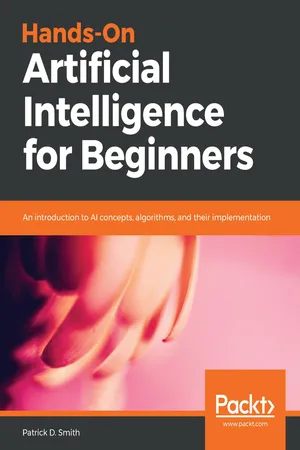
Hands-On Artificial Intelligence for Beginners
eBook - ePub

Hands-On Artificial Intelligence for Beginners

An introduction to AI concepts, algorithms, and their implementation

  1. 362 pages
  2. English
  3. ePUB (mobile friendly)
  4. Available on iOS & Android
eBook - ePub

Hands-On Artificial Intelligence for Beginners

An introduction to AI concepts, algorithms, and their implementation

About this book

Grasp the fundamentals of Artificial Intelligence and build your own intelligent systems with ease

Key Features

  • Enter the world of AI with the help of solid concepts and real-world use cases
  • Explore AI components to build real-world automated intelligence
  • Become well versed with machine learning and deep learning concepts

Book Description

Virtual Assistants, such as Alexa and Siri, process our requests, Google's cars have started to read addresses, and Amazon's prices and Netflix's recommended videos are decided by AI. Artificial Intelligence is one of the most exciting technologies and is becoming increasingly significant in the modern world.

Hands-On Artificial Intelligence for Beginners will teach you what Artificial Intelligence is and how to design and build intelligent applications. This book will teach you to harness packages such as TensorFlow in order to create powerful AI systems. You will begin with reviewing the recent changes in AI and learning how artificial neural networks (ANNs) have enabled more intelligent AI. You'll explore feedforward, recurrent, convolutional, and generative neural networks (FFNNs, RNNs, CNNs, and GNNs), as well as reinforcement learning methods. In the concluding chapters, you'll learn how to implement these methods for a variety of tasks, such as generating text for chatbots, and playing board and video games.

By the end of this book, you will be able to understand exactly what you need to consider when optimizing ANNs and how to deploy and maintain AI applications.

What you will learn

  • Use TensorFlow packages to create AI systems
  • Build feedforward, convolutional, and recurrent neural networks
  • Implement generative models for text generation
  • Build reinforcement learning algorithms to play games
  • Assemble RNNs, CNNs, and decoders to create an intelligent assistant
  • Utilize RNNs to predict stock market behavior
  • Create and scale training pipelines and deployment architectures for AI systems

Who this book is for

This book is designed for beginners in AI, aspiring AI developers, as well as machine learning enthusiasts with an interest in leveraging various algorithms to build powerful AI applications.

Trusted by 375,005 students

Access to over 1 million titles for a fair monthly price.

Study more efficiently using our study tools.

Information

Year
2018
Print ISBN
9781788991063
Edition
1
eBook ISBN
9781788992268

Deep Learning for Finance

Deep learning is one of the most exciting new technologies being used in the financial services industry, and when used correctly, can improve investment returns. While tasks such as computer vision and natural language processing (NLP) are well-researched areas, the use of Artificial Intelligence (AI) techniques in financial services is still growing. It's important to note that some of the most advanced, lucrative deep learning techniques in AI are not published, nor will they ever be. The lucrative nature of the financial services space necessitates guarding advanced algorithms and measures, and so in this chapter we will focus on principles.
The application of AI in the financial services industry is nuanced; it's being used in areas where it can perform faster and better than a human could, but still isn't being used ubiquitously. By far, the most ubiquitous use of deep learning in the financial services industry is in feature engineering.
An entire book could be written simply on the topic of deep learning in financial services. While we won't go into depth on financial topics, we will touch upon the definitions of terms and concepts that we introduce throughout this chapter. We'll be covering several basic AI-driven trading methods, as well as an event-based trading method that utilizes a new type of Artificial Neural Network (ANN) that we have yet to talk about—the Neural Tensor Network. Lastly, we'll look at how deep learning can aid us in developing optimal portfolios of stocks.
We will be looking at the following topics in this chapter:
  • Introduction to deep learning in finance
  • Deep learning in trading
  • Deep learning in asset management

Requirements

As usual, we will be utilizing Python 3 for our analysis. Python is an excellent choice for quantitative trading applications that have a frequency that's greater than a few seconds. For high-frequency applications, it is recommended that you use a mid-level language such as Java or C++.
In this chapter, we will be using finance-specific Python libraries on top of our standard deep learning stack:
Zipline—An algorithmic trading library in Python. It is currently used as the backtesting package for the quantitative trading website Quantopian (https://www.quantopian.com).

Introduction to AI in finance

Despite being one of the most computationally intensive fields, financial services is full of heuristics. The application of advanced AI techniques is tenuous at best; many firms simply don't engage in strategies that allow for easy adoption of AI. Talent wars for top quantitative talent with Silicon Valley has also made the problem worse. You may be saying to yourself don't I need to have a finance background to work with this data? It's worth noting that two of the world's top hedge funds were founded by teams that participated in the famous Netflix Machine Learning challenge. While there is incredible benefit in studying the techniques of algorithmic trading, you can get started with your knowledge of ANNs and how to handle financial data appropriately with them.
Now, let's start setting up the landscape. In financial services, there are two general sides to the business:
  • Deal-based firms: Investment banking, venture capital, and private equity
  • Public markets: Hedge funds, trading departments at large banks, and various asset management firms
You may also hear the terms buy-side and sell-side, which attempt to divide the market into firms that generally buy large amounts of securities such as hedge funds, and those you sell large amounts of securities to, such as big banks. For our purposes, this isn't very useful as we are interested in exploring applications of AI for any public market, and hence we will be using the deals versus public markets definition.

Deep learning in trading

Trading is the buying and selling of items in the financial market; in financial parlance, we call these items derivatives. Trades can be short-term (inter-day), medium-term (several days), or long-term (several weeks or more). According to experts at JP Morgan Chase, one of the largest banks in the world, AI applications are proven to be better suited than humans at short and medium-term trading strategies. In this section, we'll explore some fundamental strategies for developing intelligent trading algorithms for short and medium- term trades. But first, let's cover some basic concepts.
Trading strategies seek to exploit market inefficiencies in order to make profit. One of the core policies in algorithmic training is called alpha, which is a measure of performance. Alpha measures the active return on a specific investment by matching a stock against an index. The difference between the performance of an individual investment and its matched index is the investment's alpha. In building networks for trading strategies, we want our networks to spot market inefficiencies that generate the most alpha for us.
We can generally break traditional stock analysis down into two categories:
  • Fundamental analysis looks at the underlying factors that could influence a financial derivative, such as the general financial health of a company
  • Technical analysis looks at the actual performance of the financial derivative in a more mathematical sense, attempting to predict price movements based on patterns in the asset's price movements
In both of these cases, analysis is typically done with human reasoning, whereas deep learning comes into the world of quantitative analysis, specifically in what is known as algorithmic trading. Broadly defined, algorithmic trading is just as it sounds: trading that is conducted by a coded algorithm and not a physical human. Algorithmic trading strategies are validated by a process called backtesting, which runs the algorithm on historical data to determine whether it will perform well in the market.
Algorithmic trading is used in several different types of areas:
  • Buy-side firms: Firms utilize algorithmic trading to manage their mid-to long-term portfolio investments
  • Sell-side firms: Firms use high-frequency algorithmic trading to take advantage of market opportunities and move markets themselves
  • Systematic traders: These individuals and firms try to match a long-term investment with a short-term investment of highly correlated financial derivatives
What's shared among all three of these market entities is that algorithmic trading provides a more stable and systematic approach to active investing, which is something that a human instinct could not provide.
Another strategy relies on technical indicators, which are mathematical calculations based on the historical analysis of data. Most trading algorithms are used in what is known as high-frequency trading (HFT), which attempts to exploit market inefficiencies by conducting large numbers of extremely fast trades across markets. ...

Table of contents

  1. Title Page
  2. Copyright and Credits
  3. Packt Upsell
  4. Contributors
  5. Preface
  6. The History of AI
  7. Machine Learning Basics
  8. Platforms and Other Essentials
  9. Your First Artificial Neural Networks
  10. Convolutional Neural Networks
  11. Recurrent Neural Networks
  12. Generative Models
  13. Reinforcement Learning
  14. Deep Learning for Intelligent Agents
  15. Deep Learning for Game Playing
  16. Deep Learning for Finance
  17. Deep Learning for Robotics
  18. Deploying and Maintaining AI Applications
  19. Other Books You May Enjoy

Frequently asked questions

Yes, you can cancel anytime from the Subscription tab in your account settings on the Perlego website. Your subscription will stay active until the end of your current billing period. Learn how to cancel your subscription
No, books cannot be downloaded as external files, such as PDFs, for use outside of Perlego. However, you can download books within the Perlego app for offline reading on mobile or tablet. Learn how to download books offline
Perlego offers two plans: Essential and Complete
  • Essential is ideal for learners and professionals who enjoy exploring a wide range of subjects. Access the Essential Library with 800,000+ trusted titles and best-sellers across business, personal growth, and the humanities. Includes unlimited reading time and Standard Read Aloud voice.
  • Complete: Perfect for advanced learners and researchers needing full, unrestricted access. Unlock 1.4M+ books across hundreds of subjects, including academic and specialized titles. The Complete Plan also includes advanced features like Premium Read Aloud and Research Assistant.
Both plans are available with monthly, semester, or annual billing cycles.
We are an online textbook subscription service, where you can get access to an entire online library for less than the price of a single book per month. With over 1 million books across 990+ topics, we’ve got you covered! Learn about our mission
Look out for the read-aloud symbol on your next book to see if you can listen to it. The read-aloud tool reads text aloud for you, highlighting the text as it is being read. You can pause it, speed it up and slow it down. Learn more about Read Aloud
Yes! You can use the Perlego app on both iOS and Android devices to read anytime, anywhere — even offline. Perfect for commutes or when you’re on the go.
Please note we cannot support devices running on iOS 13 and Android 7 or earlier. Learn more about using the app
Yes, you can access Hands-On Artificial Intelligence for Beginners by Patrick D. Smith in PDF and/or ePUB format, as well as other popular books in Computer Science & Artificial Intelligence (AI) & Semantics. We have over one million books available in our catalogue for you to explore.