A new, evolutionary explanation of markets and investor behavior
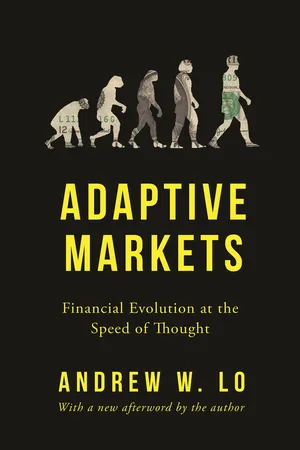
Half of all Americans have money in the stock market, yet economists can't agree on whether investors and markets are rational and efficient, as modern financial theory assumes, or irrational and inefficient, as behavioral economists believe. The debate is one of the biggest in economics, and the value or futility of investment management and financial regulation hangs on the answer. In this groundbreaking book, Andrew Lo transforms the debate with a powerful new framework in which rationality and irrationality coexist—the Adaptive Markets Hypothesis. Drawing on psychology, evolutionary biology, neuroscience, artificial intelligence, and other fields, Adaptive Markets shows that the theory of market efficiency is incomplete. When markets are unstable, investors react instinctively, creating inefficiencies for others to exploit. Lo's new paradigm explains how financial evolution shapes behavior and markets at the speed of thought—a fact revealed by swings between stability and crisis, profit and loss, and innovation and regulation. An ambitious new answer to fundamental questions about economics and investing, Adaptive Markets is essential reading for anyone who wants to understand how markets really work.
- English
- ePUB (mobile friendly)
- Available on iOS & Android
About this book
Trusted by 375,005 students
Access to over 1.5 million titles for a fair monthly price.
Study more efficiently using our study tools.
Key takeaways
Evaluate the foundational assumptions of the Efficient Market Hypothesis and behavioral economics regarding investor rationality and market efficiency. Formulate how the Adaptive Markets Hypothesis synthesizes these perspectives to explain financial market dynamics.
Analyze how principles from evolutionary biology, psychology, and neuroscience explain the adaptive nature of financial markets and investor decision-making. Explain the mechanisms through which fear, greed, and other cognitive processes influence market stability and instability.
Apply the Adaptive Markets Hypothesis to interpret historical financial events, including market crises, and to evaluate various investment strategies. Propose adaptive regulatory approaches informed by an evolutionary understanding of financial systems.
Table of contents
- Cover Page
- Title Page
- Copyright Page
- Dedication Page
- Contents
- Introduction
- Chapter 1. Are We All Homo economicus Now?
- Chapter 2. If You’re So Smart, Why Aren’t You Rich?
- Chapter 3. If You’re So Rich, Why Aren’t You Smart?
- Chapter 4. The Power of Narrative
- Chapter 5. The Evolution Revolution
- Chapter 6. The Adaptive Markets Hypothesis
- Chapter 7. The Galapagos Islands of Finance
- Chapter 8. Adaptive Markets in Action
- Chapter 9. Fear, Greed, and Financial Crisis
- Chapter 10. Finance Behaving Badly
- Chapter 11. Fixing Finance
- Chapter 12. To Boldly Go Where No Financier Has Gone Before
- Color Plates
- Afterword
- Notes
- References
- Acknowledgments
- Index
Frequently asked questions
Please note we cannot support devices running on iOS 13 and Android 7 or earlier. Learn more about using the app