In Bleeding Borders, Kristen Tegtmeier Oertel offers a fresh, multifaceted interpretation of the quintessential sectional conflict in pre--Civil War Kansas. Instead of focusing on the white, male politicians and settlers who vied for control of the Kansas territorial legislature, Oertel explores the crucial roles Native Americans, African Americans, and white women played in the literal and rhetorical battle between proslavery and antislavery settlers in the region. She brings attention to the local debates and the diverse peoples who participated in them during that contentious period.
Oertel begins by detailing the settlement of eastern Kansas by emigrant Indian tribes and explores their interaction with the growing number of white settlers in the region. She analyzes the attempts by southerners to plant slavery in Kansas and the ultimately successful resistance of slaves and abolitionists. Oertel then considers how crude frontier living conditions, Indian conflict, political upheaval, and sectional violence reshaped traditional Victorian gender roles in Kansas and explores women's participation in the political and physical conflicts between proslavery and antislavery settlers.
Oertel goes on to examine northern and southern definitions of "true manhood" and how competing ideas of masculinity infused political and sectional tensions. She concludes with an analysis of miscegenation -- not only how racial mixing between Indians, slaves, and whites influenced events in territorial Kansas, but more importantly, how the fear of miscegenation fueled both proslavery and antislavery arguments about the need for civil war.
As Oertel demonstrates, the players in Bleeding Kansas used weapons other than their Sharpes rifles and Bowie knives to wage war over the extension of slavery: they attacked each other's cultural values and struggled to assert their own political wills. They jealously guarded ideals of manhood, womanhood, and whiteness even as the presence of Indians and blacks and the debate over slavery raised serious questions about the efficacy of these principles. Oertel argues that, ultimately, many Native Americans, blacks, and women shaped the political and cultural terrain in ways that ensured the destruction of slavery, but they, along with their white male counterparts, failed to defeat the resilient power of white supremacy.
Moving beyond a conventional political history of Bleeding Kansas, Bleeding Borders breaks new ground by revealing how the struggles of this highly diverse region contributed to the national move toward disunion and how the ideologies that governed race and gender relations were challenged as North, South, and West converged on the border between slavery and freedom.
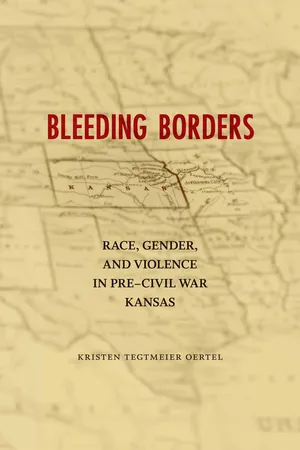
eBook - ePub
Bleeding Borders
Race, Gender, and Violence in Pre-Civil War Kansas
- 216 pages
- English
- ePUB (mobile friendly)
- Available on iOS & Android
eBook - ePub
About this book
Trusted by 375,005 students
Access to over 1.5 million titles for a fair monthly price.
Study more efficiently using our study tools.
Information
1
“THE TWO WERE SOON PRONOUNCED ONE”
RELIGIOUS, ECONOMIC, AND
SEXUAL EXCHANGE IN INDIAN KANSAS
SEXUAL EXCHANGE IN INDIAN KANSAS
Clara Gowing, a Baptist missionary in Kansas Territory from 1859 to 1864, attended the marriage of an Indian woman and a white soldier one Saturday afternoon during the Civil War. The couple wedded in haste because the new recruit for the Union army was scheduled to depart Kansas for the battlefield the following day. Though haphazardly assembled, the wedding spectacle impressed Gowing, and she recorded her observations of the ceremony in detail:
Here was a scene for a painter…. The motley group which gathered around the piazza, some dozen or more whites, including one or two military officers; the civilized Indian dressed in neat white costume like the whites; the wilder Indian decked with ribbons and beads of gaudy color, with his leather leggins and moccasins, the shirt collar open, exposing the brown breast; and yellow, black, or dirty white crape shawl tied around the head…. The trio of minister, with groom and bride standing on the piazza, the latter dressed with neatness and taste in white muslin … the whole lighted up a gorgeous September sunset sky, formed a scene not viewed every day.1
The publicly celebrated union of an Indian woman and a white man was not a “scene viewed every day” in mid-nineteenth-century America, but red-white sexual and marital exchanges were far from rare in Kansas. White missionaries and fur traders had lived among the Kansas Indians for decades, and the scarcity of white women in the area inevitably led to cross-racial sexual ties. Though some of these ties were undoubtedly forced and unsolicited, it is clear that consensual sexual relations between the two races existed and often facilitated the convergence of two vastly different cultural worlds.2
Gowing closed her report of the wedding ceremony by proclaiming, “The two were soon pronounced one.” As her narrative suggests, the once-separate Indian and Anglo worlds were moving closer, in proximity if not in culture. But Gowing’s story illustrates only one locus of exchange between native peoples and Anglos as white settlers infiltrated the valleys of the Missouri River and Kansas River after 1820. Indians and whites also forged religious and economic ties and fashioned an uneven and unstable middle ground that was neither wholly Indian nor purely Anglo. Whether by choice or by force, red and white boundaries merged in Indian Territory long before any cries of Bleeding Kansas were made; by examining Anglo-Indian contact in the region, one can conclude that the wound of Bleeding Kansas had several entry points.3
The physical and cultural middle ground created by Anglos and Indians in Kansas carried an important racial component that needs to be explored in order to fully understand race relations in antebellum Kansas. Gowing remarked that the “civilized Indian” was dressed in white, whereas the “wilder Indian” looked “gaudy” in ribbons and beads, complete with a “yellow, black or dirty white” shawl tied on his head. Gowing equated civilization with whiteness, a distinction made all the easier by the presence of “brown breasts” and “wild” Indians. Her diary illustrates that race relations sustained a less dichotomous tone than has previously been assumed, even in a nation obsessed with differences between whites and blacks and in a region fixated on sectional differences. Events in Kansas suggest that although settlers may have battled over the status of African Americans, they simultaneously united on the ground of white supremacy over Indians. Furthermore, white settlers’ perceptions of and interactions with Kansas Indians played a crucial role in developing white racial identity at midcentury. To ignore the influence of redness on the construction of whiteness and the maintenance of white supremacy and slavery is to overlook a key factor of racial formation in the United States.4
THE BLEEDING BEGINS
Before red and white intersected in Kansas, dozens of Indian tribes, each with its own unique language and culture, came into contact in the Old Northwest and plantation South, as white settlers pushed west of the Appalachians during the decades following the Revolutionary War. Conflict and coordination among tribes and with white settlers ensued, resulting in the social and economic reorganization of several Indian nations. Tribal consolidation and alliances formed new cultural hybrids among Indian groups, and increasing interaction with white settlers augmented this hybridization. The Algonquin-speaking people who traversed this “middle ground” in the upper Great Lakes region would be one of the many consolidated groups of disparate tribes who arrived in Kansas during the three decades preceding the Civil War.5
Tens of thousands of Indians moved to what in 1854 became Kansas Territory. In an action less infamous than the Jacksonian era’s violent removal of Indians from their native lands in the Southeast to reservations in Indian Territory, the U.S. government “forcefully encouraged” thousands of Indians from Ohio, Indiana, Illinois, Michigan, Wisconsin, and Missouri to move to eastern Kansas between 1820 and 1860.6 Even before this exodus, several tribes from the East, such as the Iowa, Shawnee, and Delaware, had already infiltrated the region and jockeyed with the resident Kaw, Osage, and Pawnee tribes for land and resources. Citing pressure from settlers in the plantation South and the Old Northwest, Superintendent of Indian Affairs William Clark (of Louis and Clark fame) negotiated several treaties with the Kaws and Osages in 1825. In exchange for financial annuities and agricultural implements, the resident Kansas Indians ceded thousands of acres of their land—not for white settlement but for Indians who had been displaced by violence and white encroachment in the East.7
The Indians who moved to Kansas before the passage of the Kansas-Nebraska Act arrived in the region after decades of encountering white settlers and their cultures and economies back in their home territories. One historian writes, “These intruders … brought with them syncretic cultures that often included the English language, Christianity or Christian-like religions, modern farming techniques, and sophisticated tools and weapons.”8 Their familiarity with the white world often created tension between these “immigrant Indians” and the resident Osages and Kaws, who had experienced less contact with Anglos. The first blood spilled in the territory was thus Indian, as “old” and “new” Kansas Indians battled with each other for farming and hunting lands.
Emigrant tribes such as the Delaware and Shawnee enjoyed a strategic advantage over their resident counterparts, such as the Kaw, when dealing with the federal government. The Delaware and Shawnee arrived in Kansas Territory equipped with more than a century of experience negotiating treaties with the federal government and trade agreements with white settlers.9 The reports taken by federal Indian agents on the Delaware reservation reflect the tribe’s familiarity with white ways and note their history of making peaceable treaties with the government. Alfred Cumming, superintendent of Indian affairs for the central region, proudly reported that the Delaware maintained faith in the government’s ability to protect Indian rights: “Notwithstanding the lawless intrusions upon their lands by citizens and others, the confidence of the Delawares in the integrity of the Government remains entirely unshaken; far accustomed to an implicit conformity on their part to treaty stipulations, they cannot realize the possibility that the Government will tolerate their violation by others.”10 According to Cumming, the Delaware, “a brave, honorable, and generous race,” had fulfilled their obligations to the government, and they expected reciprocity on the part of the “Great Father.” These shared expectations arose out of decades of negotiations between the two parties, treaty agreements that had become part and parcel of Delaware life since their initial removal from the coastal regions of the Northeast in the eighteenth century.11
Though the Shawnee began their negotiations with the federal government later than the Delaware, they too benefited from previous interactions with white settlers, missionaries, and officials. In an 1855 letter to George Manypenny, commissioner of Indian affairs, Superintendent Cumming reported that the “Shawnees are every where advancing towards a perfect civilization; the sound of the hammer, the saw, and the axe are now … familiar.”12 In his 1857 annual report to the commissioner, Cumming surveyed the status of each of the various tribes residing in Kansas and concluded his report with a generally positive account of the Shawnee Indian Mission and Manual Labor School. “The Shawnee Methodist Mission was … the largest and best conducted institution of that description in the Indian country,” he wrote.13 The Reverend Thomas Johnson, founder of the mission, reported from the school that the “Shawnees, and portions of other tribes, are becoming a working people, and are making considerable progress in the arts of civilized life.”14 Those tribes such as the Shawnee and Delaware who were familiar with the trappings of white society were then more likely to function effectively in treaty negotiations and trade deals.15
The Kaw, Sac and Fox, Kickapoo, and Osage Indians, on the other hand, received the brunt of white criticism, as they vehemently resisted white attempts to encroach upon their lands and challenge their cultural values. Cumming wrote in his 1857 annual report that the Sac and Fox tribe risked extinction if they failed to change their Indian ways: “This tribe is as barbarous in all their habits as they were twenty-five years ago…. They continue a courageous and intractable peoples, delighting in the chase, and addicted to war,—firmly opposed to every endeavor to inculcate upon them habits of civilization. They are rapidly diminishing in numbers…. Indeed, if they should die in the same ratio that they have done for some years past, this still brave, and once renowned tribe will soon be exterminated.”16 The Sac and Fox initially refused to allow whites in Kansas to transform their culture and relocate them to reservations. In the process, however, they engaged the white world militarily and lost many of their number to war and disease.
Like the Sac and Fox, the Kansas Kickapoo were known for their warlike stance with whites. Cumming met with Kickapoo chief Machina during his January 1857 visit and found the tribe to be in relatively good condition. However, he mentioned that the Pottawatomies who lived among the Kickapoo were “sober and industrious” and “furnish[ed] an excellent example to the Kickapoos,” implying that the Kickapoo needed such examples.17 Both the Kickapoo and the Pottawatomie tribes, however, repeatedly found themselves embroiled in conflict with their white neighbors and earned a reputation with white missionaries and settlers as being particularly stubborn.18
The Osage, too, persisted in their military and cultural antagonism toward white settlers. During the late 1840s the Comanche and Kiowas joined the Osage in attacks on U.S. Army troops who served as military escorts for government wagon trains on the Santa Fe Trail.19 In addition to defending their territorial claims in the region, the Osage protected their cultural sovereignty as well. Pioneer Charles M. Chase described the Osage men in Kansas as “the fiercest looking fellows I have ever seen.” He described their authentic dress in detail: “The blanket and the breech cloth is their only dress. Their noses and ears are loaded with twinkling trinkets, the heads shaved, leaving a narrow strip of stiff hair a half inch long from the forehead to the crown. Their faces are painted with bright yellow and red.”20 Agent John Whitfield complained about the Kaw and their habit of removing older boys from mission schools, that “instead of cultivating and improving the education they have received, you see them return with shaved heads, painted faces, and dressed in full Indian costume.”21 These observations were undoubtedly shaped by white prejudices about how “savages” dressed, but many of the Kaw and Osage clearly resisted attempts to impose the visible trappings of white “civilization” on their tribes.
While the resident and emigrant tribes differed in their levels of acceptance and/or rejection of white culture, both groups experienced a significant degree of intermixing with each other, before and after their arrival in Kansas Territory. Thus the boundaries among once-disparate tribes blurred as fragmented and dying tribes joined those bands that exhibited more strength and resilience. As early as 1830, the government recognized that “half-breed” mixes of various Indian ethnic groups would have to be acknowledged in order to apportion land properly for reservations in Kansas. In a July 16, 1830, treaty between the Sac and Fox, the Sioux, and the United States, the “half-breed” band of the Omahas, Ioways, and Otoes received entitlement to a tract of land in northeast Kansas. Twenty-five years later, Commissioner Manypenny suggested that a census be taken of the “half-breeds and mixed bloods properly entitled to share in the said reservation,” perhaps implying that the degree to which these tribes intermixed necessitated a frequent review of their members.22
Some tribes, like the Winnebagoes and Sacs, gained notoriety for their willingness to intermarry and combine tribal resources. Superintendent Cumming reported from the Nemaha Agency that “certain Winnebagoes … have lived for several years and intermarried with that [Sac] band. The agent informs me that these Winnebagoes were invited by the Sac Council to participate in the payment of their annuity.” Cumming strongly recommended that the close interconnections between the two tribes be maintained. “Many marriages connect the Winnebagoes with the Sacs, so that their tribes can only be separated by force,” he claimed, “and if that were used to separate them they would become vagabonds and a burdensome pest to their white neighbors.”23 Apparently, past experience proved that even if the government attempted to force separation of two commingling tribes, the fragmented tribes would loiter and wander throughout the region until reunited with their adopted tribal band.
Like the Winnebagoes and Sacs, the Kickapoos and Pottawatomies shared their resources and land in Kansas. Cumming reported seeing mostly Pottawatomie children at the Kickapoo mission school, and noted that he was not surprised by the tribes’ interconnectedness. He claimed that the Pottawatomies “hold the same relation to the Kickapoos as the Winnebagoes to the Sacs, and in both cases I believe a separation to be inadvisable.”24 Cumming also visited the united tribes of the Kaskaskia, Peoria, Piankeshaw, and Wea Indians; these tribes experienced such a rapid decline in population that consolidation was necessary for their survival. According to Cumming, they successfully defended their rights and established permanent settlements in Kansas, perhaps in part because they joined together in the face of intruding whites who squatted on Indian land.
The practice of intertribal mixing gained so much prominence, even when discouraged by government officials, that Superintendent Cumming recommended that the government officially sanction such behavior. He wrote: “The custom of inviting individuals of other tribes to participate in their payments even in cases where no consanguinity [exists] … prevails among many of the tribes…. It therefore becomes a matter of policy to tolerate the arrangement they voluntarily entered into; and if tolerated, it ought, in my opinion, to be authorized by order.”25 Cumming recognized that the government’s efforts to prevent certain tribes from intermixing were pointless, and under his leadership, the Central Superintendence succumbed to and reluctantly supported the Indian practice of tribal consolidation. As a result of Indian removal and migration, then, the blending of Indian cultures began well before the official arrival of white settlers in 1854.
“GOD WILL JUDGE IN RIGHTEOUSNESS”
The infiltration of religious missionaries and traders into the region during the 1830s and 1840s facilitated the syncretization of Indian and white cultures. One historian argues that the Kawsmouth settlement, a French/ Indian trading post eventually known as Kansas City, was “the most promising theater for a mixed-blood colony.”26 The conjunction of the Missouri River and Kansas River provided a strategic and fertile location for the fur trade, for agricultural pursuits, and for bringing a Christian God to the many Indians who resided in and passed through the region.
The Baptists, Catholics, Methodists, Moravians, and Presbyterians all established missions amid the eastern Kansas Indians during the 1830s and 1840s. Since their earliest efforts during ...
Table of contents
- COVER
- TITLE PAGE
- COPYRIGHT PAGE
- CONTENTS
- ACKNOWLEDGMENTS
- INTRODUCTION
- 1. “THE TWO WERE SOON PRONOUNCED ONE”
- 2. RUNAWAYS, “NEGRO STEALERS,” AND “BORDER RUFFIANS”
- 3. “ALL WOMEN ARE CALLED BAD”
- 4. “FREE SONS” AND “MYRMIDONS”
- 5. “DON’T YOU SEE OLD BUCK COMING?”
- CONCLUSION
- EPILOGUE
- NOTES
- BIBLIOGRAPHY
- INDEX
Frequently asked questions
Yes, you can cancel anytime from the Subscription tab in your account settings on the Perlego website. Your subscription will stay active until the end of your current billing period. Learn how to cancel your subscription
No, books cannot be downloaded as external files, such as PDFs, for use outside of Perlego. However, you can download books within the Perlego app for offline reading on mobile or tablet. Learn how to download books offline
Perlego offers two plans: Essential and Complete
- Essential is ideal for learners and professionals who enjoy exploring a wide range of subjects. Access the Essential Library with 800,000+ trusted titles and best-sellers across business, personal growth, and the humanities. Includes unlimited reading time and Standard Read Aloud voice.
- Complete: Perfect for advanced learners and researchers needing full, unrestricted access. Unlock 1.5M+ books across hundreds of subjects, including academic and specialized titles. The Complete Plan also includes advanced features like Premium Read Aloud and Research Assistant.
We are an online textbook subscription service, where you can get access to an entire online library for less than the price of a single book per month. With over 1.5 million books across 990+ topics, we’ve got you covered! Learn about our mission
Look out for the read-aloud symbol on your next book to see if you can listen to it. The read-aloud tool reads text aloud for you, highlighting the text as it is being read. You can pause it, speed it up and slow it down. Learn more about Read Aloud
Yes! You can use the Perlego app on both iOS and Android devices to read anytime, anywhere — even offline. Perfect for commutes or when you’re on the go.
Please note we cannot support devices running on iOS 13 and Android 7 or earlier. Learn more about using the app
Please note we cannot support devices running on iOS 13 and Android 7 or earlier. Learn more about using the app
Yes, you can access Bleeding Borders by Kristen Tegtmeier Oertel in PDF and/or ePUB format, as well as other popular books in History & American Civil War History. We have over 1.5 million books available in our catalogue for you to explore.