eBook - ePub
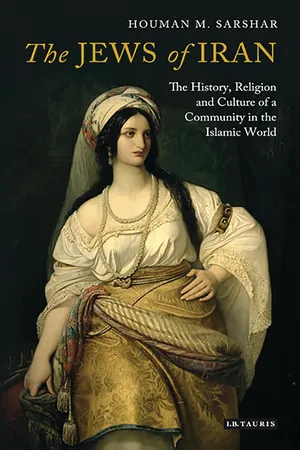
The Jews of Iran
The History, Religion and Culture of a Community in the Islamic World
- 264 pages
- English
- ePUB (mobile friendly)
- Available on iOS & Android
eBook - ePub
The Jews of Iran
The History, Religion and Culture of a Community in the Islamic World
About this book
Living continuously in Iran for over 2700 years, Jews have played an integral role in the history of the country. Frequently understood as a passive minority group, and often marginalized by the Zoroastrian and succeeding Muslim hegemony, the Jews of Iran are instead portrayed in this book as having had an active role in the development of Iranian history, society, and culture. Examining ancient texts, objects, and art from a wide range of times and places throughout Iranian history, as well as the medieval trade routes along which these would have travelled, The Jews of Iran offers in-depth analysis of the material and visual culture of this community. Additionally, an exploration of more modern accounts of Jewish women's experiences sheds light on the social history and transformations of the Jews of Iran from the rule of Cyrus the Great (c. 600–530 BCE) to the Iranian Revolution of 1978/9. This long view of the Jewish cultural influence on Iran's social, economic, and political development makes this book a unique contribution to the field of Judeo-Iranian studies and to the study of Iranian history.
Trusted by 375,005 students
Access to over 1.5 million titles for a fair monthly price.
Study more efficiently using our study tools.
Information
CHAPTER 1
NEW VISTAS ON THE HISTORY OF IRANIAN JEWRY IN LATE ANTIQUITY, PART I: PATTERNS OF JEWISH SETTLEMENT IN IRAN1
Parvaneh Pourshariati
The study of the history of Iranian Jewry in Late Antiquity remains an important desideratum for future scholarship. The picture painted thus far of this history remains at best fragmentary and episodic and, individual and important studies notwithstanding, seriously devoid of any systematic analysis.2 Scholars have sifted through the evidence provided by the Bible itself on the antiquity of the settlement of Iranian Jewry in various provinces of Iran, noting that these hark back to at least the eighth century BCE.3 Through individual and important studies, piecemeal information on the settlement of Jewry in ancient Media,4 Khuzestan, Azarbayjan,5 Armenia,6 Kurdestan,7 Gilan, Tabaristan, and Khorasan8 (though these last primarily deal with the later, post-Sasanian periods of Iranian history) have likewise been garnered. Thus, a very general maxim has been formed: when, sometime in mid-third century BCE, the Parthians (247 BCE – 224 CE) set out from the eastern regions of the Caspian Sea and began their westward journey through Parthava9 and Media, they encountered an ancient community in Iran—that of the Iranian Jewry. What is known besides this, however?
Besides this very elementary understanding,10 we still remain in the dark about many crucial aspects of this history. Thus, to date, the state-of-the-field remains predominantly the same as that which the late Walter Fischel had painted in the 1950s: the “spread and diffusion of the Jewish Diaspora beyond the Euphrates and Tigris into […] Persia […]11 still [remains] an obscure chapter of Jewish historical research.”12 Meager as our sources have been, however, and dim as the picture they present, there are yet vistas through which we can gain a better sense of this history. The present article is a preliminary attempt in explicating this perspective.
Though much has been said of the ostensible settlement of Iranian Jewry “on the trade routes” of the Near and Middle East in general—with comments that sporadically touch upon Iran13—to date no systematic effort has been made to isolate (i) the precise routes and (ii) the spatial arrangement of the settlement of Iranian Jewry on the routes that traversed the Iranian plateau, or (iii) the chronological time span of these settlement patterns. In other words, while we have long been preoccupied with garnering scattered information about the history of Jews in Iran, there has been no systematic investigation into the pattern of the settlement of Iranian Jewry in Iran and the implications of this in the context of the history of Iran in Late Antiquity and early medieval periods. At least two main routes crossed the Iranian plateau, with many roads bifurcating from these. On which of these routes do we find the most ancient settlements of Iranian Jewry? Once we have delimited these, the next important query presents itself, viz., what could possibly be the implications of our new understanding for the history of Iranian Jewry in Iran?
The present article, part one of a two-part study on the topic, has therefore, initially, a modest, albeit important aim: it is a preliminary work that seeks to trace the pattern of settlement of Iranian Jewry on the Iranian plateau and, specifically, the concentration of these settlements during the Parthian and Sasanian (224 BCE – 651 CE) periods. Briefly, in this first part, I will propose that the concentration of the settlement of Iranian Jewry on the Iranian plateau seems to have been predominantly along the northern overland trade route—namely, the road that crossed Iran at the foothills of the Alborz mountain range—and, significantly, not on the southerly route that crossed the country from Khuzistan to Fars and branched off in this last region. Once I have established this, in the forthcoming part two of this study, I will investigate the relationship of this pattern of settlement to crucial junctures of the history of Iranian Jewry in a period that spans roughly from the early fifth century CE to the Arab conquest of Iran in the early decades of the seventh century.14
Main Arteries of Trade through Iran: The Northern and the Southern Routes
Before we proceed, and in order to give the reader a sense of the itineraries of the main overland northern and southern routes—and some of their important bifurcations—a brief examination of these routes is in order. The reader must bear with me while I briefly identify these, as acquiring a picture of the location of various cities on these routes is crucial to the thesis that I will be proposing.
As is well known, only a few roads cut through the imposing Zagros mountain ranges connecting the Iranian plateau to Mesopotamia and the west.15 The most significant and celebrated of these roads was, of course, the northern route; what in the early medieval period was clearly identified as the Khorasan “highway,”16 or, at times, the “Qumis road.”17 With minor variations dictated by the social and political requisites of various junctures of Iranian history, key urban centers astride this main northern highway had themselves an ancient history.18 Due east, this highway began at one of the ancient trade entrepôts of Mesopotamia, Babylon/Seleucia/Ctesiphon (in Aramaic, Mahoza)/Baghdad and, following the course of the Arvand Rud (or Diyala river) northeast, ascended the mountains in order to enter the plateau.19 The first major city reached on this itinerary was the ancient city of Hulwan.20 Entering the Jibal at Hulwan through a “steep ascent,” the main road reached Dinavar21 and continued east to Hamadan before it arrived at the ancient city of Rayy in Tabatistan. From Rayy, due east, it proceeded through Qumis until it reached Nishspur and Tus in Khorasan. A northern road branched off from Rayy, and cutting across the Alborz range went through Amol before it reached the ancient city of Gorgan on the southeastern corner of the Caspian Sea.22 From Rayy westwards, the road proceeded to Zanjan, at which point it bifurcated, one branch of it leading to the city of Ardabil in Azarbayjan, before continuing to Armenia.23 The other branch from Zanjan continued westward to Miyanej (or Miyana)24—itself a very important trade entrêpot in later times—and thence to the region where Tabriz was later constructed.25 The road that bifurcated from the Khorasan highway to Sinn Sumayrah or “Sumayrah’s Tooth” in the Jibal, through Dinavar and Sisar, also led to Azarbayjan. This then was the main northern route and some of its main branches.
There was then the southern route. As Le Strange describes it, the southern road began in ancient Ubulla26 (later Basra) and proceeded to Ahvaz27 in Khuzestan, whence it continued eastward to the city of Shiraz in the Fars province. From Shiraz the road branched off. A northern route connected it to Isfahan and thence to the great Khorasan highway. After Shiraz, in Fars four roads took one in northeasterly, easterly, southerly, and southeasterly directions respectively. The important cities on the northeastern road were Yazd and Tabas, before the road connected to the Khorasan highway in Nishapur. On the road due east, one led to Kerman and Zaranj (in Sistan). The other two roads led to the Persian Gulf: (i) a southeastern road passed through Darabjerd, before going to Suru near the Persian Gulf; (ii) a southern route led to Siraf, the “chief harbor” of Fars.28 These, then, were the main itineraries and bifurcations of the main northern and southern roads crossing Iran and the important urban centers located on these. Hulwan, Hamadan, Rayy, Qumis, Tus, and Nishapur—the last constructed only during the Sasanian period—and finally Gorgan were thus the most important ancient urban centers of the northern route before one reached Marv on the main road and proceeded further east. Ahvaz, Shiraz,29 Kerman,30 Yazd, and finally Zarang31 in Sistan were some of the major towns on the southern route. Isfahan, being ideally situated as a north–south urban connection, had a unique history, to which I will get in due course.
Now even a superficial investigation of the pattern of settlement of Iranian Jewry, of ascertaining where we find the concentration of their settlements, will lead to a significant observation: namely, that up until the restoration of the city of Shiraz in 693 CE,32 the preponderance of the major Jewish settlements on the Iranian plateau during the Parthian and Sasanian periods was on the northern over-land trade route.33 While in this pattern of settlement the Jews of Iran were simply following the millennia-old human geography of the plateau,34 and while much has been made of the settlement of Jews on trade routes, what is especially significant for the purposes of this study is that it was on this route, and not the more southerly route, that one finds the most populated and ancient centers of Jewry in Iran. This very important issue needs to be kept in mind in what follows, for as far as I have been able to ascertain, in none of the ancient and important cities that were located on the three main branches of the southern route (i.e., Kerman, Yazd, Tabas, and Zaranj in Sistan) have scholars established the existence of any substantial Jewish communities through the Parthian and Sasanian periods.
For the purposes of the present and future studies, another significant issue must be kept in mind, namely the intimate and amicable relationship that Iranian Jewry ultimately came to establish with the Parthians,35 under whose rule they came to live for more than four centuries of their history in Iran. Naturally, this is a vast topic, a treatment of which is well beyond the confines of the present study.36 It is hoped, however, that the conclusions of this and the sequel to this study will further substantiate this well-established scholarly consensus.
As we will see, when the Parthians began their journey through the plateau to Mesopotamia and the west, in almost every region that they set foot on the northern route and wherein they even constructed a capital, be it Hyrcania (Gorgan or “land of the wolves”),37 Parthava, ancient Rhages (Rayy),38 Ecbatana39 (Hamadan), and whether in Armenia, where they established the Armenian Arsacid40 or Arshakuni dynasty, and on their way to Mesopotamia through the important crossing of the Middle Zagros, Ḥulwān, they came across an ancient Jewish Iranian community.41 It is on this itinerary, following in the footsteps of a traveler coming from the west, that we will begin our journey in search of ancient settlements of Jews in Iran. I will confine my treatment to major cities on t...
Table of contents
- Front Cover
- Author
- Dedication
- Title Page
- Copyright Page
- Contents
- List of Illustrations
- List of Contributors
- Editor’s Introduction
- 1. New Vistas on the History of Iranian Jewry in Late Antiquity, Part I: Patterns of Jewish Settlement in Iran
- 2. Loterāʾi: Jewish Jargon, Muslim Argot
- 3. The Intellectual Parameters of the Judeo-Persian Treatise Hovot Rafa’el by El‘azar Hayim b. Molla Eliyahu (Nineteenth Century)
- 4. Two Wars, Two Cities, Two Religions: The Jews of Mashhad and the Herat Wars
- 5. The Origins of the Decorated Ketubbah in Iran and Afghanistan
- 6. The Material Culture and Ritual Objects of the Jews of Iran
- 7. The Things They Left Behind
- 8. Voices of Marginality: Diversity in Jewish Iranian Women’s Memoirs and Beyond
- 9. Flights from History in Gina Barkhordar Nahai and Dalia Sofer’s Fiction
- 10. Fantasies of Flight and Inclusion: Gina Barkhordar Nahai’s Reclaiming of Jewish Iranian Identity in the American Diaspora
- Back Cover
Frequently asked questions
Yes, you can cancel anytime from the Subscription tab in your account settings on the Perlego website. Your subscription will stay active until the end of your current billing period. Learn how to cancel your subscription
No, books cannot be downloaded as external files, such as PDFs, for use outside of Perlego. However, you can download books within the Perlego app for offline reading on mobile or tablet. Learn how to download books offline
Perlego offers two plans: Essential and Complete
- Essential is ideal for learners and professionals who enjoy exploring a wide range of subjects. Access the Essential Library with 800,000+ trusted titles and best-sellers across business, personal growth, and the humanities. Includes unlimited reading time and Standard Read Aloud voice.
- Complete: Perfect for advanced learners and researchers needing full, unrestricted access. Unlock 1.5M+ books across hundreds of subjects, including academic and specialized titles. The Complete Plan also includes advanced features like Premium Read Aloud and Research Assistant.
We are an online textbook subscription service, where you can get access to an entire online library for less than the price of a single book per month. With over 1.5 million books across 990+ topics, we’ve got you covered! Learn about our mission
Look out for the read-aloud symbol on your next book to see if you can listen to it. The read-aloud tool reads text aloud for you, highlighting the text as it is being read. You can pause it, speed it up and slow it down. Learn more about Read Aloud
Yes! You can use the Perlego app on both iOS and Android devices to read anytime, anywhere — even offline. Perfect for commutes or when you’re on the go.
Please note we cannot support devices running on iOS 13 and Android 7 or earlier. Learn more about using the app
Please note we cannot support devices running on iOS 13 and Android 7 or earlier. Learn more about using the app
Yes, you can access The Jews of Iran by Houman M. Sarshar in PDF and/or ePUB format, as well as other popular books in Social Sciences & Economic History. We have over 1.5 million books available in our catalogue for you to explore.