- 360 pages
- English
- ePUB (mobile friendly)
- Available on iOS & Android
eBook - ePub
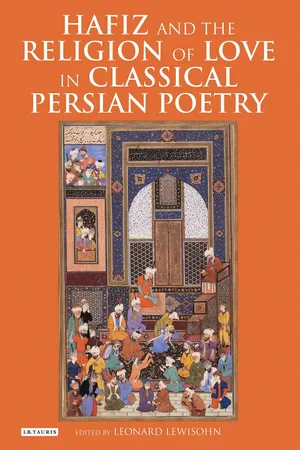
Hafiz and the Religion of Love in Classical Persian Poetry
About this book
The romantic lyricism of the great Persian poet Hafiz (1315-1390) continues to be admired around the world. Recent exploration of that lyricism by Iranian scholars has revealed that, in addition to his masterful use of poetic devices, Hafiz's verse is deeply steeped in the philosophy and symbolism of Persian love mysticism. This innovative volume discusses the aesthetic theories and mystical philosophy of the classical Persian love-lyric (ghazal) as particularly exemplified by Hafiz (who, along with Rumi and Sa'di, is Persia's most celebrated poet). For the first time in western literature, Hafiz's rhetoric of romance is situated within the broader context of what scholars refer to as 'Love Theory' in Arabic and Persian poetry in particular and Islamic literature more generally. Contributors from both the West and Iran conduct a major investigation of the love lyrics of Hafiz and of what they signified to that high culture and civilization which was devoted to the School of Love in medieval Persia. The volume will have strong appeal to scholars of the Middle East, medieval Islamic literature, and the history and culture of Iran.
Trusted by 375,005 students
Access to over 1.5 million titles for a fair monthly price.
Study more efficiently using our study tools.
Information
PART I
ḤĀFIẒ IN THE SOCIO-HISTORICAL, LITERARY AND MYSTICAL MILIEU OF MEDIEVAL PERSIA
Prolegomenon to the Study of Ḥāfiẓ
1 – Socio-historical and Literary Contexts: Ḥāfiẓ in Shīrāz
Leonard Lewisohn
Cité de l’amour
When Ḥāfiẓ was born in the city of Shīrāz some time between 710/1310 and 720/1320,1 the cultural epoch into which our poet stepped was one of the richest in all human history. As the second leading cultural capital (after Tabriz) of medieval Persia, the artistic, intellectual and literary brilliance of fourteenth-century Shīrāz under Muẓaffarid rule is perhaps best comparable to fifteenth-century Florence under Cosimo and Lorenzo de Medici. The poets and philosophers who thrived in this intellectual centre of south-western Fars easily rival the likes of Marsilio Ficino, Botticelli, Michelangelo and Pico de Mirandelo, who were to fill the capital city of Italian Tuscany a century later. For several centuries, throughout all the domains of the Islamic world, Shīrāz had been renowned as House of Knowledge (dār al-‘ilm),2 the city vaunting its learned theologians, eloquent preachers, pious ascetics, ecstatic Sufis, erudite scholars, specialist theologians, great calligraphers, famous scientists and adept hommes de lettres. Many of the natives of the city still figure as the central pillars of classical Islamic civilization. Shaykh Rūzbihān Baqlī (d. 606/1210), one of the greatest exponents of paradoxical expression and certainly the most original author of works on Sufi erotic theology, had flourished there a century before Ḥāfiẓ. Sa‘dī of Shīrāz, the greatest romantic and humanist poet in the Persian language, had died in 691/1292, less than a generation before Ḥāfiẓ’s birth, while the Illuminationist (Ishrāqī) philosopher Quṭb al-Dīn Shīrāzī (d. 710/1311), author of the encyclopaediac work Durrat al-tāj li-ghurrat al-Dubāj, had walked its streets a few years before he was born.
This city of ‘Saints and Poets’, as Arthur Arberry called it,3 was especially famous for its colleges and seminaries, its Sufi centres (khānaqāhs) and mosques, many of which had large accompanying gardens and possessed properties attached by charitable bequest to their grounds. The presence of these institutions, even if their administrators were often than not corrupt,4 lent the town a peculiar sacred ambience in the popular imagination. In Shīrāz – claimed the fourteenth-century Morrocan world traveller Ibn Baṭṭūṭa, who visited the city during Ḥāfiẓ’s life – the Qur’ān is chanted more beautifully than anywhere else in the Muslim world. The city was also like Florence in being both hotly decadent and a hotbed of religious fervour,5 with prayer assemblies, Qur’ān study classes, Sufi séances for samā‘, lecture halls full of preachers calling the populace to repent their sins, recluses and ascetics (zuhhād) down every corner and alley,6 vignettes of which appear everywhere in Ḥāfiẓ’s verse.
The city also prided itself on vast cemeteries with mausoleums of its saints. ‘In Shīrāz one thousand Sufi masters and saints or more are found’, boasted Sa‘dī in a poem describing the city in the thirteenth century, ‘around whose head the Ka‘ba continuously circumambulates’.7 The most interesting work on Shīrāz’s necropolis was a work penned by Junayd-i Shīrāzī in Ḥāfiẓ’s lifetime called The Thousand Mausoleums, a guidebook landmarking all the important tombs as sites of visitation for travellers, adding in as an extra feature a backdrop account of the city’s famous quarters.8 This work provided a veritable tourist guide to the sacred sites and shrines of Shīrāz,9 and for visitors who flocked there from all over Islamdom gave ‘the impression that the whole of Shīrāz consisted of pious Sunnis’.10 Among these holy sites, the tomb of the Sufi master Ibn Khafīf of Shīrāz (d. 371/982), renowned for his ascetic prowess, was the most popular spot of weekend visitation for the populace of the city, second only to Shāh Chirāgh, the tomb of Aḥmad ibn Mūsā, brother of the Shi‘ite Imām ‘Alī al-Riḍā, slain in 220/835.11 Ibn Baṭṭūṭa describes how Tāsh Khātun, the mother of Sulṭān Abū Isḥāq Īnjū (reg. 743/1343–753/1353: the ruler of Shīrāz when Ḥāfiẓ was a youth), paid homage to ‘the Imām, the Pole, the Saint, Abū ‘Abdu’llāh Ibn Khafīf, known to them as the Shaikh, ensampler of the whole land of Fars...
Table of contents
- Cover
- Author biography
- Title Page
- INTERNATIONAL LIBRARY OF IRANIAN STUDIES
- Epigraph
- Copyright Page
- Contents
- List of Contributors
- List of Plates
- Foreword: Hāfiz of Shīrāz
- Editor’s Introduction and Acknowledgements
- PART I HĀFIZ IN THE SOCIO-HISTORICAL, LITERARY AND MYSTICAL MILIEU OF MEDIEVAL PERSIA
- Prolegomenon to the Study of Hāfiz
- 1 – Socio-historical and Literary Contexts: Hāfiz in Shīrāz
- 2 – The Mystical Milieu: Hāfiz’s Erotic Spirituality
- PART II HĀFIZ AND THE SCHOOL OF LOVE IN CLASSICAL PERSIAN POETRY
- The Principles of the Religion of Love in Classical Persian Poetry
- The Erotic Spirit: Love, Man and Satan in Hāfiz’s Poetry
- The Radiance of Epiphany: The Vision of Beauty and Love in Hāfiz’s Poem of Pre-Eternity
- PART III HĀFIZ AND THE PERSIAN SUFI TRADITION
- Hāfiz and the Sufi
- The Religion of Love and the Puritans of Islam: Sufi Sources of Hāfiz’s Anti-clericalism
- Jalāl al-Dīn Davānī’s Interpretation of Hāfiz
- PART IV HĀFIZ’S ROMANTIC IMAGERY AND LANGUAGE OF LOVE
- The Allegory of Drunkenness and the Theophany of the Beloved in Sixteenth-Century Illustrations of Hāfiz
- Transfiguring Love: Perspective Shifts and the Contextualization of Experience in the Ghazals of Hāfiz
- The Semiotic Horizons of Dawn in the Poetry of Hāfiz
- Hāfiz and the Language of Love in Nineteenth-Century English and American Poetry
- Bibliography
- Plates
Frequently asked questions
Yes, you can cancel anytime from the Subscription tab in your account settings on the Perlego website. Your subscription will stay active until the end of your current billing period. Learn how to cancel your subscription
No, books cannot be downloaded as external files, such as PDFs, for use outside of Perlego. However, you can download books within the Perlego app for offline reading on mobile or tablet. Learn how to download books offline
Perlego offers two plans: Essential and Complete
- Essential is ideal for learners and professionals who enjoy exploring a wide range of subjects. Access the Essential Library with 800,000+ trusted titles and best-sellers across business, personal growth, and the humanities. Includes unlimited reading time and Standard Read Aloud voice.
- Complete: Perfect for advanced learners and researchers needing full, unrestricted access. Unlock 1.5M+ books across hundreds of subjects, including academic and specialized titles. The Complete Plan also includes advanced features like Premium Read Aloud and Research Assistant.
We are an online textbook subscription service, where you can get access to an entire online library for less than the price of a single book per month. With over 1.5 million books across 990+ topics, we’ve got you covered! Learn about our mission
Look out for the read-aloud symbol on your next book to see if you can listen to it. The read-aloud tool reads text aloud for you, highlighting the text as it is being read. You can pause it, speed it up and slow it down. Learn more about Read Aloud
Yes! You can use the Perlego app on both iOS and Android devices to read anytime, anywhere — even offline. Perfect for commutes or when you’re on the go.
Please note we cannot support devices running on iOS 13 and Android 7 or earlier. Learn more about using the app
Please note we cannot support devices running on iOS 13 and Android 7 or earlier. Learn more about using the app
Yes, you can access Hafiz and the Religion of Love in Classical Persian Poetry by Leonard Lewisohn in PDF and/or ePUB format, as well as other popular books in Literature & Middle Eastern History. We have over 1.5 million books available in our catalogue for you to explore.