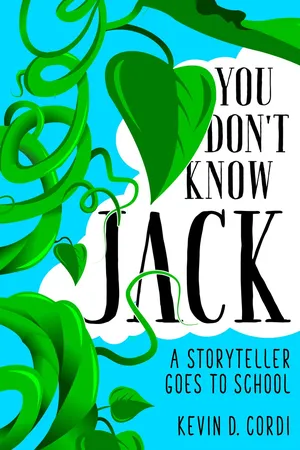
"Jack and the Beanstalk, " "Little Jack Horner, " and "Jack the Giant Killer" are all famous tales and rhymes featuring the same hero, a character who often appears in legends, fairy tales, and nursery rhymes. Unlike moralizing fairy tale heroes, however, Jack is typically depicted as foolish or lazy, though he often emerges triumphant through cleverness and tricks.With their roots traced back to England, Jack tales are an important oral tradition in Appalachian folklore. It was in his Appalachian upbringing that Kevin D. Cordi was first introduced to Jack through oral storytelling traditions. Cordi's love of storytelling eventually led him down a career path as a professional storyteller, touring the US for the past twenty-seven years.In addition to his work as a storyteller, Cordi worked a second job in an unrelated field—a high school teacher—and for many years, he kept his two lives separate. Everything changed when Cordi began telling stories in the classroom and realized he was connecting with his students in ways he had not previously. Cordi concluded that storytelling, storymaking, and drama can be used as systems of learning instead of as just entertainment.In You Don't Know Jack: A Storyteller Goes to School, Cordi describes the process of integrating storytelling into his classroom. Using autoethnographic writing, he reflects upon the use of storytelling and storymaking in order to promote inquiry and learning. He argues that engaging with the stories of others, discovering that one voice or identity should not be valued over the other, and listening, especially listening to stories of difference, are of utmost importance to education and growth.
- 234 pages
- English
- ePUB (mobile friendly)
- Available on iOS & Android
eBook - ePub
About this book
Trusted by 375,005 students
Access to over 1.5 million titles for a fair monthly price.
Study more efficiently using our study tools.
Information
Subtopic
StorytellingIndex
Social SciencesCHAPTER ONE
YOU DON’T KNOW JACK
A STORYTELLER LOOKS BACK
I am a storyteller. For the last twenty-seven years, I have toured as a professional storyteller all over the United States and beyond. I know the value of placing students in a story trance as they listen to an African folktale where the trickster Anansi struggles to find how he can own all the stories of the world. I have regaled kids and adults, sharing how my dog Jack delivered papers with my brother Mike but had to stop because the customers complained their papers arrived wet. Perhaps Jack should not have carried them in his mouth. Nothing can replace that experience. This was not my only work. For fourteen years, I also taught high school in three schools in Ohio and California, carefully designing lessons so students could create meaning. For many years, I kept these worlds separate. In my early teaching career, I did not share how I was raised on West Virginia stories because they were not part of the curriculum. I had separate identities, teacher and teller. However, that trickster known as “story” was not settling for these identities to be in just one place. Story insisted on an invitation to my classroom, and I invited it in. Once it was there, it stayed, but I wrestled with how best to use it. How would I change when I blended teller and teacher into both arenas? How would I balance these worlds, or should I seek to balance them?
I attempted to sustain the engagement between my worlds: that of teacher and that of professional storyteller. However, sometimes these worlds don’t flow together. I was raised on stories from Appalachia. I felt that my mother’s stories, although they taught me a great deal, were not welcomed in the classroom. Still, I could see them slowly being applied in my teaching. It took time, but my voice as teller, teacher, and student of Appalachia became a tool of my classroom. I often felt the community I was working with wanted one voice, but I wanted to have many voices. My identity contained a single voice, until I began to refine, reflect, and re-evaluate the use of voice and story in each setting. In this book, I explore how my identity has shifted as a storytelling teacher. In doing so, I release, revisit and ultimately redefine how I use what I know about story and drama. I examine how I use storytelling, storymaking, and drama as systems of learning instead of simply ways to entertain students. I show how stories are used and do more than record; I critically reflect upon the use of storytelling and storymaking, with and without the use of drama, in order to inform my future work as a storytelling teacher who wants to promote inquiry and learning. I do so by writing as a means of reflection. I do this by providing both a window to my work and a mirror to reflect on how these identities have influenced and continue to influence my understanding of how narrative operates in and out of a classroom setting.
Denzin (2008) states, “The goal of autoethnography … is to show rather than to tell and, thus, to disrupt the politics of traditional research relationships, traditional forms of representation, and traditional social science orientations to audiences” (69).
In one sense, this work can be considered an autoethnography, but I am not sure that it should be confined to this category. What I do know is that this is more than the telling of a story; instead it is a critical reflection of not only my work but the work of others and how these stories influenced and troubled my thinking. My autoethnography is a story relating my life as it structures my teaching practices. By writing about how I understood what it meant to be a professional storyteller and writing to guide my thinking, I can critically reflect on and learn from my experiences. My writing allows me to examine my past coupled with my present.
Learning from this work as much as re-visiting it, I want it to produce a personal transformation. I hope it will change me as an educator, instead of being torn from my artistic and teaching identities; I will create a new middle as a new understanding of what it means to have multiple identities when teaching. In her book, Nepantla: Essays from the Land in the Middle (1993), Mora reflects upon her discomfort of living on the borders, between the United States and Mexico; between European-American culture and her own Chicana culture:
There probably isn’t a week of my life that I don’t have at least one experience where I feel that discomfort, the slight frown from someone that wordlessly asks, what is someone like her doing here? But I am in the middle of my life, and well know not only the pain but also the advantage of observing both sides, albeit with my biases, of moving through two, and in fact, multiple spaces and selecting from both what I want to be part of me, of consciously shaping my space. (6)
I, too, have asked myself both as a storyteller and as a teacher, “What am I doing here?” I have also heard these questions asked by others. From shaping my space in the many worlds in which I live and work, I am in a new middle, but in this middle grounding, I need to look back to see what lies ahead as I work with storytelling, storymaking, and drama to improve as a teacher.
First, we must learn from a boy named Jack. Jack lived with his mama, and one day his mama told him, “Jack, it is time to seek out your fortune.” Although Jack was reluctant, he set out to find what he could find …
Every culture has stories and with them storytellers. Within the tales of the teller lie accounts of both wise and foolish actions. In particular, in the Appalachia and British regions, there are numerous tales about a boy named Jack. The most noted tale is “Jack and the Beanstalk” or “Jack and the Bean Tree,” but other tales abound of this often mischievous and wise folk character. There is “Jack and the Northwest Wind,” “Jack and the Robbers,” “Hardy Hard Head,” and “Jack and the Heifer Hide.” Although these tales reach homes all over the world, they were not the stories shared around my home when I was a child. Still, I am Jack. Instead of telling Jack tales, my mother would recount her own tales of growing up in West Virginia. If one listened close, they were similar to the exploits of Jack. My parents introduced many of the traditional Jacklike tales to my five brothers and sisters and me as we sat on a dilapidated old couch in Ohio. The stories followed the Jack motif—a young, poor boy (girl) would leave his or her family to find something new, becoming tempted along the way and often discovering something more of the journey. This boy or girl would transform in some poignant way as a result of his or her travels.
My folks were poor. The Jack tales appealed to them. The traditional Jack tale is not the story of nobility, but instead is a common tale. My father worked at Goodyear Tire and Rubber Company in Akron, Ohio, and, due to his disability, often was without work. He struggled to feed his family and to avoid long stays at the hospital. However, he pressed on. Like Jack, despite the obstacles, he continued. Sometimes Jack’s reward was sacks of gold, a kingdom, or the hand in marriage of a princess, but other times the rewards were internal, such as gaining friendship, advice, or awareness. My father regaled us with stories, and often this was our reward. In his stories, he taught us how to live or question the world. I remember him telling me that when he worked at a Coca-Cola bottling plant and had to use the bathroom, his boss said no, but he did anyway. In so doing, he stopped the entire bottle line. He was fired, but the next day, he was rehired with an apology. We all have human needs, and we should fight for them. Jack is constantly fighting for these human needs. After all, we could understand a poor boy wanting more than he had. This is our story. Jack tales are not steeped in the tales of kings and queens, but, instead, in the ordinary person’s journey, my story. It is hard to remember when I first heard tales like these because they were part of our daily life. As much as we watched television, my mother, and sometimes my father, would still take time to tell us stories. Octavia Sexton, who tours the country telling Jack tales, shares in this experience: “Ask me to remember when I first heard these stories is like trying to remember when I first had a drink of water, it is impossible. I don’t know. I just know there was a time we heard these tales and told them” (Wolf 2010). Although these Jack tales have their roots in Britain, they changed when they landed on American soil. The Jack tale not only has become an American tale but is also emblematic of an American journey. As Lindahl (1994) notes, when Jack came to America, his journey changed: “The American tales—perhaps like American Culture in general—foreground the individual, but not without offering him a social order that ensures his success” (xxxi). The individual highlighted in Jack tales is Jack, but Jack does not roam around aimless; he has a sense of order. Jack follows rules. Often one does not understand Jack until he explains his actions. He can and often is foolish but not without direction. He tries to seal the northwest wind because he is cold, and, as a result, even though it sounds foolish, he does it. The order that he follows does not come from a kings’ decree or from being an inherited part of royalty, but instead it comes from the rules of an individual—lying will hurt you, the journey is one you must take, and sometimes saying nothing can go a long way. It is a common journey. It is Jack’s journey. My story is a Jack journey.
Jack is pervasive in American culture. As McCarthy and Stotter (1994) note, simply hearing the name Jack rings with Americans. Jack is in our lexicon. Stotter and McCarthy state, “Jack, according to the dictionary, is a generic name for any representative of the people. Jack is one of the folk, an everyman figure” (154). I also represent an everyman story. As I mentioned, I too am Jack. In my journey to be a storyteller, I ventured by myself to discover what this means, to find my fortune. At first, my journey was not to explore being a storyteller, but instead becoming a disc jockey, but along the way, like Jack, I had magical teachers to guide me. I was transformed and instead became not only a storyteller, but a “story teacher” (Gillard 1996). This rich, almost mythic pursuit has both troubled and informed me. Like Jack, I wrestled with finding my path, but as a result of being lost, I found new direction and in turn expanded what it meant to be a storyteller and an educator.
This story begins in the American classroom. As a high school teacher, I did not realize that story could assist me in my teaching or that story was another form of teaching. I found this by accident. Once I discovered how story could be used as a meaning-making tool for students’ learning, I began to question how storytelling and storymaking can further address how students can learn with narrative tools and serve as pedagogy. Then, as a university professor, I further expanded how story acts in an interactive way to create meaning and began to advance a narrative pedagogy, incorporating process drama and narrative dimensions. Like Jack, I made my share of mistakes along the way and continue to do so, but as a result of those mishaps, new direction was formed. I have also explored story in new ways in and out of the classroom. I have served as a national consultant in more than forty states, England, Japan, Singapore, Scotland, and Canada, and most recently, Qatar. However, with every step, I learn more about my Jack journey. He started unsure and even unwilling to begin—his mother had to throw him out. When he had to begin this personal journey, a new awareness formed. Like Jack, who would finish one quest only to begin a new one, I embark every day exploring new ways to use narrative. I continue to test and retest what I know about this art called storytelling and how it changes when it is used for teaching. This is why the Jack story serves as the perfect metaphor for my discovery of what it means to be a storyteller on the road, in the classroom, and in the halls of academe.
I was raised on the tales of Appalachia. I, too, was a poor boy, a mere youth of nineteen when I discovered organized storytelling. I was accustomed to my mother sharing tales, but not others. I found storytelling on a fall day at Kent State University in Ohio. I did not set out to be a storyteller; storytelling found me. Jack was waiting for me like he was there for renowned Jack teller Ray Hicks: “That’s the way it was when I growed up. When you git like I tell it, I’m Jack. Everybody can be Jack. I’ve been Jack. I mean in different ways. Now I ain’t everything Jack has done in the tales, but still I’ve been Jack in a lot of ways. It takes Jack to live” (McCarthy 2010, 5). Jack is in all of us. His story is about acting on desires or needs, even if one does not want to. There is a personal Jack journey that we must take.
Jack teller Octavia Sexton agrees: “I heard stories that people call Jack tales. When I was growing up and we were telling and listening to stories we didn’t use the name Jack. Maybe Jack was in a tale or two, but we used the name of someone that was a well-known name, like a family name because I grew up listening to these stories” (Wolf 2010). I was not looking for Jack, but it took a Jack tale to direct me toward my vocation, to help me find my direction. At eighteen, I left for Kent State University to be a disc jockey similar to Casey Kasem or Rick Dees, popular deejays at the time. I enjoyed listening to music and sought a life sharing music with the world. However, the real work of a deejay was not always exciting since the radio station gave me a midnight shift. It was work, and work that I did not always want to do. Until storytelling arrived on campus, I was lost. As it is often with Jack, he wanders, and people and places guide him. He will simply be taking a walk but finds a princess on the way. I no longer wanted to spin records; instead, my head was spinning with uncertainty, looking for direction. The needle of this path kept skipping. I needed to find something or someone to help me. The people or animals who help Jack often provide him with magical items like a picnic blanket that has unlimited amounts of food, but only if you can say the secret words. I did not encounter magic beans or meet a stranger named “Drink Well,” but my fellow students assisted me with whom I was and whom I could become. Like Jack, I needed to leave home to find meaning in my life. This is the first stage in my journey. In fact, Sobol (1992) states the Jack tale represents a series of stages in life. He says, “Jack as a matter of fact, is less of an individual character than an emblem of human potential in many of its representative stages” 15).
Jack represents the journey seekers we can become. As de Lint reminds, “the spirit of Jacks of old is in you. It’s a lucky name—as the tales that your people still tell can vouch for” (119). As a storyteller, I needed to recognize that Jack resides in me. Texas professional storyteller Mary Grace Ketner (2013) notes that a Jack tale chronicles the journey of every person. She notes that Jack can be called Hans, Anansi, Brer Rabbit, or simply a traveler seeking more than the road can offer. In these tales, Jack exemplifies both the foolish and the wise choices in all of us. This work chronicles the wise and foolish choices I made on the path to become a storyteller and also highlights the challenges and promises of being a storytelling teacher. As a teacher, one of the foolish choices I made was limiting the stories I allowed in the classroom. It took a while to realize a storytelling teacher is more than a person who tells stories, but, instead, is someone who uses stories as a primary means of teaching. I slowly realized that story could be used not only for performance, but also to promote inquiry and engagement with and for students. Initially, I saw the role as someone who told stories, but over time I learned to think and respond using narrative. This heightened what it meant to be a storyteller and story teacher. When students confronted me with issues, I turned to stories and storymaking to guide my advice and instruction. This was not a quick or easy journey. First, I had to recognize the importance of my past to understand my present pursuit.
I was raised on journey tales. My mother nurtured me and my five brothers and sisters with her stories carrying us back to her hometown of Clay County, West Virginia. However, I did not realize that she was doing this. I thought I was simply hearing a good yarn. In fact, her vivid descriptions shared in our place in Ohio transport us to Appalachia, on an old wood porch. Here her tales began. With each tale, we learned more about her search for her fortune. Along the way, people like our mother taught stories to her that contained advice such as how to can food for the winter so they could survive. Stories of hardship became guideposts for living. She had nine sibling brothers and sisters, and they needed guidance. Stories were the compass for living. My mother would share hard-time stories, but also tell stories about eccentric family or “kin.” Her sister, my aunt, Ruby Starcher, acted as wild as a black snake in the Clay County holler when the two of them got together. She would account for the rumbles with “the boys”—her brothers, Ed, James, Homer, and Dude. Her stories also spoke of compassion in difficult times. She told of Wavey’s store, where if one didn’t have any money for penny candy, Wavey always slipped a surprise in the bag when the child was not looking. At her mother’s small house, even though they could afford little, they did not turn people away when they needed a place to sleep. They couldn’t afford a fancy tutor, and because of distance and weather or need for chores to be done, they often did not attend school. Story became my mother’s teacher, and she, in turn, shared this with us. Each tale my mother told was to teach my siblings and me about living. At that time, I learned what it meant to listen to stories, but it would be awhile before I told the stories, and it would be even longer before I understood the teaching that could develop from telling and making narratives. However, like Jack, sometimes you have to experience life to know your next or your true direction.
My Jack journey challenges my identities as teacher, storyteller, and student wrestling with who to be and when to be it. It does not contain a beanstalk, but it is about growing and discovery. Initially, for example, I did not think folk- and fairy tales could be incorporated into the high school classroom. My educational training did not prepare me to use narrative as a means of teaching. Storytelling was what I did away from school—entertaining children primarily—that was separate from my goals as an educator. What place did a fairy- or folktale have in a senior literature class? I questioned this until Jack stepped in. Jack was not expected to step into the college classroom at Kent State University, where I trained to be a high school teacher. Jack generally was not a common figure striding the hallway of Brunswick High School in Ohio as I prepared lessons on The Canterbury Tales or the proper way to provide a persuasive speech. Although we began to use stories, he came in one step at a time. I slowly developed a story curriculum and began using folktales gradually as I realized the value of stories and my role of a storymaker and teller. As Jack Zipes (2012) states, “For once a plethora of stories began to circulate in societies throughout the world, they contained the seed of fairy tales, ironically tales at first without fairies formed by metaphor and metamorphosis and by a human disposition to communicate relevant experiences” (4). The experience of my students and my own stories were not integrated into my teaching. Jack did not have a welcome mat even though he and Jacklike stories of struggle and reward were all around my classroom and school. His did not arrive until mid-year in 1995 when a young high school freshman named Jennifer Wooley asked me to create a storytelling club, Voices of Illusion, after school. How was I to know that this was the beginning for me to develop and use narrative in new directions? At that time, I also began to realize that essential to storytelling was listening, deep listening. This was the framework of story. But still, story arrived, and, being the trickster he is, The Canterbury Tales became the Brunswick Ohio tales, and students continued to tell stories. However, sometimes I did not listen deeply to my students’ stories. Instead, the prescribed curriculum artificially implanted itself over the rich narratives of my students.
I was not always the listener. In the corridors and the hallways, my students told stories. I told them to stop telling stories so we could begin our work. Little did I know that these stories could be, and often were, the work. They shared account after account with each other. However, as a teacher, story was separated from the curriculum. How could teachers teach simply by telling a story? Herein lies my journey of what happens when story comes to school. How does the school environment change when storymaking and storytelling are the primary tools for learning? Like in The Canterbury Tales, the journey provides answers, if not spaces for learning how to value narrative as a teaching tool. This is a journey of fourteen years as a classroom teacher, eleven of them teaching storytelling at the high school answering to the moniker of “the storytelling teacher.” It is reflecting both as a high school teacher and as a university professor on how I could have better applied storymaking and telling in the classes.
Jack arrived at a time when curriculum was prepackaged and state mandated. It often still is as long as we accept it. The form of assessment was not in the narratives of my students but found in rubrics and formative and ...
Table of contents
- Cover
- Title Page
- Copyright
- Dedication
- Contents
- Acknowledgments
- Chapter One: You Don’t Know Jack: A Storyteller Looks Back
- Chapter Two: Deep Listening to Stories
- Chapter Three: Exploring Narrative
- Chapter Four: Understanding Storytelling
- Chapter Five: Using Storytelling and Storymaking in My Classes
- Chapter Six: Story in Connection with Drama
- Chapter Seven: New Middle: How I Am Employing What I Know About Story and Drama
- References
Frequently asked questions
Yes, you can cancel anytime from the Subscription tab in your account settings on the Perlego website. Your subscription will stay active until the end of your current billing period. Learn how to cancel your subscription
No, books cannot be downloaded as external files, such as PDFs, for use outside of Perlego. However, you can download books within the Perlego app for offline reading on mobile or tablet. Learn how to download books offline
Perlego offers two plans: Essential and Complete
- Essential is ideal for learners and professionals who enjoy exploring a wide range of subjects. Access the Essential Library with 800,000+ trusted titles and best-sellers across business, personal growth, and the humanities. Includes unlimited reading time and Standard Read Aloud voice.
- Complete: Perfect for advanced learners and researchers needing full, unrestricted access. Unlock 1.5M+ books across hundreds of subjects, including academic and specialized titles. The Complete Plan also includes advanced features like Premium Read Aloud and Research Assistant.
We are an online textbook subscription service, where you can get access to an entire online library for less than the price of a single book per month. With over 1.5 million books across 990+ topics, we’ve got you covered! Learn about our mission
Look out for the read-aloud symbol on your next book to see if you can listen to it. The read-aloud tool reads text aloud for you, highlighting the text as it is being read. You can pause it, speed it up and slow it down. Learn more about Read Aloud
Yes! You can use the Perlego app on both iOS and Android devices to read anytime, anywhere — even offline. Perfect for commutes or when you’re on the go.
Please note we cannot support devices running on iOS 13 and Android 7 or earlier. Learn more about using the app
Please note we cannot support devices running on iOS 13 and Android 7 or earlier. Learn more about using the app
Yes, you can access You Don't Know Jack by Kevin D. Cordi in PDF and/or ePUB format, as well as other popular books in Social Sciences & Storytelling. We have over 1.5 million books available in our catalogue for you to explore.