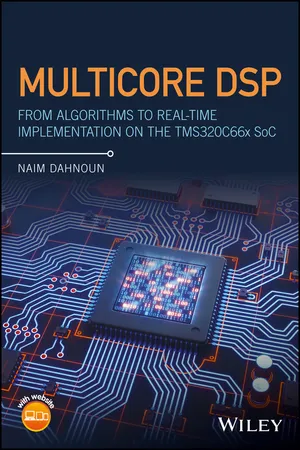
Multicore DSP
eBook - ePub

Multicore DSP

From Algorithms to Real-time Implementation on the TMS320C66x SoC

  1. English
  2. ePUB (mobile friendly)
  3. Available on iOS & Android
eBook - ePub

Multicore DSP

From Algorithms to Real-time Implementation on the TMS320C66x SoC

About this book

The only book to offer special coverage of the fundamentals of multicore DSP for implementation on the TMS320C66xx SoC 

This unique book provides readers with an understanding of the TMS320C66xx SoC as well as its constraints. It offers critical analysis of each element, which not only broadens their knowledge of the subject, but aids them in gaining a better understanding of how these elements work so well together.

Written by Texas Instruments' First DSP Educator Award winner, Naim Dahnoun, the book teaches readers how to use the development tools, take advantage of the maximum performance and functionality of this processor and have an understanding of the rich content which spans from architecture, development tools and programming models, such as OpenCL and OpenMP, to debugging tools. It also covers various multicore audio and image applications in detail.  Additionally, this one-of-a-kind book is supplemented with:

  • A rich set of tested laboratory exercises and solutions
  • Audio and Image processing applications source code for the Code Composer Studio (integrated development environment from Texas Instruments)
  • Multiple tables and illustrations

With no other book on the market offering any coverage at all on the subject and its rich content with twenty chapters, Multicore DSP: From Algorithms to Real-time Implementation on the TMS320C66x SoC is a rare and much-needed source of information for undergraduates and postgraduates in the field that allows them to make real-time applications work in a relatively short period of time. It is also incredibly beneficial to hardware and software engineers involved in programming real-time embedded systems.

Tools to learn more effectively

Saving Books

Saving Books

Keyword Search

Keyword Search

Annotating Text

Annotating Text

Listen to it instead

Listen to it instead

Information

1
Introduction to DSP

CHAPTER MENU

Learning how to master a system‐on‐chip (SoC) can be a long, daunting process, especially for the novice. However, keeping in mind the big picture and understanding why a specific piece of hardware or software is used will remove the complexity in the details.
The purpose of this chapter is give an overview for the need of multicore processors, list different types of multicore processors and introduce the KeyStone processors that are the subject of this book.

1.1 Introduction

Today’s microprocessors are based on switching devices that provide alternation between two states, ON and OFF, that represent 1 s and 0 s. Up to now, the transistor is the only practical device to be used. Having small, fast, low‐power transistors has always been the challenge for chip manufacturers. From the 1960s, as predicted by Gordon Moore (in Moore’s law), the number of transistors that could be fitted in an integrated circuit doubled every 24 months [1]. That was possible due to new material, the development of chip process technology and especially the advances in photolithography that pushed the transistor size from 10 µm in the 1960s to about 10 nm currently. As the transistor scaled, industry not only took advantage of the transistor count but also increased the clock speed, using various architecture enhancements such as instruction‐level parallelism (ILP) that can be achieved by superscaling (loading multiple instructions simultaneously and executing them simultaneously), pipelining (where different phases of instructions overlap), out‐of‐order execution (instructions are executed in any order, and the choice of the order is dynamic) and so on, and different power‐efficient cache levels and power‐aware software designs such as compilers for low‐power consumption [2] and low‐power instructions or instructions of variable length. However, the increase in clock frequency was not sustainable as power consumption became such a real constraint that it was not possible to produce a commercial device. In fact, chip manufacturers have abandoned the idea of continually increasing the clock frequency because it was technically challenging and costly and because power consumption was a real issue, especially for mobile computing devices such as smartphones and handheld computers and for high‐performance computers. Recently, static power consumption has also become a concern as the transistor scales, and therefore both dynamic power and static powers are to be considered. It is also worth noting at this stage that increase in the operating frequency requires power consumption increase, that is not linear with the frequency, as one can assume.
This is due to the fact that an increase in frequency will require an increase in voltage. For instance, an increase of 50% of the frequency will also result in an increase of 35% of the voltage [2].
To overcome the problem of frequency plateau, processor manufacturers like Texas Instruments (TI), ARM and Intel find that by keeping the frequency at an acceptable level and increasing the number of cores, they will be able to support many application domains that require high performance and low power. Having multicore processors is not a new idea; for instance, TI introduced a 5‐core processor in 1995 (TMS320C8x), a 2‐core processor in 1998 (TMS320C54x) and the OMAP (Open Multimedia Application Platform) family in 2002 [3], and Lucent produced a 3‐core processor in 2000. However, manufacturers and users were not that interested in multicore as the processors’ frequency increase was sufficient to satisfy the market and mul...

Table of contents

  1. Cover
  2. Title Page
  3. Table of Contents
  4. Preface
  5. Acknowledgements
  6. Foreword
  7. About the Companion Website
  8. 1 Introduction to DSP
  9. 2 The TMS320C66x architecture overview
  10. 3 Software development tools and the TMS320C6678 EVM
  11. 4 Numerical issues
  12. 5 Software optimisation
  13. 6 The TMS320C66x interrupts
  14. 7 Real‐time operating system: TI‐RTOS
  15. 8 Enhanced Direct Memory Access (EDMA3) controller
  16. 9 Inter‐Processor Communication (IPC)
  17. 10 Single and multicore debugging
  18. 11 Bootloader for KeyStone I and KeyStone II
  19. 12 Introduction to OpenMP
  20. 13 Introduction to OpenCL for the KeyStone II
  21. 14 Multicore Navigator
  22. 15 FIR filter implementation
  23. 16 IIR filter implementation
  24. 17 Adaptive filter implementation
  25. 18 FFT implementation
  26. 19 Hough transform
  27. 20 Stereo vision implementation
  28. Index
  29. End User License Agreement

Frequently asked questions

Yes, you can cancel anytime from the Subscription tab in your account settings on the Perlego website. Your subscription will stay active until the end of your current billing period. Learn how to cancel your subscription
No, books cannot be downloaded as external files, such as PDFs, for use outside of Perlego. However, you can download books within the Perlego app for offline reading on mobile or tablet. Learn how to download books offline
Perlego offers two plans: Essential and Complete
  • Essential is ideal for learners and professionals who enjoy exploring a wide range of subjects. Access the Essential Library with 800,000+ trusted titles and best-sellers across business, personal growth, and the humanities. Includes unlimited reading time and Standard Read Aloud voice.
  • Complete: Perfect for advanced learners and researchers needing full, unrestricted access. Unlock 1.4M+ books across hundreds of subjects, including academic and specialized titles. The Complete Plan also includes advanced features like Premium Read Aloud and Research Assistant.
Both plans are available with monthly, semester, or annual billing cycles.
We are an online textbook subscription service, where you can get access to an entire online library for less than the price of a single book per month. With over 1 million books across 990+ topics, we’ve got you covered! Learn about our mission
Look out for the read-aloud symbol on your next book to see if you can listen to it. The read-aloud tool reads text aloud for you, highlighting the text as it is being read. You can pause it, speed it up and slow it down. Learn more about Read Aloud
Yes! You can use the Perlego app on both iOS and Android devices to read anytime, anywhere — even offline. Perfect for commutes or when you’re on the go.
Please note we cannot support devices running on iOS 13 and Android 7 or earlier. Learn more about using the app
Yes, you can access Multicore DSP by Naim Dahnoun in PDF and/or ePUB format, as well as other popular books in Technologie et ingénierie & Signaux et traitement du signal. We have over one million books available in our catalogue for you to explore.