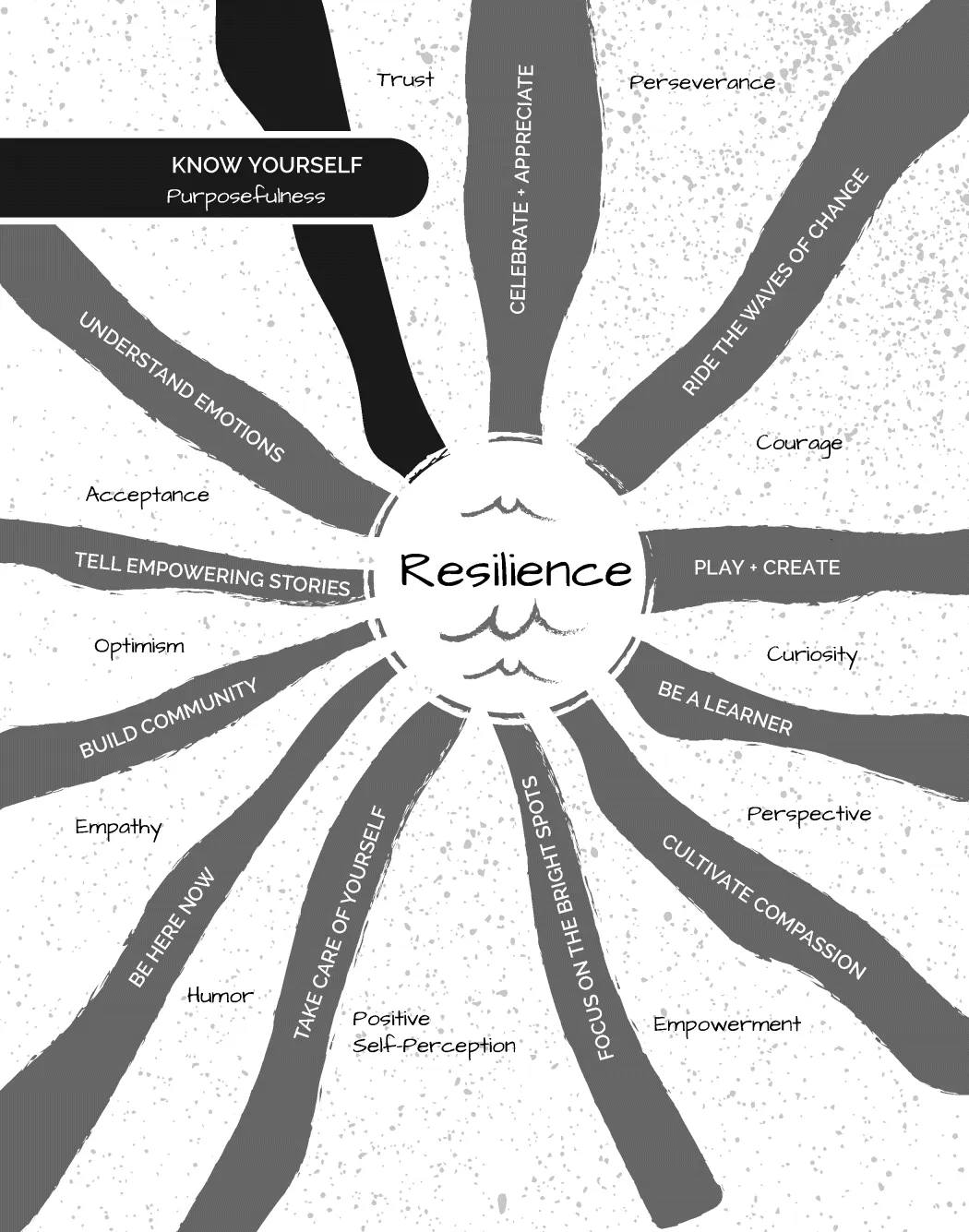
Resilience is cultivated through hundreds of little choices every day. In order to make the best choice, you need to know yourself. With self-knowledge, you can anticipate moments that might trigger you. Self-knowledge enables you to build stronger relationships with others. With knowledge of your unique talents, aptitudes, and interests, you play to your strengths and wisely direct your energy. When you're clear on your values, you align your skills, time, and energy to your purpose—and purposefulness is a key trait of the resilient.
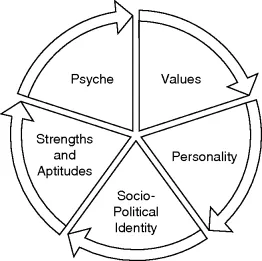
In this chapter, we'll explore how self-awareness is the foundation for the decisions crucial to boosting your resilience. We'll explore the following elements of self: Values, personality type, sociopolitical identities, and strengths and aptitudes. Because the psyche, our emotional self, is at the core of emotional resilience, Chapter 2 is devoted entirely to it. Figure 1.1, Elements of Self, reflects the aspects of ourselves that we'll explore in this chapter and in Chapter 2.
Values: What We Believe
If you followed Leo around for a day, you'd observe a principal consistently acting on his values. His three core values are family, kindness, and equity, and whether he's interacting with a student, an office staff member, his boss, or a teacher, you'll see evidence of these. When he makes decisions about allocating resources, he does so from a lens of equity. He listens to students with patience and respect, and holds them to high expectations, “Because I know what they're capable of,” he says. When he gives hard feedback, he's kind. I've coached Leo for several years. I've heard his innermost thoughts and am inspired to know an educator like Leo who lives his values so consistently. His staff members also appreciate this, as is evidenced by their annual feedback raving about his leadership, and by the exceptionally high retention of teachers at his school. Finally, Leo cites the alignment between his values and his behaviors as a source of inner strength: “I know who I am,” he says, “and that helps me manage the challenges of this job. As long as I honor who I am, I'm good.” In spite of unrelenting pressures and stressors, Leo really is doing well most of the time and research on resilient school leaders confirms that thriving leaders are grounded in their values (Patterson and Kelleher, 2005).
A value is a tightly held belief from which we act. Our core values are often enduring beliefs that can be traced back to our families of origin or religious traditions. Examples of values include compassion, responsibility, hard work, justice, and community. Sometimes we use the terms values and beliefs interchangeably; they are aspects of the same idea. Core values can change over time. You may have had different values as a young adult. Values are essentially beliefs, and beliefs are strongly held opinions. It's useful to remember that beliefs can change—our own beliefs, as well as those of others. For some, values may remain the same for many years, and that's okay too.
What are your core values? If you aren't aware of them, there's an activity in the workbook to help you identify them. You might also just consider what comes first to mind in response to these questions: What do you value most? Which behaviors and values in others do you most appreciate?
Our values orient us, drive us, and anchor us. We experience integrity when we act in alignment with them. When our actions are not aligned with our values, it doesn't feel good. We might say to ourselves, This isn't me, which can indicate that our actions don't reflect a core value. When an inner voice says something like that, listen closely. Interestingly, psycho-neuroimmunologists find that our immune systems are strengthened or depleted by the degree of integrity with which we live our lives. When we act in ways that are out of alignment with our values, we physically don't feel good. This is why, when you are asked to do something you don't believe in, you might say, “It makes me feel sick to my stomach to have to do this,” because your body literally feels unwell.
Can you recall a time recently when you felt that you acted in alignment with your values? Or another time when you did something that conflicted with a value? What might it feel like to work with the same degree of conviction that a superhero has about her values? Your values can be a source of strength when you're aware of them. I know you have them, even if you're not crystal clear right now on what they are. We can also forget what our values are and find ourselves operating on autopilot, sometimes not in alignment with our values. This is why we need time to reflect on who we are and what we value, and also to talk with others about our values. Now might be a good time to take a break from reading and engage in some of the activities in the workbook!
Implications for Leaders
- A great way to start the year is to have staff identify their core values and share those with each other. (See activities in the workbook for how to do this.)
- When a teacher is distraught or confused, ask about his or her core values, or if you know what they are, remind him or her of those.
- Organizations thrive when they have clear, shared values and where practices align to those values. Schools need articulated, lived values.
- People want to feel connected to values, and connected to each other through values. When shared values aren't strong, people resort to their own individual values, which weakens the school's overall mission. Invite your team to do an integrity scan. Review your organization's mission or vision statements. Do they include clearly stated values that are instructive and that compel people to take action?