![]()
Part I
The product
![]()
Chapter 1
The extra-virgin olive oil chain
Claudio Peri
University of Milan, Milan, Italy
Abstract
This chapter presents the classification and commercial denomination of six olive oil categories recognized in international law (two virgin and four refined). Extra-virgin olive oil is the highest quality olive oil. The extra-virgin olive oil chain, is presented as a sequence of five processes: (i) olive tree cultivation, (ii) olive harvesting and processing, (iii) oil storage, bottling and distribution, (iv) selling bottled oil and (v) oil use in culinary preparations. Processes (ii) and (iii), the subject matter of this handbook, are further presented as a sequence of unit operations. The main steps and conditions determining oil quality and yield are outlined.
1.1 The legal classification and denomination of olive oils
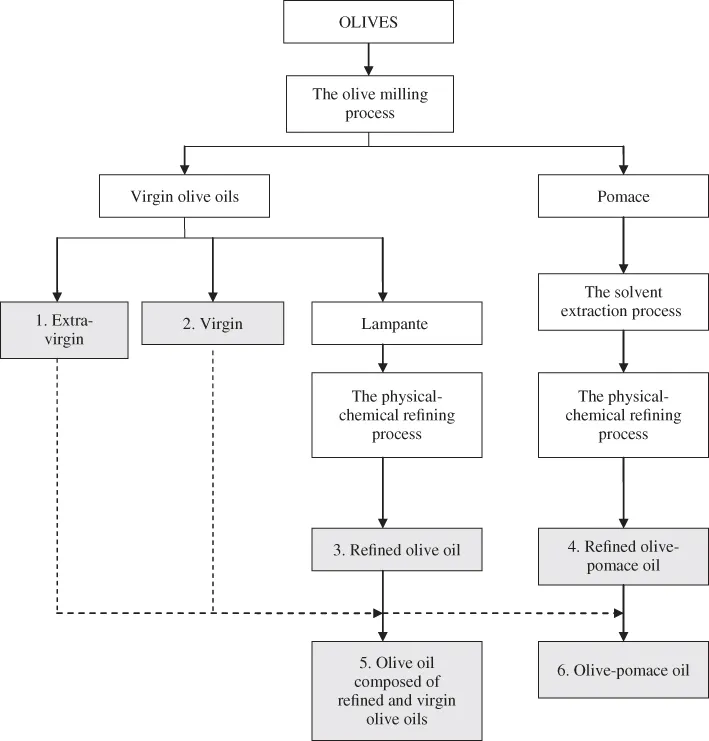
When talking or reading about olive oil, the first point to be clarified is the category of olive oil that is being discussed. Ignoring the category that the oil belongs to can be a source of confusion and misunderstanding and can lead to mistakes in buying, tasting or using it. Figure 1.1 is a flow-chart of the classification and denomination of the various categories of virgin and refined olive oils as globally agreed (see Council Regulation (EC) No. 1234/2007 of 22 October 2007, (Single CMO Regulation), consolidated version 2013-01-26, Annex XVI).
The six categories highlighted by the grey background are suitable for human consumption.
The flow-chart starts with the olive milling process, whose products are the ‘virgin’ olive oils. Two of them, namely extra-virgin and virgin, are allowed for consumption. The third category, lampante, becomes edible only after a physical-chemical refining process and it is called ‘refined olive oil’.
On the other hand, the pomace, which is the solid residue from the milling process, still contains a small amount of olive oil that is impossible to extract by mechanical means. It can be extracted with solvents; the raw oil from this extraction is refined with a process very similar to that applied to lampante oil. The refined oil derived from pomace is called ‘refined olive-pomace oil’.
Both the ‘refined olive oil’ and the ‘refined olive-pomace oil’ can be mixed with extra-virgin or virgin olive oil in various undefined proportions in order to improve their flavour. These are called, respectively, ‘olive oil composed of refined and virgin olive oil’ and ‘olive-pomace oil’.
Chapter 17 gives a short presentation of the refining process. It is important that olive oil producers, retailers and consumers know the difference in technological and compositional terms between a virgin oil and a refined oil.
Regarding quality, extra-virgin olive oil is higher in quality than virgin olive oil and refined olive oil is higher in quality than refined olive-pomace oil. Refined olive oil is very mild and almost neutral in taste: it is very good for cooking, frying and for preserving canned vegetables or meat or fish. Extra-virgin olive oil is flavourful and tasty. A picture of the culinary uses of olive oil and especially excellent extra-virgin olive oils is given in Chapter 24.
1.2 The subject of this handbook
Focusing on extra-virgin olive oil opens a wide panorama because the oil varies depending on cultivar, climate and soil, and the conditions of the production-extraction-storage-and-distribution process. Extra-virgin olive oils can be of common or good or excellent quality. The purpose of this handbook is to discuss the technological and management conditions that allow an operator of the extra-virgin olive oil chain to improve the quality of the product, which is finally served at the consumer's table.
1.3 The extra-virgin olive oil chain
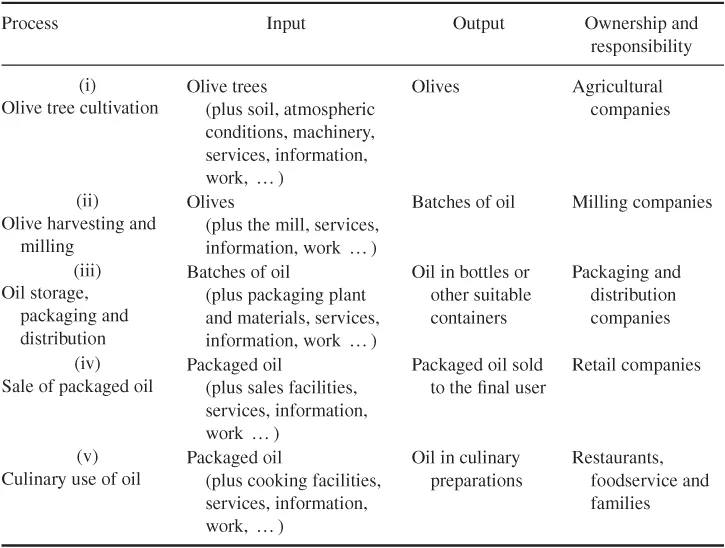
The extra-virgin olive oil chain can be divided into a series of five processes: (i) olive tree cultivation, (ii) olive harvesting and milling, (iii) oil storage, bottling and distribution, (iv) oil selling and (v) oil use in culinary preparations (Table 1.1).
Table 1.1 The processes of the extra-virgin olive oil chain.
These five processes have different structural and operational requirements, different marketing policies and different economies of scale. They are therefore usually managed and owned by different companies.
Processes (ii) and (iii) represent the core content of this handbook. There is some discussion about process (i) in Chapters 5 (olive tree cultivars) and 7 (olive harvesting), whereas Chapter 24 gives some general indications about the use of extra-virgin olive oil in culinary preparations.
1.3.1 Compact versus complex chain organization
The most compact organization of an extra-virgin olive oil chain entails a direct connection between only two parts (or modules): the first is represented by the producer and the second by the final consumer. In this case, which is very common in olive oil producing regions, a producer who is responsible for the chain from the field to the package, sells his oil directly to the final consumer, either a family or a restaurant. This organization is typical of traditional markets in a narrow area close to production, but sometimes it is also implemented in a global market and across continents. It is common to find commercial agreements between a restaurant in Los Angeles or Tokyo and a producer in Andalusia or Tuscany.
On the other hand, very complex chain organizations are implemented in large-scale and global businesses with multiple inputs and outputs connecting the five processes listed in Table 1.1.
Traceability of product origin and identity is easy in the case of the compact chain, whereas it may be very difficult or impossible in complex chain organizations.
1.3.2 The extra-virgin olive oil processes
As chains can be considered sequences of processes, processes can similarly be considered as sequences of unit operations. Processes are interconnected in series in a chain, so unit operations are interconnected in series in a process with the output of a unit operation being the input of the following one (Peri et al. 2004). Table 1.2 presents the unit operations of processes (ii) and (iii).
Table 1.2 The unit operations of extra-virgin olive oil processes.
| Monitoring of olive maturity. Supply and maintenance of harvesting nets, crates and equipment | Harvesting | |
| Storage and transportation of olives | |
| Mill plant maintenance, cleaning, and start trial | Olive reception at the mill plant | |
| Standards agreed upon between the olive grower and the milling company | Visual inspection, control of origin and olive integrity | Decisions in case of nonconformity to standards |
| Milling batches, identification and weighing | Record of milling batches |
| Deleafing at the olive grove site. Supply of potable water | Olive cleaning and washing | Disposal of solid residues and dirty water |
| Olive milling or pitting | In case of pitting: discharge and use of olive stones |
| Olive-paste malaxation | Monitoring and control of the time-temperature relationship |
| Solid-liquid and liquid-liquid separation | Pomace to treatment and use. Wastewater to disposal |
| Supply of filter aids or filter pads | Oil filtration | Disposal of exhausted filtering material |
| Agreed upon standards of oil quality and yield | Oil weighing, chemical and sensory evaluation | Decisions in case of nonconformity |
| Maintenance of storage facilities | Storage batches formation and identification | Standard documentation of storage batches |
| Oil storage | Waste disposal |
| Customers' orders and requirements | Oil blending, packaging batches formation | Chemical and sensory evaluation of packaging batches. Record of packaging batches |
| Maintenance and supply of packaging material | Packaging | Waste disposal |
| Shipment of consignment to customers | |
1.4 Yield and quality
The primary objective of an extra-virgin olive oil company is to maximize oil yield and quality. Obtaining the largest quantity of oil with a high level of quality is the ultimate measure of process effectiveness and efficiency.
Contrary to the situation with other agricu...