- English
- ePUB (mobile friendly)
- Available on iOS & Android
eBook - ePub
About this book
This essential guide to the knowledge and tools in the field includes everything from the basic concepts to modern methods, while also forming a bridge to bioinformatics.
The textbook offers a very clear and didactical structure, starting from the basics and the theory, before going on to provide an overview of the methods. Learning is now even easier thanks to exercises at the end of each section or chapter. Software tools are explained in detail, so that the students not only learn the necessary theoretical background, but also how to use the different software packages available. The wide range of applications is presented in the corresponding book Applied Chemoinformatics - Achievements and Future Opportunities (ISBN 9783527342013). For Master and PhD students in chemistry, biochemistry and computer science, as well as providing an excellent introduction for other newcomers to the field.
The textbook offers a very clear and didactical structure, starting from the basics and the theory, before going on to provide an overview of the methods. Learning is now even easier thanks to exercises at the end of each section or chapter. Software tools are explained in detail, so that the students not only learn the necessary theoretical background, but also how to use the different software packages available. The wide range of applications is presented in the corresponding book Applied Chemoinformatics - Achievements and Future Opportunities (ISBN 9783527342013). For Master and PhD students in chemistry, biochemistry and computer science, as well as providing an excellent introduction for other newcomers to the field.
Tools to learn more effectively

Saving Books

Keyword Search

Annotating Text

Listen to it instead
Information
1
Introduction
Thomas Engel and Johann Gasteiger
1Ludwig‐Maximilians‐University Munich, Department of Chemistry, Butenandtstraße 5‐13, 81377 Munich, Germany
2Computer‐Chemie‐Centrum, Universität Erlangen‐Nürnberg, Nägelsbachstr. 25, 91052 Erlangen, Germany
Outline
- 1.1 The Rationale for the Books
- 1.2 The Objectives of Chemoinformatics
- 1.3 Learning in Chemoinformatics
- 1.4 Outline of the Book
- 1.5 The Scope of the Book
- 1.6 Teaching Chemoinformatics
1.1 The Rationale for the Books
In 2003 we issued the book
(J. Gasteiger, T. Engel, Editors, Wiley‐VCH Verlag GmbH, Weinheim, Germany, ISBN 13: 978‐3‐527‐30681‐7)
which was well accepted and contributed to the development of the field of chemoinformatics. However, with the enormous progress in chemoinformatics, it is now time for an update. As we started out on this endeavor, it became rapidly clear that all the developments require presenting the field in more than a single book. We have therefore edited two volumes:
- Chemoinformatics – Basic Concept and Methods
- Applied Chemoinformatics – Achievements and Future Opportunities [1]
In this first volume, “Basic Concept and Methods,” the essential foundations and methods that comprise the technology of chemoinformatics are presented.
The second volume, “From Methods to Applications,” shows how this technology has been applied to a variety of fields such as chemistry, drug discovery, pharmacology, toxicology, agricultural, food, and material science as well as process control. The links to the second volume are referenced in the present volume by “Applications Volume”. The “Applications Volume” emerged from the single “Applications” chapter of the 2003 textbook. The fact that applications now merit a book of their own clearly demonstrates how enormously the field has grown. Chemoinformatics has certainly matured to a scientific discipline of its own with many applications in all areas of chemistry and in related fields.
Both volumes consist of chapters written by different authors. In order to somehow ensure that the material is not too heterogeneous, we have striven to adapt the contributions to an overall picture and inserted cross‐references as mentioned above. We hope that this helps the reader to realize the interdependences of many of the methods and how they can work together in solving chemical problems.
Both volumes are conceived as textbooks for being used in teaching and self‐learning of chemoinformatics. In particular, this first, “Methods Volume,” is addressed to students, explaining the basic approaches and supporting this with exercises. Altogether, we wanted to present with both books a comprehensive overview of the field of chemoinformatics for students, teachers, and scientists from all areas of chemistry, from biology, informatics, and medicine.
1.2 The Objectives of Chemoinformatics
Chemistry deals with compounds and their properties and transformations. The field of chemistry has experienced an enormous development in the last two centuries, and this development has dramatically increased in the last couple of decades. On the other hand, society has become increasingly interested in the effects chemicals have on human health and on the environment. Therefore, it wants to know a priori about these effects and not a posteriori. This demands for methods that allow one to make predictions on the physical, chemical, and biological properties of compounds and to make predictions on the course and products of chemical reactions.
Quantum mechanics is a method in theoretical chemistry, but its application to many problems of high interest is too complicated to be solved or asks for computational resources that are still beyond reach. For example, this applies to the interaction of chemicals with biological systems or to the influence of reaction conditions such as time, temperature, solvent, or catalyst on chemical reactions (although quite interesting inroads have already been made).
How is it then that although the laws of chemistry are too complicated to be solved, chemists still can do their jobs and make compounds with wonderful properties that society needs and chemists run reactions from small‐scale laboratory experiments to large‐scale reactors in the chemical industry? The secret to success has been learning from experiments and learning from data. Chemists have done a series of experiments, have analyzed them, have looked for common features and for those that are different, have developed models that allowed them to put these observations into a systematic ordering scheme, have made inferences and checked them with new experiments, and have then confirmed, rejected, or refined their models. This process is called inductive learning (Figure 1.1), a method chemists have employed from the very beginning (see Section 1.3).
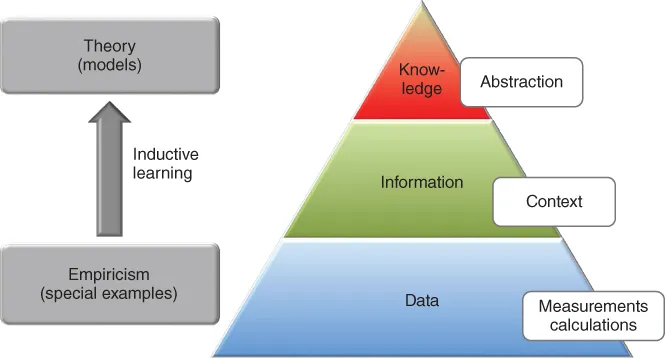
Table Figure 1.1 Inductive learning.
In this manner, the laws and rules of nature and of compounds and their reactions were learned. Thus, enough knowledge was accumulated to launch an entire industry, the chemical industry, that produces a cornucopia of chemicals having a wide range of properties that allow us to maintain our present standard of living. This process of inductive learning is still not over; we are still far away from understanding and predicting all chemical phenomena. This is most vividly illustrated by our poor knowledge of undesired side effects of compounds, such as toxicity. We still have to strive to increase our knowledge of chemistry.
This is where chemoinformatics comes in!
Typical challenges where chemoinformatics methods might assist are for the three fundamental questions of a chemist:
- What structure do I need for a certain property, be it a drug, a paint, or a glue? This is the domain of establishing structure–property relationship (SPR) or structure–activity relationship (SAR) or even finding such relationships on a quantitative basis (QSPR or QSAR).
- How can I synthesize the compound that should have the desired property? This is the domain of synthesis design and the planning of chemical reactions.
- What is the structure of the compound that was obtained in my reaction? This is the domain of structure elucidation, which, in most part, utilizes information from a battery of spectra (infrared, NMR, and mass spectra).
An additional difficulty soon became apparent: the amount of chemical information was dramatically increasing. It became clear that managing this huge quantity of information could only be handled with electronic means, by storing the information in databases. Chemoinformatics methods have been developed to assist in the process of inductive learning, in supporting chemists in solving their three fundamental questions, and in storing chemical information in databases.
In this book, we want to build on the long history of applying informatics methods to chemical problems and pay tribute to the scientists who have started out decades ago to develop this interdisciplinary field. For this...
Table of contents
- Cover
- Table of Contents
- Dedication
- Foreword
- List of Contributors
- Chapter 1: Introduction
- Chapter 2: Principles of Molecular Representations
- Chapter 3: Computer Processing of Chemical Structure Information
- Chapter 4: Representation of Chemical Reactions
- Chapter 5: The Data
- Chapter 6: Databases and Data Sources in Chemistry
- Chapter 7: Searching Chemical Structures
- Chapter 8: Computational Chemistry
- Chapter 9: Modeling and Prediction of Properties (QSPR/QSAR)
- Chapter 10: Calculation of Structure Descriptors
- Chapter 11: Data Analysis and Data Handling (QSPR/QSAR)
- Chapter 12: QSAR/QSPR Revisited
- Chapter 13: Bioinformatics
- Chapter 14: Future Directions
- Answers Section
- Substance Index
- End User License Agreement
Frequently asked questions
Yes, you can cancel anytime from the Subscription tab in your account settings on the Perlego website. Your subscription will stay active until the end of your current billing period. Learn how to cancel your subscription
No, books cannot be downloaded as external files, such as PDFs, for use outside of Perlego. However, you can download books within the Perlego app for offline reading on mobile or tablet. Learn how to download books offline
Perlego offers two plans: Essential and Complete
- Essential is ideal for learners and professionals who enjoy exploring a wide range of subjects. Access the Essential Library with 800,000+ trusted titles and best-sellers across business, personal growth, and the humanities. Includes unlimited reading time and Standard Read Aloud voice.
- Complete: Perfect for advanced learners and researchers needing full, unrestricted access. Unlock 1.4M+ books across hundreds of subjects, including academic and specialized titles. The Complete Plan also includes advanced features like Premium Read Aloud and Research Assistant.
We are an online textbook subscription service, where you can get access to an entire online library for less than the price of a single book per month. With over 1 million books across 990+ topics, we’ve got you covered! Learn about our mission
Look out for the read-aloud symbol on your next book to see if you can listen to it. The read-aloud tool reads text aloud for you, highlighting the text as it is being read. You can pause it, speed it up and slow it down. Learn more about Read Aloud
Yes! You can use the Perlego app on both iOS and Android devices to read anytime, anywhere — even offline. Perfect for commutes or when you’re on the go.
Please note we cannot support devices running on iOS 13 and Android 7 or earlier. Learn more about using the app
Please note we cannot support devices running on iOS 13 and Android 7 or earlier. Learn more about using the app
Yes, you can access Chemoinformatics by Thomas Engel,Johann Gasteiger in PDF and/or ePUB format, as well as other popular books in Physical Sciences & Analytic Chemistry. We have over one million books available in our catalogue for you to explore.