Train your brain for better decisions, problem solving, and innovation
Think Smarter: Critical Thinking to Improve Problem-Solving and Decision-Making Skills is the comprehensive guide to training your brain to do more for you. Written by a critical thinking trainer and coach, the book presents a pragmatic set of tools to apply critical thinking techniques to everyday business issues. Think Smarter is filled with real world examples that demonstrate how the tools work in action, in addition to dozens of practice exercises applicable across industries and functions, Think Smarter is a versatile resource for individuals, managers, students, and corporate training programs.
Thinking is the foundation of everything you do, but we rely largely on automatic thinking to process information, often resulting in misunderstandings and errors. Shifting over to critical thinking means thinking purposefully using a framework and toolset, enabling thought processes that lead to better decisions, faster problem solving, and creative innovation. Think Smarter provides clear, actionable steps toward improving your critical thinking skills, plus exercises that clarify complex concepts by putting theory into practice. Features include:
A comprehensive critical thinking framework
Over twenty-five "tools" to help you think more critically
Critical thinking implementation for functions and activities
Examples of the real-world use of each tool
Learn what questions to ask, how to uncover the real problem to solve, and mistakes to avoid. Recognize assumptions your can rely on versus those without merit, and train your brain to tick through your mental toolbox to arrive at more innovative solutions. Critical thinking is the top skill on the wish list in the business world, and sharpening your ability can have profound affects throughout all facets of life. Think Smarter: Critical Thinking to Improve Problem-Solving and Decision-Making Skills provides a roadmap to more effective and productive thought.
Trusted by 375,005 students
Access to over 1.5 million titles for a fair monthly price.
Clarity, the first and most important step in critical thinking, is about understanding the issue, problem, goal, or objective—the headscratcher that you’re looking to solve. If you’re not clear, you risk solving the wrong problem. For example, let’s say you have to fix a customer problem. What happens if you don’t have a clear idea of the problem that customer actually has? You might spend a good deal of time and effort attempting to solve something that wasn’t a problem in the first place. Although your customer might really appreciate your effort, you haven’t solved the headscratcher.
Here’s a specific example: It’s Monday morning at 11:00 am. You’re in Los Angeles, waiting on a flight scheduled for an 11:30 am departure to Dallas. You have a business meeting that starts at 7:30 am on Tuesday. You hear an announcement: “Folks, we have a mechanical situation on the plane, so I’m afraid this flight is cancelled.” You and 200 other people make a mad dash to the customer service center.
After you wait in line for what seems like forever, the customer agent, who is unbelievably polite and empathetic, gives you the good news: “We’ve automatically booked you on the first flight out tomorrow morning.”
You respond, “That’s just not going to work. I have a 7:30 am meeting tomorrow. Is there any way you can get me to Dallas today?”
The agent responds, “There’s a flight through Chicago that leaves in 50 minutes. You can connect to a flight to Dallas at 5:30 pm, arriving at 8:00 pm. Is that okay?”
You say, “Yes!”
Although the agent initially had a solution for getting you to Dallas, that wasn’t your problem. Your problem was getting to Dallas today so that you could (1) get some sleep and (2) make your meeting tomorrow.
Without clarity on an issue, you risk redos, mistakes, and even addressing a symptom of a problem but not actually solving the headscratcher.
In this section, we’ll introduce 10 tools you can use to get clear. In many instances, you’ll probably use only a few at a time. Some you’ll use more often than others, and as you practice, you’ll probably favor a few. It doesn’t matter how many or what tools you use; the objective is to get clear. We’ll explain each tool, provide you with examples of using it in your work, and close each chapter with a few exercises to practice. In the last chapter of this section, we’ll summarize clarity and the tools that I presented.
The Takeaway
Spend some time getting clear on the headscratcher you are solving—even if you think you already are. A small investment in clarity at the beginning of the process can save a tremendous amount of time and effort later on, because it minimizes the possibility of having to go back and start again because you were unclear.
Chapter 4 Empty Your Bucket
The Bucket
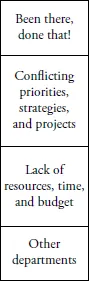
The first tool I introduce for critical thinking and clarity helps you get your head in the right place. We all have a bucket that contains the memories of our experiences: past projects, interactions with other people, or attempts at solving a problem. When you encounter a situation that is similar to one you remember, many of the memories you first invoke tend to be negative. Specifically, they focus on why this prior task was unsuccessful or the constraints and barriers you faced. Figure 4.1 shows what a typical bucket looks like.
Figure 4.1 A Filled Bucket
The problem is there is no room in a filled bucket for critical thinking and creativity. You can’t think critically or be innovative from the perspective of the memories in your bucket—because it’s filled with prior experiences that significantly affect the way you reach conclusions. If you’re thinking from the perspective of the things in your bucket, then your conclusions are going to be heavily biased based on those items. As a result, your breadth of conclusions will be narrow. If, however, you understand and can learn to ignore what’s in your bucket, then you’re much more likely to be able to create new conclusions.
For example, let’s say senior management issues a directive about a project that they’ve labeled as a top priority. Perhaps you have had experience with this statement, and your initial reaction is something like, “Yeah, this and every other project. I’ll just wait a few days to see if the priority changes.” We don’t want to discount your experience; you might be perfectly correct. This is your knee-jerk reaction, and maybe it’s accurate; in a few days, the project’s urgency will pass. However, suppose this time the project truly is a priority. Then you’ve made an assumption based on past experience that’s to your detriment. If you empty your bucket, forget about the past, and take a closer look at what this issue is, you’ll get a better idea about what’s different this time. One way to do this might be to ask a few questions about this project’s importance relative to the other projects on which you are working.
When looking at a headscratcher, you must have the attitude of there is always a way. Although this might not always be the case, you’re much more likely to find a way if you start by believing there’s one. You’re putting yourself at a disadvantage if you approach the headscratcher with the moaning-and-groaning-filled bucket containing the stories of how something didn’t work in the past.
Of course, you can’t wipe out your memories, nor would you want to. Many of your memories are good ones you don’t want to throw out, and many contain useful information you’ll want and need to call upon. What you want to do is understand what’s in your bucket and how those memories might be affecting the way you think.
Figure 4.2 An Empty Bucket
How do you empty your bucket and prevent those experiences from adversely affecting your thinking? There’s always a way. Think, for example, of someone in the past for whom you cared dearly, who may have had a significant health issue, economic hardship, or difficult family or social situation and managed to work through it, perhaps someone such as a cancer survivor. Think about the problems that individual had to endure and solve. Now realize that if he or she can solve that problem with all those hardships, surely you can solve your problem despite—and occasionally with the help of—the items in your bucket.
Admittedly, you might have some pretty huge items in your bucket. Perhaps a business partner once conducted shady deals behind your back, leaving you with trust issues. Maybe you’ve had a history of running out of time on certain projects, or your team has consistently run over budget. Not all bucket items are easy to overcome. But there’s a much greater chance of doing so if you think in terms of “There’s always a way,” as opposed to “I can’t do that.”
Getting Started with Emptying Your Bucket
Here are a few situations where you can start emptying your...
Table of contents
Cover
Contents
Title
Copyright
Dedication
Preface
Acknowledgments
Section I: Introduction and the Framework for Critical Thinking
Section II: Clarity
Section III: Conclusions
Section IV: Conclusions and Innovation
Section V: Decisions
Critical Thinking Summary and Suggestions
About the Author
Index
End User License Agreement
Frequently asked questions
Yes, you can cancel anytime from the Subscription tab in your account settings on the Perlego website. Your subscription will stay active until the end of your current billing period. Learn how to cancel your subscription
No, books cannot be downloaded as external files, such as PDFs, for use outside of Perlego. However, you can download books within the Perlego app for offline reading on mobile or tablet. Learn how to download books offline
Perlego offers two plans: Essential and Complete
Essential is ideal for learners and professionals who enjoy exploring a wide range of subjects. Access the Essential Library with 800,000+ trusted titles and best-sellers across business, personal growth, and the humanities. Includes unlimited reading time and Standard Read Aloud voice.
Complete: Perfect for advanced learners and researchers needing full, unrestricted access. Unlock 1.5M+ books across hundreds of subjects, including academic and specialized titles. The Complete Plan also includes advanced features like Premium Read Aloud and Research Assistant.
Both plans are available with monthly, semester, or annual billing cycles.
We are an online textbook subscription service, where you can get access to an entire online library for less than the price of a single book per month. With over 1.5 million books across 990+ topics, we’ve got you covered! Learn about our mission
Look out for the read-aloud symbol on your next book to see if you can listen to it. The read-aloud tool reads text aloud for you, highlighting the text as it is being read. You can pause it, speed it up and slow it down. Learn more about Read Aloud
Yes! You can use the Perlego app on both iOS and Android devices to read anytime, anywhere — even offline. Perfect for commutes or when you’re on the go. Please note we cannot support devices running on iOS 13 and Android 7 or earlier. Learn more about using the app
Yes, you can access Think Smarter by Michael Kallet in PDF and/or ePUB format, as well as other popular books in Business & Decision Making. We have over 1.5 million books available in our catalogue for you to explore.