Authored by a leading educator, this book teaches the fundamental mathematics and physics concepts associated with medical imaging systems. Going beyond mere description of imaging modalities, this book delves into the mechanisms of image formation and image quality common to all imaging systems: contrast mechanisms, noise, and spatial and temporal resolution, making it an important reference for medical physicists and biomedical engineering students. This is an extensively revised new edition of The Physics of Medical X-Ray Imaging by Bruce Hasegawa (Medical Physics Publishing, 1991), and includes a wide range of modalities such as X-ray CT, MRI and SPECT.
- 322 pages
- English
- ePUB (mobile friendly)
- Available on iOS & Android
eBook - ePub
Fundamental Mathematics and Physics of Medical Imaging
About this book
Trusted by 375,005 students
Access to over 1.5 million titles for a fair monthly price.
Study more efficiently using our study tools.
Information
Topic
MedicineII
Intermediate Concepts
CHAPTER4
Physical Determinants of Contrast
A MEDICAL IMAGE CAN BE roughly described in terms of the three basic features given in Chapter 1: contrast, spatial resolution, and noise. Spatial resolution or clarity refers to the spatial detail of small objects within the image. Noise refers to the precision within the image; a noisy image will have large fluctuations in the signal across a uniform object, while a precise signal will have very small fluctuations. The subject of this chapter, contrast, relates to the difference in signals between a structure and its immediate surroundings. For example, if circles are displayed against a black background, a white circle will have larger contrast relative to the background when compared to gray circles (Figure 4.1). One uses the differences in gray shades to “visually” distinguish different tissue types, determine anatomical relationships, and sometimes assess their physiological functions. The larger the contrast between different tissue types, the easier it is to make distinctions clinically. It is often the objective of an imaging system to maximize the contrast in the image for a particular object or tissue of interest, although this is not always true since there may be design compromises where noise and spatial resolution are also very important. The contrast in an x-ray image depends on both physical characteristics of the object and properties of the device(s) used to image the object. The focus of this chapter is x-ray image contrast and we discuss the physical determinants of contrast, including material properties, x-ray spectra, detector response, and the role of perturbations such as scatter radiation and image intensifier veiling glare. We include physical determinants of contrast for several other medical imaging modalities, including those used in nuclear medicine, magnetic resonance imaging, and computed tomography to round off the discussion.
4.1COMPONENTS OF X-RAY IMAGE CONTRAST
Contrast can be quantified as the fractional difference in a measurable quantity between adjacent regions of an image. Usually, when we say “contrast,” we mean image contrast, which is the fractional difference in signals between two adjacent regions of an image. In conventional radiography, contrast can be separated into three components: (1) radiographic contrast, (2) detector contrast, and (3) display contrast (Table 4.1 and Figure 4.2).
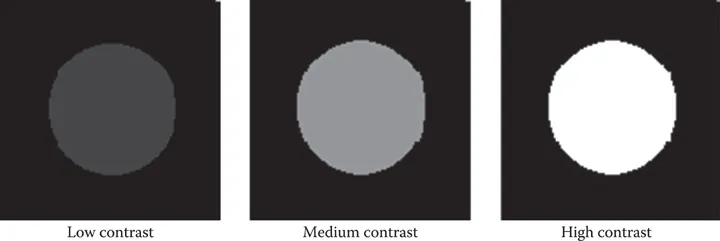
FIGURE 4.1Contrast relates to the relative difference between an object (circle here) and its surrounding background. Here the background gray level is set to black and the object gray level increased from a low-contrast ...
Table of contents
- Cover
- Half Title
- Title
- Copyright
- Table of Contents
- Series Preface
- Preface
- Acknowledgments
- Author
- Introduction
- Section I Basic Concepts
- Section II Intermediate Concepts
- Section III Advanced Concepts
- Section IV Dynamic Imaging
- Section V Tomographic Imaging
- Index
Frequently asked questions
Yes, you can cancel anytime from the Subscription tab in your account settings on the Perlego website. Your subscription will stay active until the end of your current billing period. Learn how to cancel your subscription
No, books cannot be downloaded as external files, such as PDFs, for use outside of Perlego. However, you can download books within the Perlego app for offline reading on mobile or tablet. Learn how to download books offline
Perlego offers two plans: Essential and Complete
- Essential is ideal for learners and professionals who enjoy exploring a wide range of subjects. Access the Essential Library with 800,000+ trusted titles and best-sellers across business, personal growth, and the humanities. Includes unlimited reading time and Standard Read Aloud voice.
- Complete: Perfect for advanced learners and researchers needing full, unrestricted access. Unlock 1.5M+ books across hundreds of subjects, including academic and specialized titles. The Complete Plan also includes advanced features like Premium Read Aloud and Research Assistant.
We are an online textbook subscription service, where you can get access to an entire online library for less than the price of a single book per month. With over 1.5 million books across 990+ topics, we’ve got you covered! Learn about our mission
Look out for the read-aloud symbol on your next book to see if you can listen to it. The read-aloud tool reads text aloud for you, highlighting the text as it is being read. You can pause it, speed it up and slow it down. Learn more about Read Aloud
Yes! You can use the Perlego app on both iOS and Android devices to read anytime, anywhere — even offline. Perfect for commutes or when you’re on the go.
Please note we cannot support devices running on iOS 13 and Android 7 or earlier. Learn more about using the app
Please note we cannot support devices running on iOS 13 and Android 7 or earlier. Learn more about using the app
Yes, you can access Fundamental Mathematics and Physics of Medical Imaging by Jack Lancaster,Bruce Hasegawa in PDF and/or ePUB format, as well as other popular books in Medicine & Radiology, Radiotherapy & Nuclear Medicine. We have over 1.5 million books available in our catalogue for you to explore.